
Institutional crypto hiring is consolidating around compliance and market infrastructure roles in the US
25 May, 202615 mins

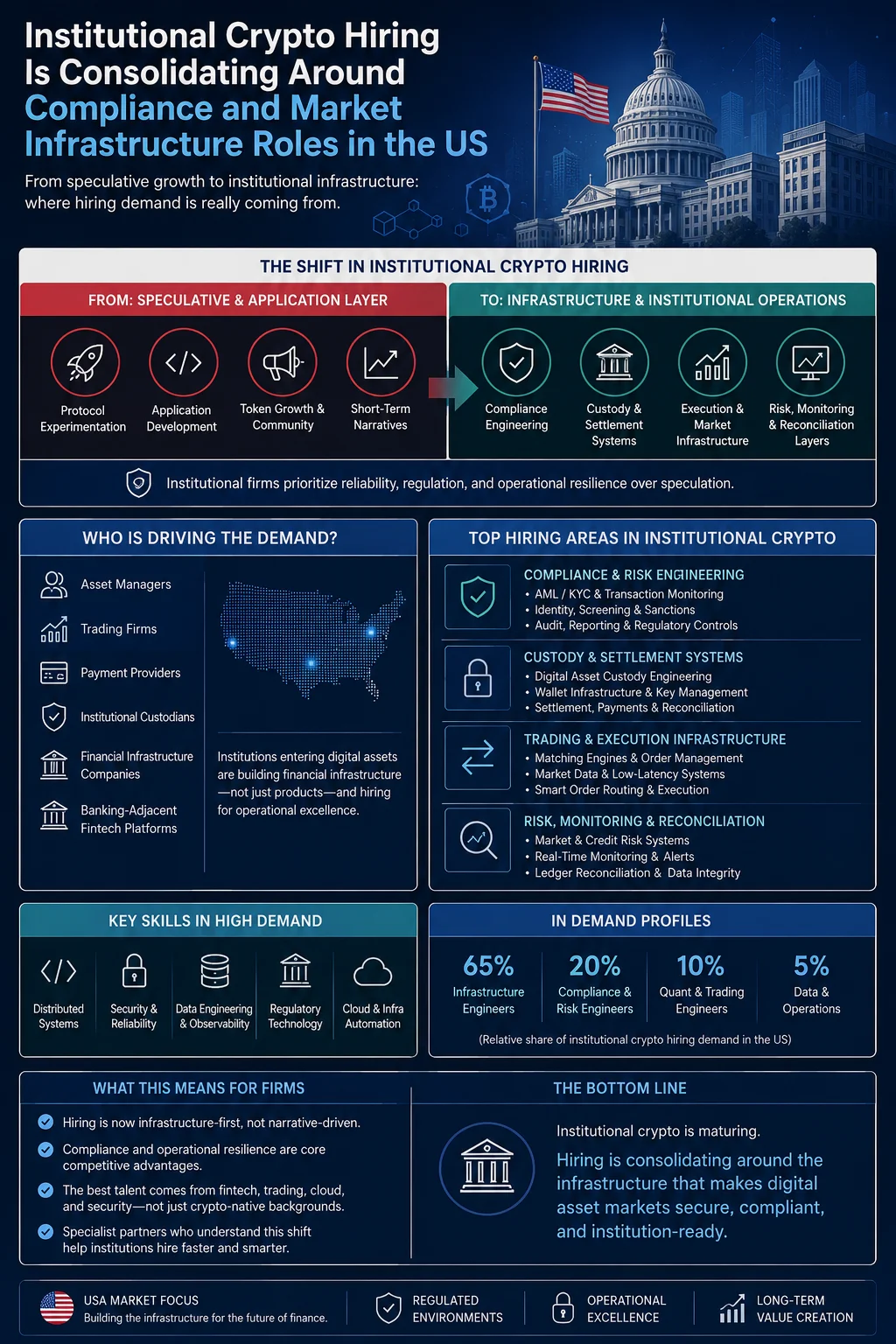
Institutional crypto hiring in the United States is no longer behaving like a speculative technology cycle.
The hiring market is reorganising around infrastructure reliability, execution correctness, compliance architecture, and operational resilience. That shift changes which teams are expanding, which engineers are valuable, and how institutional firms evaluate recruitment partners.
The previous cycle prioritised protocol experimentation, token velocity, and application-layer growth. The current market rewards firms capable of operating regulated financial infrastructure under institutional constraints.
This is changing the structure of hiring across digital asset markets.
In practice, most institutional hiring demand now sits inside four operational categories:
- Compliance-heavy financial infrastructure
- Custody and settlement systems
- Trading and execution architecture
- Risk, monitoring, and reconciliation layers
The implications for hiring are significant.
Firms entering digital assets from traditional finance are not hiring “crypto talent” in the abstract. They are hiring engineers, operators, and infrastructure specialists capable of maintaining reliability inside highly regulated environments.
That distinction is reshaping the US crypto talent market.
Institutional crypto is becoming infrastructure-first
The market narrative around institutional crypto often focuses on ETFs, regulatory developments, or asset flows.
The hiring signal tells a more useful story.
Most institutional firms are building infrastructure layers rather than speculative products. Engineering demand is increasingly concentrated around systems that resemble traditional financial architecture:
- Custody infrastructure
- Payment and settlement systems
- Transaction monitoring
- Ledger reconciliation
- Execution routing
- Identity and compliance systems
This reflects a broader convergence between fintech infrastructure engineering and blockchain system design.
The firms hiring most aggressively are no longer only crypto-native exchanges or protocol startups. Demand is increasingly coming from:
- Asset managers
- Trading firms
- Payment providers
- Institutional custodians
- Financial infrastructure companies
- Banking-adjacent fintech platforms
The hiring environment therefore looks increasingly similar to institutional fintech recruitment, with blockchain architecture becoming an embedded infrastructure layer rather than a standalone category.
This changes what “good crypto talent” actually means.
The highest demand roles in institutional crypto hiring
Institutional firms are prioritising execution reliability over experimentation.
As a result, hiring density is consolidating around operationally critical roles.
Blockchain infrastructure engineers
Infrastructure engineers remain among the hardest profiles to hire across the US market.
Demand is strongest for engineers with experience in:
- Distributed systems
- Consensus architecture
- Validator infrastructure
- Node reliability
- Low-latency systems
- Security-critical backend engineering
The strongest candidates increasingly come from adjacent systems-heavy environments rather than purely crypto-native companies.
Many institutional firms now actively target talent from:
- High-frequency trading firms
- Cloud infrastructure companies
- Payments infrastructure platforms
- Cybersecurity engineering teams
- Capital markets infrastructure
This reflects a growing recognition that operational discipline matters more than ideological blockchain exposure.
Blockchain infrastructure engineers
Infrastructure engineers remain among the hardest profiles to hire across the US market.
Demand is strongest for engineers with experience in:
- Distributed systems
- Consensus architecture
- Validator infrastructure
- Node reliability
- Low-latency systems
- Security-critical backend engineering
The strongest candidates increasingly come from adjacent systems-heavy environments rather than purely crypto-native companies.
Many institutional firms now actively target talent from:
- High-frequency trading firms
- Cloud infrastructure companies
- Payments infrastructure platforms
- Cybersecurity engineering teams
- Capital markets infrastructure
This reflects a growing recognition that operational discipline matters more than ideological blockchain exposure.
Compliance and risk engineering
Compliance-heavy engineering has become one of the most strategically important hiring layers across institutional crypto.
This is particularly visible in the US market, where regulatory uncertainty continues to shape infrastructure decisions.
Firms are aggressively hiring engineers capable of building:
- AML transaction monitoring systems
- Identity verification infrastructure
- Audit and reporting layers
- Risk surveillance systems
- Financial controls architecture
These roles increasingly sit at the intersection of fintech compliance systems and blockchain transaction infrastructure.
The available talent pool remains extremely limited because few engineers possess both distributed systems familiarity and regulated financial systems exposure.
Institutional trading infrastructure
Hiring demand is also expanding around institutional execution systems.
This includes:
- Matching engine optimisation
- Smart order routing
- Liquidity infrastructure
- Market connectivity systems
- Low-latency execution architecture
The compensation bands for these roles remain among the highest in institutional crypto because operational failure directly impacts financial performance.
In New York and Chicago specifically, competition for these engineers increasingly overlaps with traditional quantitative trading markets.
Why institutional firms struggle to hire effectively
Most institutional crypto hiring problems are not caused by talent shortages alone.
The larger issue is signal distortion.
Many firms entering digital assets still evaluate candidates using outdated assumptions about crypto hiring. They often over-prioritise:
- Years spent in crypto-native companies
- Token market familiarity
- Surface-level blockchain exposure
Meanwhile, the market increasingly rewards infrastructure discipline, operational reliability, and systems engineering maturity.
This creates a mismatch between hiring processes and actual operational requirements.
In practice, the strongest institutional hires are often candidates who understand:
- Reliability engineering
- Financial systems architecture
- Distributed infrastructure constraints
- Security-critical execution environments
rather than candidates with purely speculative crypto experience.
This is where specialist recruitment partners become strategically important.
Why institutional hiring increasingly requires specialist recruiters
Institutional crypto recruitment is becoming structurally more complex.
The hiring challenge is no longer simply finding engineers interested in blockchain. The challenge is identifying candidates capable of operating under institutional-grade constraints.
That requires recruiters who understand:
- Distributed systems architecture
- Financial infrastructure environments
- Compensation calibration across crypto and fintech
- Infrastructure role fragmentation
- Regulatory hiring constraints
- Technical hiring signal interpretation
Generalist recruitment firms typically struggle in these environments because institutional crypto hiring increasingly behaves like infrastructure hiring rather than startup scaling.
This distinction matters.
A recruiter who cannot distinguish between:
- protocol engineering,
- infrastructure reliability,
- execution architecture,
- or compliance engineering
will struggle to evaluate talent quality accurately.
The result is slower hiring velocity, weaker candidate calibration, and increased hiring risk.
What institutional firms should look for in a recruitment partner
Most institutional firms evaluate recruitment agencies using speed metrics alone.
That is increasingly insufficient.
The more valuable signal is whether a recruitment partner understands how infrastructure hiring systems are evolving.
A strong institutional crypto recruitment partner should understand:
Engineering role fragmentation
Institutional crypto teams are becoming highly specialised.
“Blockchain engineer” is no longer a meaningful standalone category.
Modern institutional hiring increasingly separates:
- Infrastructure engineering
- Protocol engineering
- Custody systems
- Compliance engineering
- Security architecture
- Trading systems
- DevOps reliability
- Data infrastructure
A recruitment partner should understand how these layers interact operationally.
Compensation benchmarking
Institutional crypto compensation has become increasingly distorted across the US market.
The same role may vary significantly depending on:
- Regulatory exposure
- Infrastructure criticality
- Trading system complexity
- Security responsibility
- Token exposure
- Remote flexibility
Strong recruitment partners help firms benchmark realistically against competing infrastructure markets rather than relying on outdated crypto salary assumptions.
Access to passive infrastructure talent
The strongest infrastructure engineers are rarely active applicants.
Most operate inside:
- trading firms,
- financial infrastructure companies,
- large-scale cloud systems,
- or security engineering environments.
A specialist recruiter must therefore operate through targeted network access rather than inbound applications alone.
This is particularly important for institutional hiring because the available candidate pool is structurally limited.
Where Axiom fits into institutional hiring
Axiom operates within the intersection of blockchain infrastructure, fintech systems, AI, and institutional engineering markets.
That positioning matters because institutional crypto hiring increasingly overlaps with adjacent infrastructure systems rather than existing as an isolated market.
In practice, the strongest institutional candidates often move between:
- fintech infrastructure,
- distributed systems engineering,
- AI infrastructure,
- cybersecurity,
- and blockchain execution environments.
Axiom’s recruitment approach reflects this convergence.
Rather than treating crypto hiring as a standalone vertical, the focus is placed on infrastructure capability, systems reliability, and operational alignment.
This enables stronger calibration across roles involving:
- custody systems,
- institutional trading architecture,
- compliance engineering,
- blockchain infrastructure,
- and distributed financial systems.
The advantage for clients is not simply access to candidates.
It is improved hiring signal quality.
The US institutional market is becoming structurally selective
The broader hiring market is also becoming more selective.
During earlier crypto cycles, firms frequently hired aggressively ahead of operational maturity.
That pattern is changing.
Institutional firms now prioritise:
- smaller engineering teams,
- higher systems reliability,
- operational discipline,
- and infrastructure correctness.
This reduces tolerance for weak hiring decisions.
The result is a hiring market where:
- specialist infrastructure engineers command premium compensation,
- compliance-heavy roles continue expanding,
- and recruitment quality becomes increasingly strategic.
The firms that scale successfully will likely be those capable of combining blockchain-native infrastructure understanding with institutional operational discipline.
That combination remains relatively rare across the current US hiring market.
Final thoughts
Institutional crypto hiring is no longer defined by speculative growth.
It is being reshaped by infrastructure maturity.
The strongest hiring demand now sits inside systems responsible for reliability, compliance, execution, and operational resilience. That shift changes how firms evaluate talent, structure engineering teams, and select recruitment partners.
The recruitment environment is therefore becoming increasingly infrastructure-led rather than market-cycle-led.
For firms scaling institutional crypto teams in the United States, hiring quality is increasingly determined by whether recruiters understand the underlying systems architecture behind the roles themselves.
That is where specialist infrastructure-focused recruitment partners become operationally valuable rather than purely transactional.
Axiom operates directly within these infrastructure-heavy hiring environments, helping institutional firms identify engineering and operational talent across blockchain, fintech, AI, and digital asset systems.
Frequently Asked Questions
Q: What roles are most in demand in institutional crypto hiring?
The highest demand roles currently include blockchain infrastructure engineers, compliance engineers, custody infrastructure specialists, trading systems engineers, and risk infrastructure professionals.
Q: Why is institutional crypto hiring different from previous crypto cycles?
The market is shifting away from speculative application growth toward regulated financial infrastructure, operational resilience, and compliance-heavy systems.
Q: Why are specialist recruitment firms important in institutional crypto hiring?
Institutional crypto hiring requires recruiters who understand distributed systems, financial infrastructure, compliance environments, and infrastructure role fragmentation.
Q: How does Axiom support institutional crypto hiring?
Axiom helps firms hire across blockchain infrastructure, fintech systems, AI engineering, compliance-heavy environments, and institutional operational architecture.