Digital Asset Hiring in the United States Is Shifting Toward Institutional Infrastructure and Regulatory Execution
02 Jul, 202618 mins

The United States digital asset industry has matured significantly over the past few years. Hiring is no longer driven purely by speculative market cycles or token launches. Instead, demand is increasingly linked to infrastructure, regulation, institutional investment, and operational resilience.
Banks, asset managers, payment companies, exchanges, stablecoin issuers, and fintech firms are investing heavily in digital asset capabilities. Many are building long-term teams rather than expanding rapidly during bull markets and downsizing during downturns.
This represents a structural shift in the labour market. Companies are hiring fewer generalists and placing greater emphasis on professionals who understand regulated financial infrastructure, blockchain technology, digital asset custody, risk management, and institutional trading.
For hiring managers, this creates a more competitive recruitment environment. Experienced candidates often receive multiple offers, while organisations without a clear hiring strategy struggle to attract professionals with relevant industry experience.
Institutional Adoption Is Driving Hiring Demand
Institutional participation continues to reshape the digital asset ecosystem.
Traditional financial institutions that once observed the market from the sidelines are now developing products involving tokenised assets, digital asset custody, stablecoin payments, treasury management, and blockchain-based settlement infrastructure.
Rather than building experimental innovation teams, organisations are integrating digital assets into existing financial systems. This requires professionals who understand both blockchain technology and regulated financial markets.
The hiring conversation has therefore shifted away from simply finding "crypto talent."
Instead, employers increasingly look for candidates capable of operating within highly regulated environments while understanding distributed ledger technology, digital asset markets, and institutional operational requirements.
This convergence between financial services and blockchain has significantly expanded the talent market but also increased competition for experienced professionals.
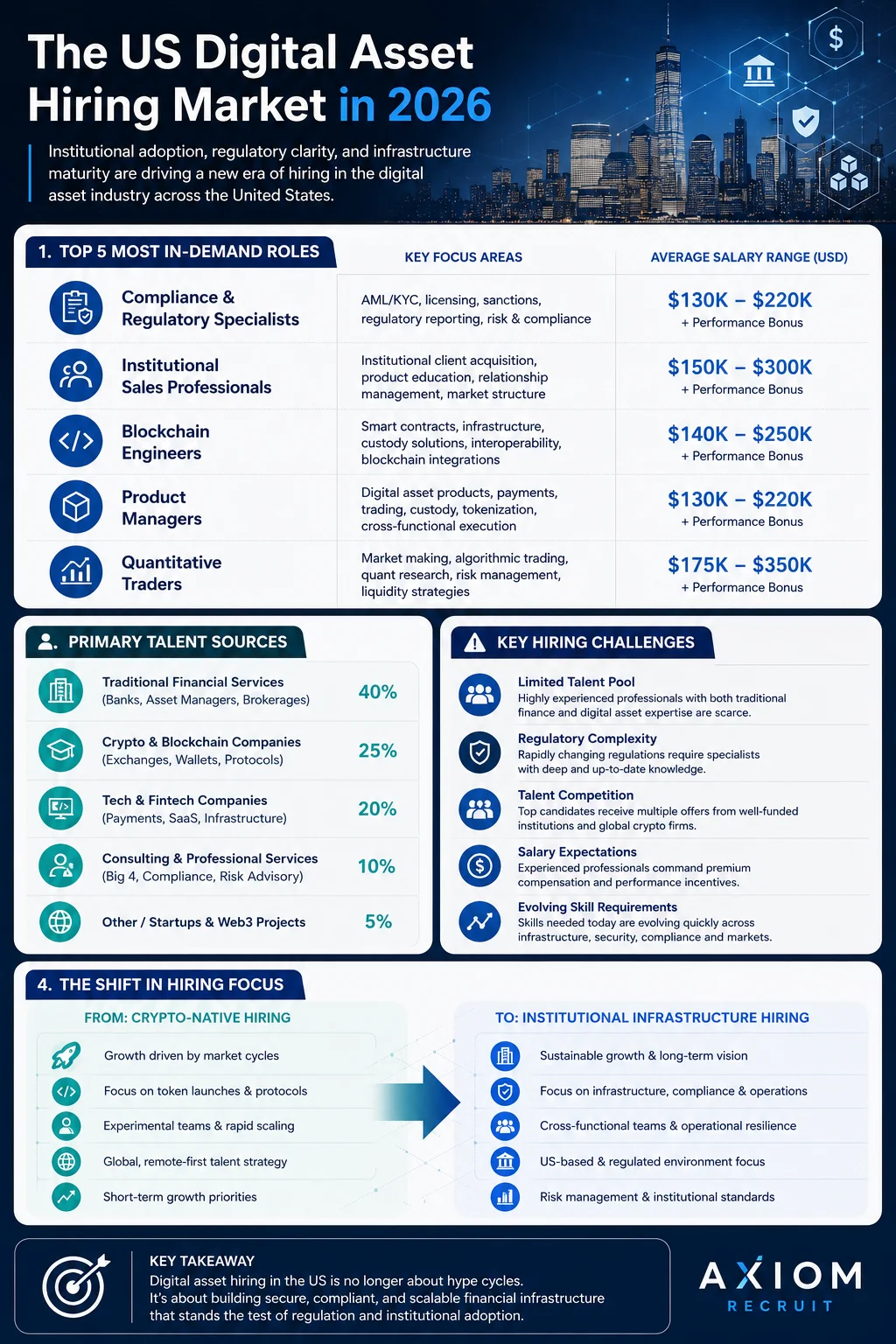
The Most In-Demand Digital Asset Roles in the US
Hiring demand remains strongest across infrastructure and execution-focused positions.
Compliance and Regulatory Specialists
As regulatory expectations continue to evolve, compliance professionals have become one of the most valuable hires across digital asset businesses.
Companies need specialists who understand AML, KYC, sanctions screening, transaction monitoring, licensing requirements, and regulatory reporting across multiple jurisdictions.
Professionals with experience working in both traditional financial institutions and digital asset businesses are particularly sought after.
Institutional Sales Professionals
Institutional adoption has created strong demand for sales professionals capable of engaging hedge funds, family offices, asset managers, banks, and corporate treasury teams.
Unlike retail-focused sales roles, these professionals require a deep understanding of digital asset products, market structure, custody solutions, and regulatory considerations.
Relationship management has become just as important as technical knowledge.
Blockchain Engineers
Engineering remains one of the most competitive hiring markets.
Companies continue investing in smart contracts, payment infrastructure, tokenisation platforms, custody systems, interoperability solutions, and blockchain integrations.
Developers with experience across multiple blockchain ecosystems remain difficult to hire, particularly those who have delivered production-level infrastructure rather than experimental projects.
Product Managers
As institutional products become more sophisticated, product managers capable of translating commercial requirements into technical delivery are becoming increasingly valuable.
Successful candidates often combine experience across fintech, payments, capital markets, and blockchain technology.
Rather than managing isolated crypto products, they coordinate multiple stakeholders across engineering, compliance, operations, legal, and commercial teams.
Risk and Operations Professionals
Operational excellence has become a competitive advantage.
Digital asset firms increasingly require professionals capable of managing settlement operations, treasury management, liquidity, counterparty risk, and reconciliation processes.
Many of these hires now come directly from investment banks, payment providers, and traditional financial institutions rather than purely crypto-native companies.
Hiring Has Become More Selective
One of the biggest misconceptions in digital asset recruitment is that companies are hiring aggressively across every function.
In reality, recruitment has become more disciplined.
Businesses are making fewer hires but investing more heavily in each appointment.
Hiring managers increasingly prioritise professionals who can deliver measurable commercial or operational outcomes rather than candidates with broad blockchain knowledge alone.
Experience implementing regulated financial products, launching institutional services, or scaling operational infrastructure often outweighs theoretical expertise.
For candidates, this means demonstrating business impact has become more important than simply listing blockchain technologies or token ecosystems on a CV.
Salary Expectations Continue to Rise
Compensation remains highly competitive across the US digital asset market, particularly for professionals with institutional experience.
Approximate salary ranges include:
Role | Typical Base Salary (USD) |
Compliance Manager | $150,000–$220,000 |
Blockchain Engineer | $170,000–$260,000 |
Senior Product Manager | $180,000–$260,000 |
Institutional Sales Director | $180,000–$350,000+ (plus commission) |
Digital Asset Operations Lead | $140,000–$220,000 |
Equity remains an important component of many compensation packages, although candidate expectations have changed considerably.
Professionals increasingly evaluate equity based on liquidity, vesting schedules, company maturity, and exit potential rather than simply accepting it as a substitute for cash compensation.
For employers, transparent discussions around equity are becoming essential to securing senior hires.
Why Experienced Candidates Remain Difficult to Hire
Although more professionals have entered the digital asset industry over recent years, genuinely experienced candidates remain scarce.
The challenge is no longer finding people interested in blockchain.
The challenge is identifying professionals who have successfully built products, managed institutional clients, navigated regulatory environments, and scaled businesses through multiple market cycles.
Many companies continue competing for the same relatively small group of experienced operators.
As a result, recruitment timelines have lengthened, counteroffers have become more common, and candidate expectations continue to rise.
Where Companies Are Finding Digital Asset Talent
The competition for experienced digital asset professionals has changed considerably. Five years ago, most hiring focused on candidates already working in crypto-native businesses. Today, the strongest candidates often come from adjacent industries where the skills are highly transferable.
Investment banks, payment companies, fintech firms, market infrastructure providers, asset managers, cybersecurity businesses, and enterprise software companies have become important sources of talent. These professionals bring experience working in regulated environments, managing operational risk, building financial products, and supporting institutional clients.
This broader talent pool reflects the changing nature of the industry. Digital assets are becoming another layer of financial infrastructure rather than a standalone technology sector. Companies that limit their search to candidates with crypto experience alone often overlook highly capable professionals who can transition successfully into digital asset businesses.
At the same time, crypto-native experience remains valuable for roles involving protocol engineering, decentralised finance, blockchain infrastructure, smart contract development, and digital asset custody. The most successful hiring strategies combine both perspectives rather than treating them as separate talent markets.
The Skills That Differentiate High-Performing Candidates
Technical expertise alone is no longer enough.
As organisations mature, they increasingly look for candidates who can operate across technical, commercial, and regulatory environments. The ability to communicate with engineers, compliance teams, executives, regulators, and institutional clients has become a significant advantage.
For engineering roles, employers increasingly value experience with scalable distributed systems, cloud infrastructure, cybersecurity, smart contract security, and production-grade blockchain applications. Engineers who understand reliability, performance, and operational resilience often stand out over candidates whose experience is limited to experimental projects.
For commercial roles, deep industry relationships matter more than broad sales experience. Institutional clients expect advisers who understand market structure, custody models, settlement processes, tokenisation, and the evolving regulatory landscape.
Leadership positions require another layer of expertise. Hiring managers want executives who have successfully navigated market volatility, managed regulatory change, scaled teams, and delivered sustainable growth rather than relying solely on favourable market conditions.
Why Traditional Recruitment Methods Are Becoming Less Effective
The US digital asset hiring market has become increasingly relationship-driven.
Many senior professionals are not actively applying for jobs through online job boards. They are already employed, well compensated, and regularly approached by competing firms.
This means traditional recruitment methods often produce a large number of applicants but very few candidates with the experience required for institutional digital asset businesses.
The strongest candidates are typically identified through industry networks, executive search, referrals, and long-term relationships built within the market.
For employers, speed has also become critical. Top candidates frequently progress through multiple interview processes simultaneously. Lengthy hiring cycles, inconsistent interview feedback, or delays in making offers can quickly result in losing preferred candidates to competitors.
Building a Competitive Employer Value Proposition
Compensation remains important, but it is no longer the only factor influencing hiring decisions.
Senior candidates increasingly evaluate the long-term opportunity before accepting an offer. They want to understand the company's strategy, financial position, leadership team, regulatory approach, product roadmap, and commitment to digital assets.
Clear career progression also plays a significant role. Many experienced professionals are looking for opportunities to build teams, influence product strategy, and contribute to the next stage of institutional adoption.
Flexibility has become another competitive advantage. Hybrid working arrangements, remote opportunities, international collaboration, and exposure to global markets continue to attract experienced talent.
Companies that communicate these advantages clearly often outperform organisations that compete primarily on salary.
Why Specialist Recruitment Partners Deliver Better Outcomes
Digital asset recruitment requires a different approach from traditional technology hiring.
The market moves quickly, role requirements evolve rapidly, and experienced candidates are often difficult to reach through conventional sourcing methods.
Specialist recruiters understand the technical language, regulatory landscape, compensation expectations, and hiring challenges unique to digital assets. They can assess whether candidates have genuine production experience, institutional credibility, or leadership capability rather than simply matching keywords on a CV.
This industry knowledge helps companies reduce hiring risk while improving the quality of shortlisted candidates.
For candidates, specialist recruiters also provide valuable market insight, helping them understand compensation trends, employer expectations, and long-term career opportunities within the digital asset ecosystem.
The Outlook for US Digital Asset Hiring
The hiring outlook remains positive, although growth is expected to continue in a measured and disciplined way.
Institutional adoption is likely to remain the primary driver of recruitment over the coming years. As tokenisation, digital payments, stablecoins, blockchain settlement, and regulated digital asset products become more widely adopted, organisations will continue investing in experienced professionals who can support this transformation.
Demand is expected to remain strongest across engineering, compliance, cybersecurity, institutional sales, product management, operations, and executive leadership.
Rather than expanding rapidly during periods of market optimism, employers are increasingly building resilient teams capable of supporting long-term business objectives regardless of market conditions.
This reflects a broader shift in the industry. Digital assets are becoming part of mainstream financial infrastructure, and hiring strategies are evolving to match that reality.
Partnering With Axiom to Build High-Performing Digital Asset Teams
Hiring in digital assets requires more than access to candidates. It requires an understanding of how the market is evolving, where experienced professionals can be found, and what motivates them to move.
At Axiom, we specialise in recruiting across digital assets, blockchain, fintech, AI, and Web3. Our network includes experienced engineers, commercial leaders, compliance specialists, operations professionals, and executive talent who have helped build some of the industry's leading businesses.
Whether you're making your first strategic hire or scaling an institutional digital asset team, we help organisations identify professionals with the technical expertise, commercial experience, and leadership capability needed to support long-term growth.
Key Takeaways
The US digital asset hiring market has entered a more mature phase. Recruitment is increasingly shaped by institutional adoption, regulatory expectations, and the need for reliable financial infrastructure rather than speculative market cycles.
Companies that broaden their talent search, communicate a compelling long-term vision, and move quickly during the hiring process are best positioned to secure experienced professionals.
As competition continues to increase, access to specialist recruitment expertise will remain an important advantage for organisations building the next generation of digital asset businesses.
Frequently Asked Questions
What are the most in-demand digital asset roles in the US?
Blockchain engineers, compliance professionals, institutional sales specialists, product managers, cybersecurity experts, digital asset operations leaders, and executive leadership roles remain among the most sought-after positions.
Are companies only hiring candidates with crypto experience?
No. Many employers now recruit professionals from investment banking, fintech, payments, asset management, cybersecurity, and enterprise technology who have transferable skills relevant to digital assets.
What salaries can experienced digital asset professionals expect?
Senior professionals typically earn between $140,000 and $350,000+ in base salary depending on the role, experience, and company stage. Equity and performance bonuses often form part of the overall compensation package.
Why is hiring taking longer?
Demand for experienced professionals continues to exceed supply. Many senior candidates receive multiple offers, making speed, employer branding, and a well-managed interview process increasingly important.
Why work with a specialist digital asset recruitment partner?
Specialist recruiters understand the market, maintain relationships with passive candidates, and can assess technical and commercial expertise more effectively than generalist recruitment firms, reducing hiring time and improving candidate quality.
Related Posts

The Infrastructure Layer Is Becoming the Product
03 Jul, 2026