Institutional blockchain hiring is converging with fintech infrastructure recruitment in the US
12 Jun, 202615 mins

The distinction between blockchain hiring and fintech infrastructure recruitment is becoming increasingly difficult to separate across the United States.
Institutional firms are no longer treating blockchain systems as isolated innovation environments. They are integrating blockchain architecture into broader financial infrastructure systems where operational reliability, compliance survivability, and execution correctness matter more than speculative product velocity.
This is changing how firms structure engineering teams and evaluate talent.
The hiring signal is increasingly clear.
The strongest demand no longer sits around broad “Web3 hiring” categories. It is consolidating around infrastructure-heavy roles operating at the intersection of:
- Financial systems
- Distributed infrastructure
- Compliance architecture
- Transaction reliability
- Operational security
- Institutional execution systems
This reflects a broader convergence between blockchain engineering and regulated financial infrastructure.
That convergence is reshaping recruitment across the US market.
Blockchain infrastructure is becoming financially integrated
Earlier blockchain hiring cycles largely operated independently from traditional financial infrastructure.
That separation is fading.
Institutional adoption has forced blockchain systems to operate under many of the same constraints that govern fintech infrastructure environments including:
- Reliability
- Auditability
- Compliance
- Transaction integrity
- Operational continuity
- Security resilience
As a result, blockchain engineering increasingly resembles financial infrastructure engineering.
This shift is particularly visible among:
- Stablecoin infrastructure providers
- Institutional custodians
- Payment infrastructure firms
- Financial settlement platforms
- Banking-adjacent fintech companies
- Capital markets infrastructure firms
The hiring implications are significant because these environments require operational discipline that many earlier crypto-native teams did not prioritise.
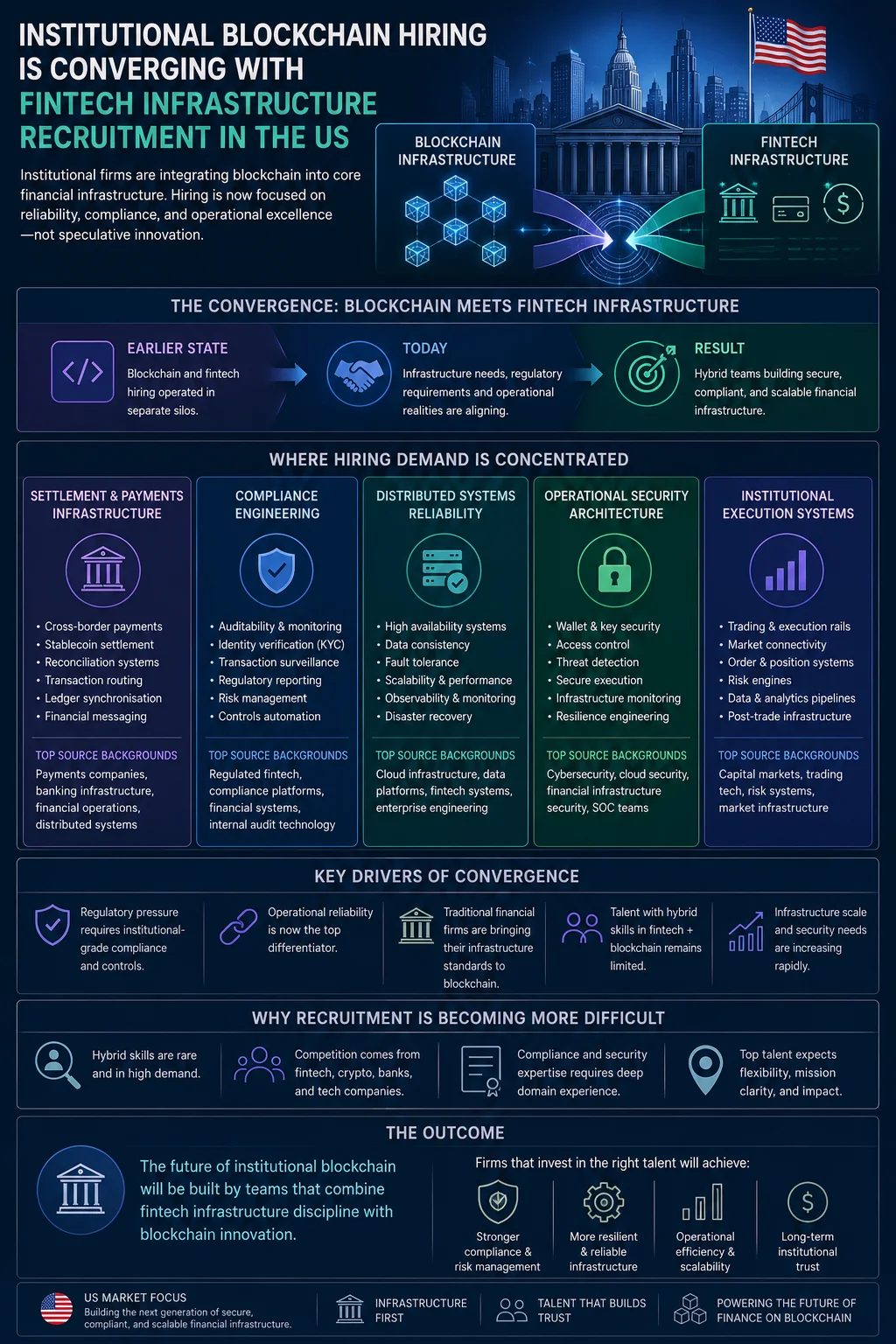
The highest demand roles now sit between fintech and blockchain systems
The convergence between fintech and blockchain infrastructure is creating new categories of operational hiring demand.
These are no longer purely blockchain roles or purely fintech roles.
They are hybrid infrastructure environments.
Settlement and payments infrastructure engineers
Settlement architecture is becoming one of the most strategically important infrastructure layers across institutional blockchain systems.
Firms are hiring engineers capable of supporting:
- Cross-border payment systems
- Stablecoin settlement infrastructure
- Reconciliation systems
- Transaction routing
- Ledger synchronisation
- Financial messaging architecture
These environments increasingly resemble modern payments infrastructure rather than speculative blockchain development.
The strongest candidates often come from:
- Payments companies
- Banking infrastructure platforms
- Financial operations systems
- Distributed ledger engineering
- Enterprise transaction systems
This reflects a broader operational convergence between fintech and blockchain architecture.
Compliance-heavy blockchain engineering
Compliance engineering is becoming structurally embedded inside blockchain hiring.
This is especially true in the US where institutional adoption remains heavily influenced by regulatory exposure.
Firms are increasingly building blockchain systems capable of supporting:
- Auditability
- Transaction monitoring
- Identity verification
- Reporting automation
- Regulatory controls
- Risk management systems
This creates demand for engineers capable of operating across both distributed systems and regulated financial environments.
The available candidate market remains relatively small because these hybrid infrastructure capabilities are difficult to develop organically.
Institutional infrastructure security
Security infrastructure remains among the most critical hiring categories across institutional blockchain systems.
The operational risks involved in institutional digital assets are materially different from earlier consumer-focused crypto products.
Firms are aggressively hiring for:
- Wallet security systems
- Infrastructure monitoring
- Threat detection architecture
- Access control systems
- Secure execution environments
- Infrastructure resilience engineering
Many of these hires now come from cybersecurity and financial infrastructure environments rather than purely blockchain-native markets.
Why recruitment is becoming more difficult
Institutional blockchain hiring is becoming more complex because the market itself is fragmenting operationally.
The category “blockchain engineer” now includes multiple distinct infrastructure environments with very different operational requirements.
For example:
- Smart contract engineering
- Distributed systems reliability
- Settlement infrastructure
- Compliance architecture
- Institutional trading systems
- Financial operations engineering
These are not interchangeable skill sets.
Many firms still underestimate how specialised the market has become. This creates hiring inefficiencies because recruitment processes often fail to evaluate infrastructure adjacency properly.
The strongest institutional candidates are increasingly those capable of operating across systems boundaries rather than inside narrow blockchain-only environments.
That changes how recruitment needs to function.
Why specialist recruitment firms are becoming strategically important
Institutional blockchain hiring increasingly requires recruiters who understand both fintech infrastructure and distributed systems engineering.
Generalist technology recruiters frequently struggle because they evaluate blockchain hiring through surface-level technology familiarity rather than operational systems understanding.
That distinction matters.
A recruiter hiring for institutional settlement infrastructure should understand:
- Transaction lifecycle systems
- Financial reconciliation architecture
- Distributed ledger constraints
- Infrastructure reliability engineering
- Compliance-heavy operational environments
Without this systems understanding, candidate evaluation quality deteriorates quickly.
This is particularly important because the strongest candidates are often passive infrastructure engineers already operating inside mature financial or cloud infrastructure environments.
The recruitment challenge therefore becomes interpretation-driven rather than volume-driven.
What firms should look for in a blockchain infrastructure recruitment partner
The most valuable recruitment partners increasingly operate as infrastructure interpreters rather than purely candidate suppliers.
Cross-market infrastructure understanding
A strong recruitment partner should understand how:
- Blockchain systems,
- fintech infrastructure,
- cybersecurity,
- distributed systems,
- and financial operations
interact operationally.
This improves hiring calibration significantly.
Access to infrastructure-adjacent talent
The strongest institutional blockchain engineers are often not sourced from crypto-native startups.
Many operate inside:
- payment infrastructure firms,
- trading systems,
- cloud infrastructure companies,
- cybersecurity platforms,
- or banking technology environments.
A recruitment partner should therefore understand infrastructure adjacency rather than relying solely on crypto-native talent pools.
Compensation and hiring intelligence
Compensation structures across institutional blockchain hiring remain highly fragmented.
Salary ranges vary depending on:
- Infrastructure criticality
- Regulatory exposure
- Operational risk
- Distributed systems complexity
- Security ownership
- Institutional maturity
Strong recruitment partners help firms benchmark against adjacent infrastructure markets rather than relying on outdated crypto compensation assumptions.
Where Axiom supports institutional blockchain hiring
Axiom operates across blockchain infrastructure, fintech engineering, AI systems, and institutional technology recruitment.
That positioning reflects how the infrastructure market itself is evolving.
The convergence between fintech and blockchain systems means firms increasingly require recruitment partners capable of understanding operational complexity across multiple infrastructure layers.
Axiom supports hiring across:
- Institutional blockchain systems
- Compliance-heavy engineering
- Financial infrastructure architecture
- Distributed systems reliability
- Trading and settlement infrastructure
- Security-critical operational environments
Rather than treating blockchain hiring as a standalone vertical, the focus is placed on infrastructure alignment, operational maturity, and systems-level hiring calibration.
This becomes increasingly valuable as institutional blockchain environments continue converging with regulated financial infrastructure systems.
The US hiring market is entering an infrastructure-first phase
The broader US blockchain hiring market is becoming increasingly infrastructure-first.
This reflects a structural shift away from speculative scaling and toward operational resilience.
The firms hiring most effectively today are prioritising:
- Smaller high-performance teams
- Reliability engineering
- Operational continuity
- Infrastructure scalability
- Compliance survivability
- Security maturity
This is likely to remain the dominant institutional hiring pattern over the coming years.
The operational demands of financial infrastructure environments leave little tolerance for weak hiring decisions.
Final thoughts
Institutional blockchain hiring is no longer separate from fintech infrastructure recruitment.
The two markets are increasingly converging around shared operational constraints involving reliability, compliance, execution integrity, and infrastructure security.
This is reshaping how firms evaluate engineering talent, structure teams, and select recruitment partners across the United States.
The strongest hiring demand now sits inside operationally critical infrastructure systems rather than speculative blockchain product environments.
For firms scaling institutional blockchain teams, recruitment quality increasingly depends on whether hiring partners understand both distributed systems architecture and financial infrastructure operations.
That is where infrastructure-focused recruitment firms become strategically valuable.
Axiom supports institutional blockchain hiring across fintech infrastructure, distributed systems engineering, compliance-heavy environments, and operationally critical blockchain architecture.
Frequently Asked Questions
Q: Why are blockchain and fintech hiring converging?
Institutional blockchain systems increasingly operate under the same reliability, compliance, and operational constraints as regulated fintech infrastructure.
Q: What blockchain roles are most in demand in the US?
Settlement infrastructure engineers, compliance-heavy blockchain engineers, distributed systems specialists, security engineers, and institutional trading infrastructure professionals remain highly sought after.
Q: Why is institutional blockchain hiring difficult?
The strongest candidates often operate in adjacent infrastructure markets such as payments, cybersecurity, cloud infrastructure, and financial systems engineering rather than purely crypto-native environments.
Q: How does Axiom support institutional blockchain recruitment?
Axiom helps firms hire across blockchain infrastructure, fintech systems, institutional trading architecture, compliance engineering, distributed systems reliability, and security-critical operational environments.