
Blockchain engineering demand is consolidating around execution, validation, and security infrastructure
15 May, 202618 mins

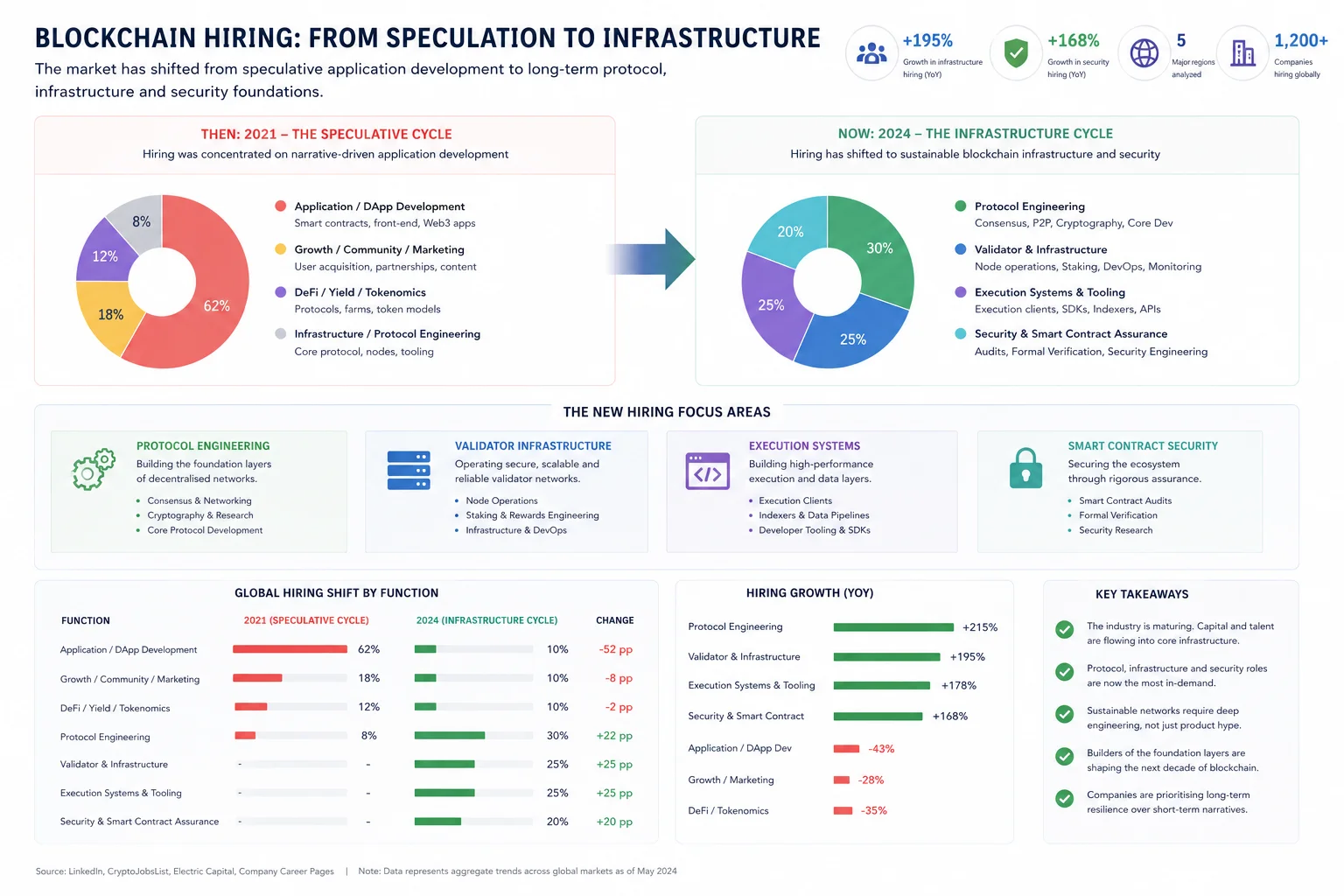
The blockchain hiring market is reorganising around infrastructure reliability rather than speculative application expansion.
This reflects broader market maturation across distributed systems engineering.
Earlier hiring cycles prioritised:
- rapid protocol experimentation
- NFT application development
- consumer-facing decentralised applications
- ecosystem growth incentives
The current market increasingly prioritises:
- execution correctness
- validation infrastructure
- consensus reliability
- settlement architecture
- security-critical engineering
The implication is structural.
Blockchain systems are increasingly being treated as financial and operational infrastructure rather than experimental product ecosystems.
This is changing:
- engineering hiring priorities
- compensation allocation
- protocol team structure
- seniority benchmarks
- security investment patterns
Blockchain hiring is shifting toward protocol infrastructure
Protocol infrastructure engineering now represents the highest-value hiring category in blockchain markets.
This reflects increasing operational complexity across:
- Layer 1 systems
- Layer 2 scaling environments
- modular blockchain architecture
- interoperability systems
- validator infrastructure
The market is rewarding engineers capable of maintaining:
- throughput reliability
- consensus correctness
- state consistency
- execution efficiency
- network resilience
Application-layer development remains important, but infrastructure reliability has become commercially critical.
The strongest hiring density is now concentrated around:
- protocol engineering
- distributed systems
- performance optimisation
- cryptographic infrastructure
- security architecture
Execution-layer engineering is becoming operationally critical
Execution systems are increasingly central to blockchain infrastructure hiring.
This reflects scaling pressure across:
- transaction throughput
- validator coordination
- settlement finality
- interoperability routing
- rollup architecture
Execution-layer engineers now operate similarly to distributed systems engineers in large-scale cloud infrastructure environments.
Key responsibilities frequently include:
- state transition optimisation
- execution client development
- transaction propagation systems
- node performance tuning
- low-latency networking
The hiring market strongly favours engineers with:
- systems programming backgrounds
- Rust or Go expertise
- distributed infrastructure experience
- networking optimisation capability
This reflects the growing convergence between blockchain systems engineering and traditional infrastructure engineering.
Validator infrastructure hiring is expanding globally
Validator and node infrastructure roles are growing rapidly across institutional blockchain environments.
This reflects increasing institutional participation in staking and settlement infrastructure.
Demand is strongest around:
- validator reliability
- staking infrastructure
- node orchestration
- fault tolerance systems
- slashing protection architecture
- uptime optimisation
The operational risk profile has increased significantly.
Validator failures can now create:
- direct financial loss
- governance instability
- reputational damage
- settlement disruption
As a result, hiring standards have become substantially more infrastructure-focused.
Many companies now recruit from:
- cloud infrastructure engineering
- SRE environments
- distributed compute systems
- networking infrastructure teams
rather than purely crypto-native backgrounds.
Blockchain security hiring is becoming structurally dominant
Security engineering is increasingly the most constrained talent category across blockchain infrastructure markets.
This reflects the irreversible execution nature of blockchain systems.
Unlike traditional infrastructure environments, execution failures frequently produce permanent financial impact.
As a result, demand is rising rapidly for:
- smart contract auditors
- protocol security engineers
- cryptographic systems engineers
- MEV infrastructure specialists
- formal verification engineers
- wallet security specialists
Security hiring now operates as a standalone infrastructure category rather than a secondary engineering function.
This reflects broader institutionalisation across blockchain systems.
The market is differentiating between protocol and application engineering
One of the largest changes in blockchain hiring is the growing separation between:
- protocol engineering
- application-layer development
Earlier hiring cycles often grouped both categories together under “Web3 engineering.”
That distinction is now operationally insufficient.
Protocol engineers typically focus on:
- consensus systems
- execution architecture
- validator infrastructure
- cryptographic correctness
- distributed coordination systems
Application engineers focus more heavily on:
- smart contract logic
- decentralised application UX
- frontend integration
- wallet interaction systems
The compensation gap between these categories is widening significantly.
Institutional blockchain infrastructure is changing hiring standards
Institutional adoption is introducing reliability expectations similar to traditional financial infrastructure environments.
This is especially visible across:
- custody infrastructure
- settlement systems
- tokenisation platforms
- exchange architecture
- regulated stablecoin environments
Hiring managers increasingly prioritise:
- operational discipline
- infrastructure maturity
- incident response experience
- security ownership
- systems reliability
Pure speculative ecosystem experience is becoming less sufficient for senior infrastructure roles.
United States blockchain hiring remains infrastructure-led
The US continues to dominate blockchain infrastructure hiring.
Demand remains strongest around:
- protocol systems
- custody infrastructure
- exchange infrastructure
- Layer 2 execution environments
- security-critical engineering
Senior blockchain infrastructure engineers in the US commonly command:
- $200,000 to $450,000+ total compensation
- protocol token incentives
- long-term equity structures
Security engineers and protocol architects remain among the highest-paid infrastructure profiles in the broader crypto market.
UK blockchain hiring is increasingly compliance-oriented
The UK blockchain market is becoming increasingly shaped by:
- regulated digital assets
- institutional custody
- tokenised finance infrastructure
- compliance-heavy blockchain systems
London-based hiring demand is strongest around:
- blockchain compliance infrastructure
- institutional wallet systems
- regulated trading infrastructure
- settlement architecture
This reflects convergence between fintech infrastructure and blockchain execution systems.
Senior blockchain infrastructure engineers in the UK commonly fall between:
- £100,000 to £180,000 base salary
- token or equity upside depending on company maturity
Europe is prioritising regulated blockchain infrastructure
European blockchain hiring remains highly shaped by regulation and financial infrastructure alignment.
The strongest demand exists across:
- Germany
- Switzerland
- France
- the Netherlands
Hiring concentration is strongest around:
- tokenisation infrastructure
- settlement systems
- digital identity infrastructure
- regulated DeFi architecture
- privacy-preserving systems
European firms are also investing more heavily in:
- zero-knowledge systems
- privacy engineering
- compliance-aware protocol architecture
This reflects Europe’s broader regulatory positioning.
Dubai and UAE blockchain hiring is infrastructure and capital driven
Dubai continues positioning itself as a blockchain infrastructure hub.
Hiring activity is strongest around:
- exchange infrastructure
- custody systems
- digital asset platforms
- tokenisation infrastructure
- institutional trading systems
The UAE market remains supply constrained.
As a result, firms frequently compete aggressively for:
- protocol engineers
- security engineers
- exchange infrastructure specialists
Compensation frequently includes:
- relocation support
- tax advantages
- long-term retention incentives
APAC blockchain hiring is operationally diverse
APAC blockchain hiring remains highly fragmented by market structure.
Singapore remains the region’s institutional crypto infrastructure centre.
Hiring demand there focuses heavily on:
- custody infrastructure
- institutional trading systems
- settlement architecture
- tokenisation systems
Meanwhile:
- Hong Kong is increasing regulated digital asset hiring
- Japan prioritises security-heavy blockchain infrastructure
Australia remains focused on institutional fintech convergence
India continues functioning as a major engineering supply market across:
- protocol engineering
- smart contract development
- blockchain infrastructure support
Smart contract hiring is becoming more security-heavy
Smart contract engineering is increasingly security-dominated rather than purely feature-oriented.
This reflects:
- exploit frequency
- governance complexity
- institutional capital exposure
Hiring managers increasingly prioritise:
- formal verification knowledge
- secure contract architecture
- exploit mitigation capability
- auditing experience
Developers with direct exploit-response experience now command substantial market premiums.
Blockchain engineering is converging with distributed systems infrastructure
The strongest long-term hiring signal is convergence between blockchain systems and traditional distributed infrastructure engineering.
Many blockchain systems now resemble:
- high-throughput distributed compute systems
- low-latency networking infrastructure
- fault-tolerant consensus architecture
As a result, hiring increasingly overlaps with:
- cloud infrastructure
- SRE
- networking systems
- distributed databases
- high-performance compute
This is changing talent allocation patterns across the market.
Compensation fragmentation is accelerating
Compensation is diverging sharply between infrastructure-critical and application-heavy roles.
The strongest salary growth is visible in:
- protocol engineering
- blockchain security
- validator infrastructure
- cryptographic systems
- performance optimisation
Meanwhile, generic frontend Web3 roles are seeing:
- slower compensation growth
- higher candidate supply
- reduced scarcity premiums
This reflects broader infrastructure maturation.
Hiring bottlenecks are increasingly operational
The market shortage is not “blockchain developers” broadly.
The shortage exists in engineers capable of:
- operating distributed blockchain infrastructure
- managing execution reliability
- maintaining validator systems
- securing financial execution environments
This distinction matters significantly for hiring strategy.
Companies that optimise for generic blockchain branding frequently encounter:
- hiring mismatch
- infrastructure weakness
- security gaps
- scalability limitations
What hiring managers are prioritising in 2026
The strongest blockchain engineering candidates now demonstrate:
- distributed systems capability
- infrastructure ownership
- protocol-level understanding
- security discipline
- operational reliability
Hiring managers increasingly assess:
- incident management history
- protocol contribution quality
- systems optimisation capability
- execution-layer knowledge
- infrastructure scalability experience
This reflects the operational maturation of blockchain systems.
Final takeaways
Blockchain hiring is increasingly consolidating around:
- execution infrastructure
- validator systems
- protocol engineering
- security-critical architecture
The speculative application phase has not disappeared entirely, but infrastructure reliability now dominates engineering demand.
The market increasingly rewards engineers capable of operating blockchain systems as production-grade financial infrastructure.
This is changing:
- compensation structures
- hiring priorities
- engineering team composition
- infrastructure investment patterns
Companies treating blockchain purely as an application layer are increasingly misaligned with broader market direction.
Frequently Asked Questions
Q: What are the most in-demand blockchain roles in 2026?
The strongest demand exists around:
- protocol engineering
- blockchain security
- validator infrastructure
- execution-layer systems
- distributed infrastructure engineering
Q: Are smart contract engineers still highly paid?
Yes, particularly engineers with:
- security expertise
- auditing experience
- exploit mitigation capability
- formal verification knowledge
Q: Which regions are hiring blockchain engineers most aggressively?
The US remains the largest infrastructure market, followed by Singapore, Dubai, London, and selected European financial centres.
Q: Why are blockchain security engineers so difficult to hire?
The role requires overlap between:
- distributed systems
- cryptography
- infrastructure reliability
- exploit analysis
- financial systems understanding
The supply pool remains extremely limited.
Q: Is blockchain hiring still growing?
Yes, but hiring is shifting toward infrastructure and operational reliability rather than speculative ecosystem expansion.
CTA
Blockchain infrastructure is increasingly operating under institutional reliability expectations.
Hiring strategy now requires clarity around:
- execution systems
- security architecture
- validator reliability
- protocol infrastructure maturity
Axiom works with blockchain, crypto, fintech, and infrastructure companies across the US, UK,
Europe, Dubai, and APAC to help build specialised engineering teams operating within security-critical distributed systems.