AI Engineer Hiring in 2026: A Step-by-Step Guide for Founders and Tech Leaders
16 Apr, 202615 mins

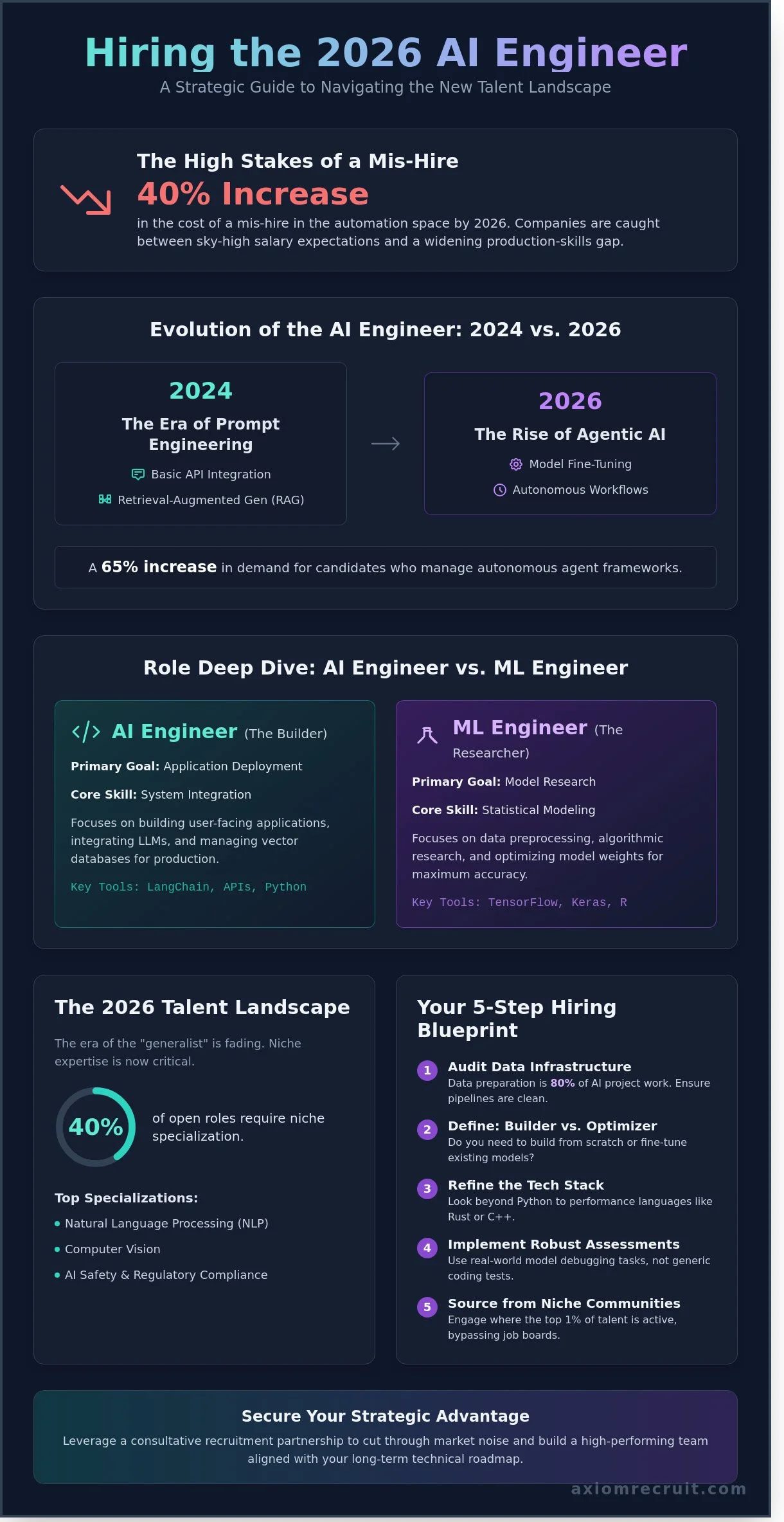
By 2026, the cost of a mis-hire in the automation space has risen by 40% compared to just two years ago. Most hiring managers find themselves stuck between sky-high salary expectations and candidates who can't bridge the gap between theory and production. You're likely tired of competing with Big Tech's bottomless pockets while trying to distinguish between a pure ML researcher and the application engineer your project actually needs. If you want to hire an AI engineer who can actually scale your operations, you need a strategy that looks beyond the buzzwords and focuses on proven implementation.
We've developed this guide to help you master the complexities of the 2026 talent market with quiet confidence. You'll gain a dependable framework to identify and secure top-tier talent, ensuring your technical vetting is both rigorous and fair. We'll walk you through a step-by-step process that simplifies modern recruitment, focusing on practical assessments and long-term stability. This article provides the clear, results-oriented roadmap you need to build a high-performing team while lowering the risks inherent in a volatile market.
Key Takeaways
- Define the modern hybrid role of the 2026 AI engineer to ensure your candidates possess the necessary systems architecture and software engineering expertise.
- Learn how to audit your existing data infrastructure and distinguish between "builders" and "optimizers" before starting your search.
- Implement a robust assessment framework to hire ai engineer talent based on real-world model debugging rather than outdated, generic coding tests.
- Discover the niche digital communities and specialized platforms where the top 1% of engineering talent actually engages, bypassing ineffective traditional job boards.
- Leverage a consultative recruitment partnership to cut through market noise and secure a strategic fit that aligns with your long-term technical roadmap.
Understanding the AI Engineer Role in 2026
By 2026, the criteria to hire ai engineer professionals have shifted from basic API integration to complex system design. The modern AI engineer is a hybrid specialist. They combine the rigour of software engineering with the analytical depth of data science and the structural foresight of systems architecture. Businesses no longer look for someone who can simply write a prompt. They need experts who can build robust, scalable infrastructures that support proprietary intelligence.
The role has evolved significantly since the early 2020s. While 2024 was defined by prompt engineering and basic RAG (Retrieval-Augmented Generation), 2026 focuses on model fine-tuning and the orchestration of autonomous workflows. This shift toward "Agentic AI" means engineers must understand how to create systems that don't just answer questions but take independent actions to solve business problems. At Axiom Recruit, we've seen a 65% increase in requests for candidates who can manage these autonomous agent frameworks since January 2025.
Understanding Artificial Intelligence Engineering as a distinct discipline is vital for any strategic partnership. It's about moving beyond "off-the-shelf" solutions. To remain competitive, your team needs individuals who can integrate custom models into existing legacy stacks while ensuring data privacy and operational efficiency.
AI Engineer vs. Machine Learning Engineer: Key Differences
It's easy to confuse these roles, but the distinction is critical for your hiring strategy. ML engineers typically focus on the research, mathematical modeling, and training of new algorithms. In contrast, AI engineers focus on the application and deployment of those models into production environments. While both roles utilize Python, PyTorch, and TensorFlow, their goals differ. Axiom's bespoke solutions help you identify which profile fits your specific project needs.
- AI Engineer: Focuses on building user-facing applications, integrating LLMs, and managing vector databases.
- ML Engineer: Focuses on data preprocessing, algorithmic research, and optimizing model weights for accuracy.
Use this reference to guide your internal HR discussions:
Feature | AI Engineer | ML Engineer |
|---|---|---|
Primary Goal | Application Deployment | Model Research |
Core Skill | System Integration | Statistical Modeling |
Key Tools | LangChain, APIs, Python | TensorFlow, Keras, R |
The 2026 Talent Landscape: Scarcity and Specialisation
The era of the "generalist" AI engineer is fading. As the market matures, we're seeing a sharp rise in niche specialisations. Data from the first quarter of 2026 shows that 40% of open roles now require specific expertise in NLP (Natural Language Processing), Computer Vision, or AI Safety. AI Safety officers, in particular, have become essential for firms navigating the latest UK and EU regulatory frameworks.
Global talent flow is also changing. Regional tech hubs like London and Dubai have introduced competitive "AI Visas," drawing top-tier talent away from traditional silicon valleys. This makes the effort to hire ai engineer talent more competitive than ever. As your local recruitment partner, Axiom stays connected to these global shifts to ensure you have access to the best candidates, whether you're looking for a local expert or a remote specialist.
How to Define Your AI Engineering Requirements
Success in artificial intelligence begins long before the first interview. You need a blueprint that aligns with your specific business goals. Building a high-performing team requires a clear understanding of your internal readiness and the specific problems you want to solve. Follow these five steps to prepare your search.
- Audit your data infrastructure: AI models are only as good as the data feeding them. IBM reports that data preparation accounts for 80% of the work in AI projects. Ensure your pipelines are clean and accessible before you attempt to hire ai engineer talent.
- Choose between a builder or an optimizer: A "zero-to-one" builder creates custom architectures from scratch. An optimizer focuses on fine-tuning existing open-source models like Llama 3 or Mistral to improve performance.
- Refine the tech stack: Python remains the industry standard, but performance-critical applications in 2026 require proficiency in Rust or C++. These languages handle memory management more efficiently for high-scale deployments.
- Set 180-day KPIs: Define what success looks like by the six-month mark. This might include a 15% reduction in model latency or the successful deployment of a retrieval-augmented generation (RAG) system.
- Develop a candidate persona: Balance technical depth with industry context. A great engineer understands both the code and the commercial impact of their work.
If you're unsure where your current infrastructure stands, Axiom Recruitment provides consultative support to help you identify the exact technical profile your project requires.
Technical Must-Haves: The 2026 Skill Matrix
The technical landscape moves fast. Candidates must demonstrate mastery of orchestration frameworks like LangChain or Haystack to manage complex LLM workflows. MLOps is equally vital; 90% of machine learning models fail to reach production without robust CI/CD pipelines. Additionally, data engineering is no longer a separate silo. Modern AI hires must know how to build the very pipelines that sustain their models.
The "Soft" Side: Why Domain Expertise Matters
Technical skill is only half the battle. An engineer in Fintech needs a natural instinct for fraud patterns and risk, while a Healthcare specialist must prioritize patient privacy and HIPAA standards. Communication is the bridge between the "black box" of AI and your business goals. Your hire must explain complex algorithmic decisions to non-technical stakeholders clearly. Finally, ethical reasoning is mandatory. With the EU AI Act entering full enforcement in 2024, engineers must navigate bias and compliance as part of their daily workflow.
Vetting AI Talent: A Robust Assessment Framework
Traditional coding assessments often fall short when you need to hire ai engineer talent. While LeetCode challenges measure a candidate's grasp of basic algorithms, they don't account for the non-deterministic nature of machine learning. An engineer might write perfect Python code but fail to understand why a model's weights aren't converging. You need an assessment framework that mirrors the actual challenges your team faces every day.
Move your evaluation toward real-world take-home assignments. Instead of asking for a generic sorting algorithm, provide a messy dataset and a model with a bottleneck. Ask the candidate to optimize the inference speed or debug a vanishing gradient issue. This reveals their practical problem-solving skills and their comfort level with frameworks like PyTorch or TensorFlow. A successful candidate won't just provide a solution; they'll explain the trade-offs they made to achieve it.
The architectural interview is where you test for long-term stability. Focus on how they handle data drift and edge cases. Ask them to design a system that remains resilient when input distributions shift. Verifying claims of State of the Art (SOTA) performance is also vital. Don't take a high accuracy percentage at face value. Ask for the specific validation sets, the precision-recall curves, and the confidence intervals used to back up those numbers. This ensures their past successes were rooted in rigorous methodology rather than overfitted data.
The Technical Interview: Probing the "Why" Not Just the "How"
Ask candidates: "How would you handle a 20% drop in model accuracy after a data schema change?" This question tests their understanding of data lineage and pipeline integrity. It's not just about the code. It's about their resource awareness. A great engineer builds models that are cost-effective to run. If they can achieve 95% accuracy with a $5,000 compute budget instead of 96% with a $50,000 budget, they show a business-first mindset. They should also demonstrate a habit of reading weekly research breakthroughs to keep your tech stack relevant.
Portfolio and Open Source Verification
Reviewing a GitHub profile requires looking past the "green squares." Look for contributions to major libraries like Hugging Face or Transformers. These contributions prove they can work within complex, production-grade codebases. While a high Kaggle ranking shows a competitive spirit and a knack for feature engineering, it doesn't always translate to real-world production experience. Prioritize candidates who document their work clearly. Their ability to explain why they chose a specific optimizer or loss function is a strong indicator of their future performance on your team.
Sourcing Strategies: Where the Top 1% Hide
Senior AI talent isn't scrolling through generic job boards. Research from 2024 indicates that 85% of high-level technical placements occur through passive sourcing or niche networking rather than active applications. To hire ai engineer talent at the top of their field, you must look where they contribute. This means monitoring ArXiv pre-prints for groundbreaking research or engaging in specialized Discord servers like those for LangChain or Hugging Face. These spaces allow you to see their work in real-time before they even consider a move.
Regional strategies also dictate your success. London's AI corridor, centered around the Knowledge Quarter, remains a powerhouse for academic-led innovation. However, the UAE tech ecosystem is growing rapidly. The 2023 expansion of the UAE Golden Visa has made Dubai a magnet for researchers seeking tax-free environments and high-spec compute clusters. Understanding these geographic nuances helps you tailor your outreach to what these specific pools value most.
Building an Attractive Employer Brand for AI Talent
Engineers in 2026 prioritize three things: high-quality data, massive compute resources, and project autonomy. They don't want to spend 70% of their time cleaning messy datasets. Show them your stack and your hardware. A 2025 industry survey showed that 62% of AI professionals would reject an offer if the company lacked a clear ethical AI framework. Flexibility is also non-negotiable. Hybrid models remain the standard for retaining top-tier talent who value deep-work blocks over constant office presence.
The Global Search: Navigating Visas and Relocation
Expanding your search globally increases your chances to hire ai engineer specialists with rare skill sets. The UK Global Talent Visa offers a fast-track for those endorsed by bodies like Tech Nation, while the UAE Golden Visa provides 10-year residency for exceptional researchers. Hiring remote international talent saves on relocation costs, but local hires often integrate faster into the company culture. We use real-time market intelligence to help you set salaries that are competitive in both the London and Dubai markets, ensuring your offer stands out in a crowded field.
Finding the right technical lead requires a partner who understands the local and global landscape. Partner with Axiom Recruitment to access our exclusive network of vetted AI professionals today.
Partnering with Axiom Recruit for AI Success
Finding the right talent shouldn't feel like a shot in the dark. Generalist recruiters often flood your inbox with resumes that don't meet high technical standards. At Axiom Recruit, we bypass that noise. Our network is built on years of immersion in specific tech ecosystems. When you want to hire ai engineer talent, you need a partner who understands the difference between a prompt engineer and a machine learning specialist.
Our consultative approach starts by helping you define the role before we search for candidates. We've found that 40% of hiring failures stem from poorly defined job descriptions. We fix that. We bring deep roots in both the AI and Blockchain (Web3) ecosystems, allowing us to source specialists who understand how these technologies converge. This expertise reduces your time-to-hire by an average of 15 days compared to traditional methods. By focusing on expert cultural matching, we also help you avoid the high costs of turnover.
- Specialized networks that ignore the "noise" of generalist job boards.
- Strategic role definition to ensure you find the exact skill set required.
- Reduced risk of turnover through rigorous cultural and technical alignment.
- Deep roots in the AI and Web3 communities for high-level sourcing.
Our Bespoke AI Recruitment Process
We act as a supportive partner from the initial brief to successful onboarding. Our team handles rigorous technical pre-screening, so you only interview the top 5% of applicants. We don't just check boxes; we verify code and architectural thinking. In a 2023 project, we helped a fintech startup scale their AI engineering team from 3 to 12 members in just 4 weeks, ensuring every hire aligned with their specific tech stack and fast-paced culture.
Next Steps: Secure Your AI Future
The competition for talent is accelerating. Industry reports suggest a massive talent war will peak by 2026 as legacy industries complete their digital transformations. Proactive hiring is the only way to stay ahead. To help you prepare, we offer a market salary benchmark report specifically for AI roles. This provides the concrete data you need to make competitive offers in a tight market.
Don't leave your technical growth to chance. Hire ai engineer specialists who can drive your vision forward and keep you competitive. Partner with Axiom to find your next AI leader today.
Future-Proof Your Team for the 2026 AI Shift
The race to hire ai engineer talent is no longer just about filling a seat; it's about securing the specialized expertise needed to navigate a market where AI models evolve weekly. By 2026, successful hiring requires a precise assessment framework and a deep understanding of how these roles integrate into your specific tech stack. You've learned how to look beyond the resume to find the top 1% of engineers who can actually ship production-ready solutions.
Axiom Recruit has been at the forefront of this evolution, specializing in AI and Web3 recruitment since 2021. With dedicated offices in Dubai, London, and the US, we provide a global reach that connects you with elite talent across three continents. Our success-based permanent recruitment model ensures our goals are perfectly aligned with your long-term growth. We don't just send candidates; we build the teams that define the future of your industry.
Ready to scale your technical capabilities with confidence? Find your next AI engineer with Axiom Recruit and let's start building your 2026 roadmap today. Your next breakthrough is just one strategic hire away.
Frequently Asked Questions
What is the average salary for an AI engineer in 2026?
In 2026, the average base salary for an AI engineer in the United States is expected to range between $165,000 and $210,000. Senior roles often exceed $250,000 when including performance bonuses and equity. These figures vary based on local market demand in tech hubs like San Francisco or London. We track these trends closely to ensure your offers remain competitive and attractive to the top-tier talent you need.
Can I hire an AI engineer for a part-time or contract role?
Yes, you can hire ai engineer specialists for part-time or contract projects through specialized agencies or freelance platforms. Current market data shows that 35% of AI development projects use contract talent to handle specific implementation phases. This flexibility helps you manage costs while accessing high-level expertise for short-term goals. It's a strategic way to scale your team without the overhead of a full-time hire while maintaining high standards.
What is the difference between an AI engineer and a Data Scientist?
AI engineers focus on building and deploying production-ready models, while data scientists primarily focus on analyzing data and finding patterns. A 2025 LinkedIn Talent report notes that AI engineers spend 70% of their time on software engineering and architecture. Data scientists spend a similar percentage on statistical modeling and data cleaning. You'll need an engineer when you're ready to integrate AI into your software product for customers.
How do I test an AI engineer’s knowledge of Large Language Models (LLMs)?
Test an engineer's LLM knowledge by asking them to optimize a specific prompt for a RAG (Retrieval-Augmented Generation) pipeline. Ask for a 30-minute live coding session where they adjust hyper-parameters like temperature or top-p to reduce hallucinations. Successful candidates should explain how they use frameworks like LangChain or LlamaIndex. This practical test ensures they understand the mechanics of modern generative AI systems and can deliver reliable results.
Should I hire a junior AI engineer and train them up?
Hiring a junior AI engineer is a viable strategy if you have at least one senior mentor to guide them. Training a junior hire takes 6 to 9 months before they reach full productivity in a complex environment. This approach saves approximately $40,000 in initial salary costs compared to hiring a mid-level professional. It's a long-term investment that builds a loyal team tailored to your specific business needs and technical stack.
What are the top programming languages for AI in 2026?
Python remains the leading language for AI in 2026, used in 85% of machine learning projects according to the TIOBE Index. C++ follows closely for performance-critical edge computing, while Mojo has gained a 12% market share for high-performance AI infrastructure. Rust is also seeing increased adoption for its memory safety features in large-scale deployments. Choosing the right language depends on your specific performance requirements and existing software systems.
How long does it typically take to hire a senior AI engineer?
It typically takes 45 to 60 days to hire ai engineer at a senior level in the current market. This timeline includes three rounds of technical interviews and a final cultural fit assessment. Competition is high, so 25% of top candidates receive multiple offers within 10 days of starting their search. Moving quickly through your evaluation process is essential to securing the best talent for your team before competitors do.
Does an AI engineer need a PhD in Computer Science?
No, an AI engineer doesn't need a PhD in Computer Science to be successful in a commercial role. Industry data shows that 65% of working AI engineers hold a Master's degree or a Bachelor's degree with relevant certifications. Practical experience with frameworks like PyTorch and a portfolio of deployed models are often more valuable to employers than academic credentials. Focus on their proven ability to deliver functional software and solve real problems.