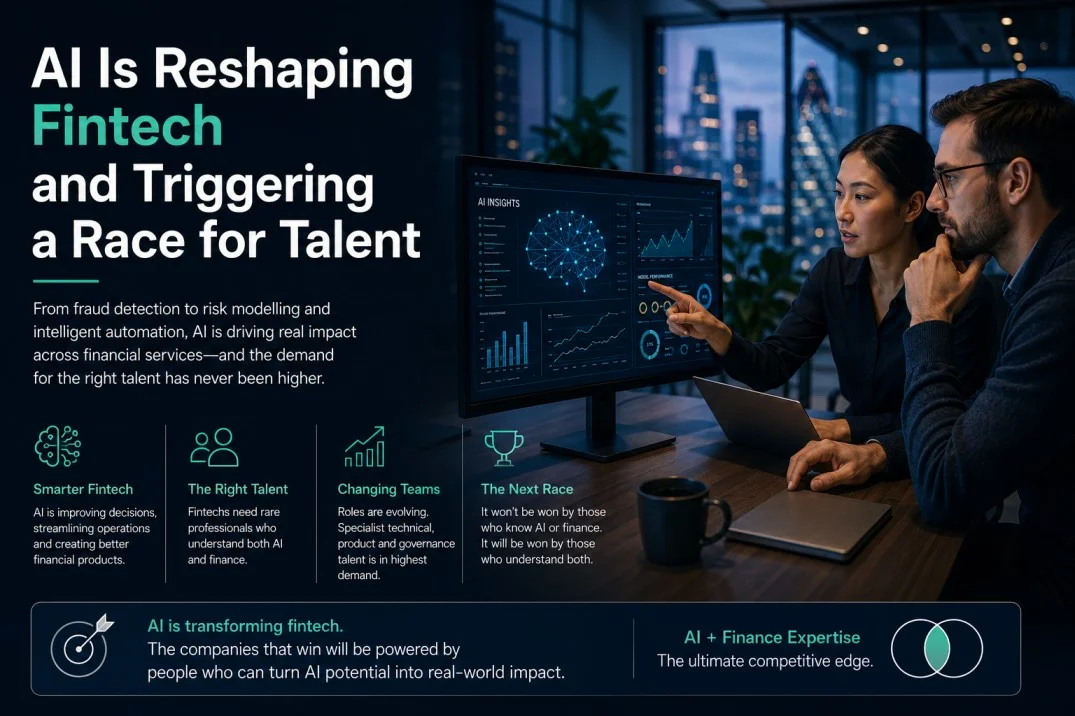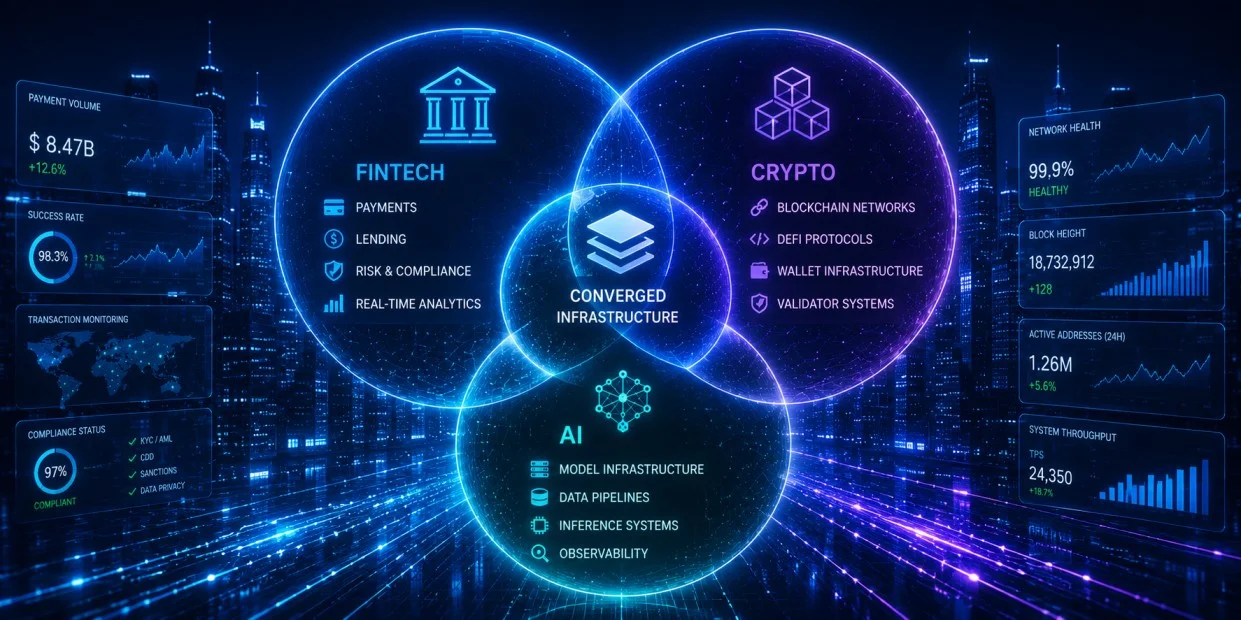
AI hiring in Dubai is consolidating around inference and deployment infrastructure
18 May, 202615 mins

Dubai’s AI hiring market is no longer centered around experimentation alone.
In 2026, hiring demand across the UAE is increasingly concentrated around operational AI systems. Companies are moving beyond proof-of-concept model experimentation and reallocating hiring budgets toward infrastructure reliability, inference optimisation, orchestration layers, and enterprise deployment systems.
This is changing what “AI talent” actually means in practice.
Two years ago, companies across Dubai aggressively competed for machine learning researchers, data scientists, and generative AI specialists. Most hiring strategies prioritised experimentation velocity. Teams were assembled around model exploration rather than production-grade reliability.
That hiring model is now fragmenting.
Today, UAE employers are prioritising engineers capable of operationalising AI systems under enterprise constraints. Reliability, latency, governance, security, and deployment scalability have become primary hiring filters.
This reflects a broader shift occurring across global AI infrastructure markets, but Dubai is accelerating faster than many regions due to concentrated government investment, enterprise digital transformation initiatives, and sovereign-backed AI infrastructure expansion.
The UAE’s AI hiring market is becoming increasingly infrastructure-heavy.
AI hiring demand is shifting away from research-heavy teams
The largest hiring growth in Dubai is no longer concentrated in foundational model research.
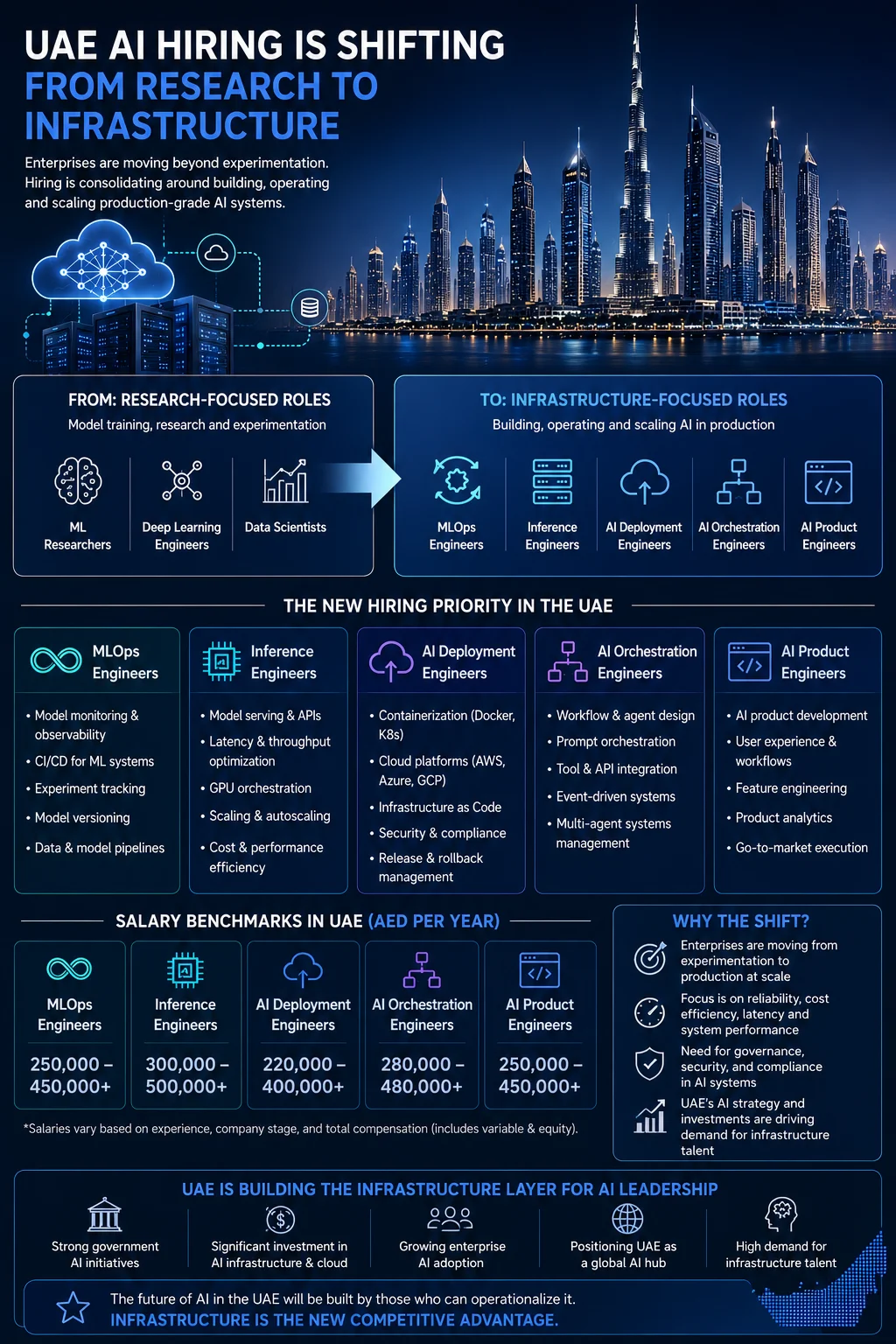
Instead, demand is consolidating around applied infrastructure roles:
- AI infrastructure engineers
- LLM deployment engineers
- AI product engineers
- MLOps specialists
- AI platform architects
- Retrieval system engineers
- AI security engineers
- AI integration specialists
This reflects a structural transition from model experimentation toward operational AI systems.
Many UAE organisations adopted generative AI quickly in 2024 and 2025. However, deployment maturity exposed a new set of engineering constraints:
- unreliable inference outputs
- latency bottlenecks
- orchestration instability
- fragmented data pipelines
- compliance concerns
- hallucination mitigation
- enterprise integration failures
As a result, hiring priorities changed.
Companies no longer view AI as an isolated innovation initiative. AI is increasingly treated as enterprise infrastructure.
This changes how technical hiring is structured.
In practice, hiring managers in Dubai are now evaluating candidates less on theoretical model knowledge and more on operational systems experience.
The highest-value candidates typically demonstrate experience with:
- distributed inference infrastructure
- vector database systems
- retrieval-augmented generation pipelines
- model serving optimisation
- GPU orchestration
- observability tooling
- enterprise deployment architecture
- AI governance systems
This shift mirrors broader infrastructure maturation patterns seen previously in cloud engineering and DevOps markets.
UAE enterprises are hiring for AI reliability rather than experimentation
One of the clearest signals across Dubai’s hiring market is the growing emphasis on AI reliability engineering.
Enterprise adoption has exposed the operational fragility of many generative AI systems.
Internal deployments frequently struggle with:
- unpredictable outputs
- integration instability
- governance failures
- poor retrieval accuracy
- escalating infrastructure costs
As AI systems become embedded into banking, logistics, healthcare, fintech, and government infrastructure, reliability becomes commercially critical.
This is particularly relevant in the UAE where enterprise and public-sector digital transformation programmes are moving aggressively toward AI integration.
As a result, hiring managers increasingly prioritise engineers capable of reducing operational uncertainty.
The strongest candidates are often those with hybrid infrastructure backgrounds spanning:
- backend distributed systems
- cloud infrastructure
- data engineering
- AI deployment systems
- platform engineering
This is why many companies are now recruiting from adjacent infrastructure markets rather than relying exclusively on traditional machine learning talent pools.
Dubai’s AI hiring market is becoming globally competitive
The UAE is no longer competing only within regional hiring markets.
Dubai-based employers are increasingly competing globally for AI infrastructure talent.
This creates several structural hiring challenges.
First, compensation expectations have increased significantly.
Senior AI infrastructure engineers in Dubai now commonly command compensation packages ranging between AED 420,000 and AED 900,000 annually depending on deployment expertise, infrastructure ownership, and enterprise scaling experience.
Highly specialised engineers with expertise in inference optimisation, GPU orchestration, or enterprise LLM deployment can exceed these ranges substantially.
Second, talent availability remains structurally constrained.
Most experienced AI infrastructure engineers are already embedded within:
- hyperscalers
- global fintech firms
- AI-native startups
- infrastructure vendors
- enterprise cloud platforms
The available candidate pool remains relatively small compared to hiring demand.
This imbalance is pushing UAE employers toward international recruitment strategies.
Many Dubai companies are now sourcing talent from:
- Europe
- Singapore
- India
- Eastern Europe
- the United Kingdom
Cross-border hiring has become operationally necessary rather than optional.
AI product engineering is emerging as a critical hiring category
Another major shift across Dubai’s AI market is the rise of AI product engineering.
Many companies initially hired pure machine learning specialists expecting them to build complete AI-enabled products.
This created execution gaps.
Modern AI products require significantly broader engineering coordination:
- backend architecture
- retrieval systems
- orchestration pipelines
- frontend AI interaction layers
- observability tooling
- security controls
- data infrastructure
- model evaluation systems
As a result, AI product engineers are becoming increasingly valuable.
These roles operate between infrastructure engineering and product execution.
Strong candidates typically understand:
- API orchestration
- LLM integration systems
- prompt architecture
- retrieval optimisation
- workflow automation
- cloud deployment infrastructure
- scalable backend systems
In Dubai, fintech and enterprise SaaS companies are particularly active in this category.
AI product engineering is increasingly viewed as a systems integration discipline rather than a purely machine learning function.
AI hiring in fintech and government sectors is accelerating fastest
Two sectors are driving a disproportionate share of UAE AI hiring demand:
Fintech infrastructure
Dubai’s fintech ecosystem continues expanding rapidly across:
- digital banking
- payments infrastructure
- wealth platforms
- compliance automation
- fraud detection
- financial operations tooling
These systems increasingly rely on AI-enabled infrastructure.
Hiring demand is strongest for engineers capable of integrating AI into regulated financial environments.
This requires experience with:
- governance systems
- observability
- auditability
- security infrastructure
- risk-sensitive deployment architecture
Fintech employers are prioritising operational maturity over experimentation speed.
Government and sovereign-backed AI systems
The UAE government continues investing heavily into national AI infrastructure.
This is creating sustained demand across:
- AI governance systems
- smart city infrastructure
- digital identity systems
- multilingual AI tooling
- public-sector automation
- sovereign AI infrastructure
Government-backed initiatives are particularly focused on long-term infrastructure reliability rather than short-term experimentation.
This creates strong hiring demand for senior platform engineers and infrastructure architects.
The strongest AI candidates are increasingly multidisciplinary
One of the biggest hiring distortions in Dubai’s AI market is the assumption that AI hiring revolves entirely around machine learning expertise.
In practice, the highest-performing candidates increasingly combine multiple infrastructure disciplines.
The most valuable engineers often sit at the intersection of:
- distributed systems
- backend architecture
- cloud infrastructure
- AI orchestration
- data systems
- product engineering
Pure research-heavy profiles are becoming less dominant outside specialised AI labs.
This reflects broader infrastructure convergence across enterprise AI systems.
As AI products mature, operational engineering complexity increases faster than modelling complexity.
That changes hiring priorities substantially.
Why many UAE companies struggle to hire strong AI engineers
Several recurring hiring issues continue affecting AI recruitment across Dubai.
Generic AI role definitions
Many companies still use overly broad AI job descriptions.
Terms like “AI engineer” or “machine learning specialist” often fail to communicate the actual infrastructure requirements of the role.
This weakens candidate targeting and increases hiring inefficiency.
The strongest hiring teams define infrastructure ownership clearly.
Unrealistic full-stack AI expectations
Some employers expect candidates to simultaneously manage:
- model development
- deployment
- cloud architecture
- frontend integration
- data engineering
- security systems
These expectations rarely align with real market specialisation.
The AI talent market is fragmenting into increasingly specialised execution layers.
Hiring structures must adapt accordingly.
Compensation mismatch
Many companies still benchmark compensation against traditional software engineering salaries.
This no longer reflects infrastructure scarcity.
Senior AI infrastructure candidates often evaluate opportunities globally, not regionally.
Compensation expectations increasingly reflect international market dynamics.
How companies in Dubai are finding stronger AI candidates
The most effective hiring teams across the UAE are changing their recruitment strategies significantly.
They are increasingly:
- recruiting from infrastructure engineering markets
- targeting distributed systems engineers with AI adjacency
- evaluating deployment ownership rather than theoretical credentials
- prioritising architecture capability over tool familiarity
- using technical evaluation systems aligned with real production constraints
The strongest AI hires are rarely sourced through volume-based recruitment alone.
High-performing candidates are typically passive, infrastructure-focused, and highly selective.
This is pushing more companies toward retained hiring models and specialised technical recruitment partnerships.
AI hiring across Dubai is becoming infrastructure-first
The broader pattern across the UAE is increasingly clear.
AI hiring is evolving into infrastructure hiring.
The market is no longer driven primarily by experimentation narratives or generative AI hype cycles.
Instead, hiring demand is consolidating around operational systems capable of supporting enterprise-scale AI deployment under real-world constraints.
This changes how companies should evaluate candidates, structure teams, and allocate hiring budgets.
The organisations that adapt fastest will likely build stronger long-term AI capability.
The organisations that continue hiring around generic AI narratives may struggle with execution maturity, deployment reliability, and infrastructure scalability.
Final thoughts
Dubai’s AI hiring market is entering a more operational phase.
The next wave of hiring demand will likely centre less on experimentation and more on infrastructure durability, orchestration reliability, and deployment scalability.
This is not simply a technology shift.
It is a structural hiring reorganisation across enterprise AI systems.
Companies hiring in the UAE increasingly need engineers who can operationalise AI reliably under production constraints, not simply prototype models quickly.
That distinction is becoming one of the defining filters in the region’s AI hiring market.
If your organisation is building AI infrastructure teams across Dubai or the wider UAE market, working with specialised technical recruiters can materially improve hiring precision, candidate quality, and long-term retention outcomes.
Frequently Asked Questions
Q: What AI roles are most in demand in Dubai in 2026?
AI infrastructure engineers, AI product engineers, MLOps specialists, LLM deployment engineers, and AI platform architects are currently among the highest-demand roles across the UAE market.
Q: Are AI salaries increasing in Dubai?
Yes. Senior AI infrastructure engineers are commanding significantly higher compensation due to global competition and limited talent availability.
Q: Why is AI hiring becoming infrastructure-focused?
As enterprise AI adoption matures, operational constraints such as reliability, scalability, governance, and deployment stability become more important than experimentation alone.
Q: Is Dubai attracting international AI talent?
Yes. Many UAE companies are actively recruiting globally due to local shortages in experienced AI infrastructure engineering talent.
Q: What skills are companies prioritising most?
Distributed systems engineering, cloud infrastructure, AI deployment architecture, orchestration systems, vector databases, and enterprise AI integration experience are increasingly prioritised.