The Ultimate Guide to Hiring Machine Learning Experts in 2026
16 Apr, 202615 mins

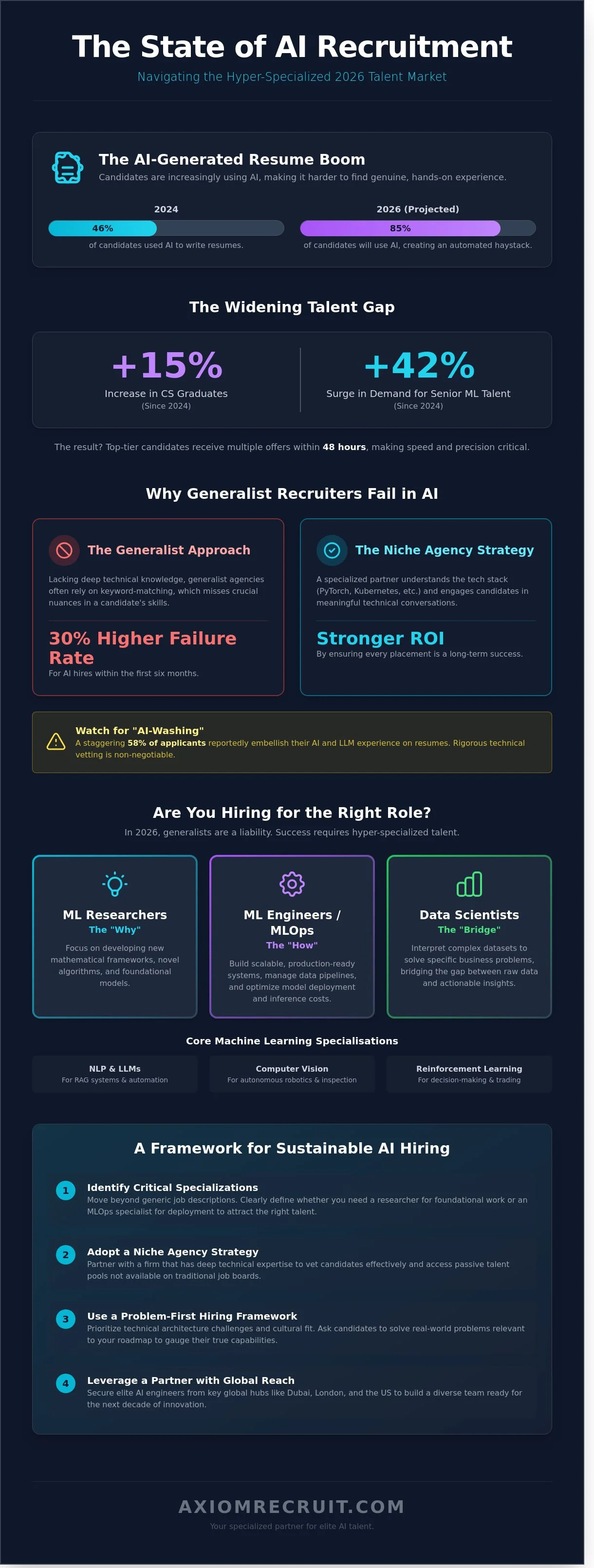
A 2024 report from ResumeBuilder found that 46% of candidates are already using AI to write their resumes, a figure projected to reach 85% by 2026. This trend makes machine learning recruitment feel like a constant search for a needle in an increasingly automated haystack. You've likely felt the frustration of reviewing dozens of "perfect" profiles only to find the candidates lack the hands-on experience needed for complex GenAI or MLOps projects. It's a challenge to maintain your hiring standards when the technical requirements shift every few months.
We're here to help you cut through the noise with a dependable strategy for finding elite AI talent. This guide gives you a repeatable framework for vetting deep technical skills and accessing passive candidates who aren't active on traditional job boards. You'll learn how to lower the risk of a high-cost bad hire and build a team that's ready for the next decade of innovation. We've simplified the complexities of the global market so you can focus on what matters: hiring the right person the first time.
Key Takeaways
- Identify the critical differences between ML Researchers and MLOps specialists to ensure your team is built for specialized GenAI projects.
- Discover why a niche agency strategy provides a stronger ROI than traditional platforms for your machine learning recruitment efforts.
- Adopt a problem-first hiring framework that prioritizes technical architecture and cultural fit over generic job descriptions.
- Learn how to leverage a local partner with global reach to secure elite AI engineers across key hubs in Dubai, London, and the US.
- Master the complexities of the 2026 talent market to transform your recruitment process into a sustainable competitive advantage.
The State of Machine Learning Recruitment in 2026
Machine learning recruitment has transitioned from a niche subset of IT hiring into a high-stakes, standalone discipline. In 2026, the market no longer views machine learning as a broad category. It's a specialized field requiring deep expertise in neural architecture, model deployment, and ethical AI governance. Companies have moved past the era of hiring generalist data scientists. Instead, the focus has shifted toward hyper-specialized roles like LLM Architects, GenAI Researchers, and MLOps Engineers who can bridge the gap between a prototype and a production-ready system.
The talent landscape remains incredibly tight. A January 2026 industry report indicated that while the number of computer science graduates has increased by 15% since 2024, the demand for senior-level ML talent has surged by 42%. This demand-supply gap means that top-tier candidates often receive multiple offers within 48 hours of entering the market. Traditional methods often fall short in this environment. The recruitment process for these roles requires more than just a standard background check; it demands a technical evaluation that respects the candidate's time and expertise.
Relying on keyword-matching software is a recipe for failure in 2026. Automated filters often miss the nuance of a candidate's actual contributions to a project, leading to missed opportunities or poor-quality hires. Successful machine learning recruitment now depends on a recruiter's ability to engage in technical discourse and understand the specific challenges of a business's AI roadmap.
The Evolution of the ML Job Market
The rise of autonomous systems in 2026 has fundamentally shifted hiring priorities. Businesses now prioritize candidates who understand how models interact with physical hardware or real-time data streams. This shift has also led to an increase in "AI-washing" on resumes, where 58% of applicants reportedly embellish their experience with large language models. Consequently, firms are moving toward "full-stack" ML engineers. These professionals don't just build models; they manage data pipelines and optimize inference costs, ensuring the AI adds actual value to the bottom line.
Why Generalist Agencies Struggle with AI
Generalist agencies often lack the depth to distinguish between a data analyst who uses SQL and a deep learning engineer who builds custom transformers. This lack of technical clarity leads to high turnover. In fact, a 2025 study showed that AI hires made through non-specialized agencies have a 30% higher failure rate within the first six months. To find the right fit, partners must understand the underlying tech stack, including frameworks like PyTorch and TensorFlow, as well as orchestration tools like Kubernetes. At Axiom, we focus on these technical details to ensure every placement is a long-term success.
Specialised ML Roles: What Are You Actually Hiring For?
Successful machine learning recruitment starts with a clear definition of the role. Hiring managers often conflate different functions, which leads to misaligned expectations and high turnover. You must distinguish between the three pillars of the AI workforce. ML Researchers focus on the "why," developing new mathematical frameworks and algorithms. ML Engineers focus on the "how," building the scalable systems that run those algorithms. Data Scientists bridge the gap by interpreting complex datasets to solve specific business problems. In 2026, these distinctions are sharper than ever as companies move from experimental pilots to full-scale deployment.
Recent data from the Federal Reserve Board shows that AI uptake in the workplace reached approximately 5% of firms by early 2024, with that figure nearly tripling in specific sectors by 2026. This rapid growth means you can't afford to hire a generalist when your project requires a specialist. Identifying the specific technical niche is your first step toward a successful hire.
Core Machine Learning Specialisations
- NLP and LLMs: These specialists handle everything from sentiment analysis to complex Retrieval-Augmented Generation (RAG) systems. They're essential for businesses automating customer service or internal knowledge bases.
- Computer Vision: This field is critical for the 35% of industrial firms now using automated visual inspection or autonomous warehouse robotics. These experts work with image segmentation and object detection.
- Reinforcement Learning: This niche is the backbone of high-frequency trading and complex robotics. It's about training models to make a sequence of decisions by rewarding desired outcomes.
The Rise of MLOps and Infrastructure
Research is a sandbox, but production is the real world. This is where MLOps becomes vital. MLOps specialists ensure that models don't "drift" or lose accuracy once they're live. They focus on CI/CD for machine learning, model monitoring, and massive scalability. If your model can't handle 10,000 concurrent requests, it isn't ready for the market.
The AI Architect has emerged as a cornerstone of the 2026 enterprise. This person doesn't just write code; they design the entire ecosystem. They decide whether to use on-premise hardware or cloud-based solutions like AWS or Azure. They ensure the data pipeline is secure and compliant with global regulations. If you're looking to build a sustainable department, our dedicated consultants can help you identify the right architectural leadership for your team.
We're also seeing a significant intersection between ML and Blockchain technologies. Decentralised AI requires specialists who understand how to run models on distributed ledgers. This protects data privacy while allowing for collaborative model training. By 2026, about 15% of Web3 projects are expected to integrate some form of on-chain machine learning, creating a new breed of hybrid developer.
Sourcing Strategies: In-House vs. Specialised Agency
Effective machine learning recruitment in 2026 requires more than a standard LinkedIn Recruiter seat. While internal HR teams excel at scaling general departments, they often struggle with the technical depth required for AI roles. The most common objection to using a niche agency is the cost, yet the ROI is found in the speed of delivery. Research from 2025 indicates that the average time-to-fill for a Senior ML Engineer via internal channels is 114 days. A specialized partner reduces this to 42 days by accessing pre-vetted talent pools.
Elite ML engineers are rarely active on job boards. Approximately 85% of the top 5% of AI talent is "passive," meaning they don't respond to generic automated outreach. They engage with recruiters who understand the difference between PyTorch and TensorFlow or the nuances of Retrieval-Augmented Generation (RAG). As AI impacts the US labor market and global tech hubs, companies need real-time market intelligence. We provide 2026 salary benchmarking that reflects the current 12% annual growth in specialized AI compensation, ensuring your offers aren't rejected at the final stage.
The Hidden Costs of In-House Tech Hiring
Internal teams often overlook the "vacancy tax" on their product roadmaps. A vacant Lead ML role costs a firm roughly $1,200 per day in lost productivity and delayed releases. There is also the burden of technical interview fatigue. When internal teams lack a deep network, they often put 15 or more unqualified candidates in front of your engineering leads. This drains the energy of your most expensive staff. Specialized agencies filter this down to the top 3 candidates, protecting your team's time for actual development.
The Axiom Approach: AI-Driven Sourcing
We use machine learning to solve machine learning recruitment challenges. Our proprietary sourcing tools analyze GitHub contributions, ArXiv research papers, and Kaggle rankings to find talent across the UK, US, and UAE. We don't just find names; we build "warmth" through long-term relationships. This global network allows us to identify the top 5% of engineers before they even consider a move. We act as your local recruitment partner with a global reach, providing the "can-do" attitude needed to secure world-class talent for your specific project needs.
The Machine Learning Hiring Framework
Success in machine learning recruitment requires a shift from generic job descriptions toward a problem-first approach. Elite talent isn't looking for a list of requirements; they're looking for a challenge that matches their specific expertise. Our framework ensures you identify these specialists quickly and treat them as partners from the first interaction.
- Step 1: Define the technical problem. Instead of hiring a generic engineer, look for someone to optimize a recommendation engine for 5 million daily active users.
- Step 2: Implement a vetting process that balances speed with depth. Combine a short coding task with a high-level architecture review.
- Step 3: Conduct interviews focused on edge cases. Ask how they'd manage a 20% drop in model accuracy due to sudden data drift.
- Step 4: Benchmark against 2025 salary data. Top-tier candidates expect equity-inclusive offers that reflect their impact on the company's valuation.
- Step 5: Standardize onboarding. Provide access to GPU clusters and clean data pipelines on day one to maximize retention.
Vetting Technical Competence
Whiteboard exercises don't predict how an engineer handles messy, real-world data. We've found that take-home projects or pair programming sessions work better for machine learning recruitment because they simulate the actual work environment. You need to test for mathematical intuition rather than library memorization. Ask candidates to explain the trade-offs between different optimization algorithms. Verify their experience with large-scale production environments. A candidate who can build a model in a notebook but can't scale it to a 10-terabyte dataset will struggle in a modern AI role.
Assessing Cultural and Strategic Fit
You must decide if your team needs a "Research" or an "Engineer" mindset. A 2025 industry survey indicated that 44% of AI initiatives fail because the team prioritizes academic perfection over product delivery. Look for candidates who can explain complex neural networks to non-technical stakeholders without using dense jargon. They should align with the iterative nature of startups, where shipping a functional model today is more valuable than a perfect one next quarter. We focus on finding individuals who view themselves as business problem-solvers first and AI practitioners second.
Finding the right balance of technical skill and strategic vision is what we do best. Partner with Axiom for bespoke AI staffing solutions that secure the talent your business needs to lead the market.
Partnering with Axiom Recruit for AI Success
Finding the right talent in a competitive market requires more than just a database of resumes. Axiom Recruit acts as your dedicated partner in the AI and Blockchain space, bridging the gap between high-level innovation and human expertise. We don't just fill seats; we find the technical truth behind every candidate. Whether you're a startup scaling your first engineering team or a global enterprise refining your neural networks, we provide bespoke solutions for permanent placements, contract roles, and executive search. Our focus on machine learning recruitment ensures that your organization stays ahead of the curve as we approach 2026.
We believe in dependable results. Our consultants understand the nuances of deep learning, natural language processing, and computer vision. This technical depth allows us to vet candidates with a level of precision that generalist firms can't match. We treat every hire as a strategic partnership, focusing on long-term stability and cultural fit rather than quick wins.
Global Reach, Local Expertise
Axiom maintains a physical presence in Dubai, London, and the US, giving us a unique "local partner" advantage in the world's most active tech hubs. In the UAE, our office supports the region's rapid AI transformation, specifically aligning with initiatives like the Dubai Universal Blueprint for Artificial Intelligence. We understand the local regulatory environments and the specific talent needs of the Middle East market.
In the UK and US, we help clients navigate mature but highly fragmented talent pools with a single, unified point of contact. While digital tools are essential, we still value the "physical verbal handshake." Being on the ground allows us to understand the local culture and office dynamics of our clients. It's this balance of global reach and local presence that makes our machine learning recruitment strategy so effective for companies operating across multiple time zones.
The Synergy of AI and Web3
The future of technology lives at the intersection of decentralization and artificial intelligence. Axiom is uniquely positioned to support companies building in this space. We provide access to cross-disciplinary talent that understands both cryptography and neural networks; a rare combination that's becoming essential for 2026 projects. As decentralized AI models and on-chain machine learning gain traction, having a recruitment partner who speaks both languages is a significant competitive advantage.
Our network includes engineers who can build secure, scalable, and intelligent systems from the ground up. We're committed to helping you find the visionaries who will define the next era of the internet. Stop settling for "good enough" hires and start building a team that's ready for the future. Partner with Axiom to build your 2026 AI team and secure the elite talent your mission requires.
Secure Your Competitive Edge in the 2026 AI Landscape
Navigating the complexities of machine learning recruitment in 2026 demands more than a standard job posting. Success rests on identifying highly specialized roles and implementing a rigorous hiring framework that prioritizes technical depth over generalist skills. Since 2021, Axiom Recruit has focused exclusively on the AI, Web3, and Blockchain sectors to ensure your team stays ahead of the curve. We operate from strategic hubs in Dubai, London, and Valletta, bridging the gap between elite global talent and ambitious firms.
Building a robust AI department requires a partner who understands the nuances of success-based and retained search models. We tailor our approach to your specific growth stage, whether you're a seed-stage startup or an established enterprise. It's time to move past the talent shortage and start building with confidence. Find Your Next Elite ML Hire with Axiom Recruit today. We're ready to help you turn your technical vision into a reality.
Frequently Asked Questions
What is the average salary for a Machine Learning Engineer in 2026?
In 2026, the average salary for a Machine Learning Engineer in the UK ranges from £85,000 to £140,000, while UAE roles command between AED 38,000 and AED 65,000 monthly. These figures represent a 15% increase from 2024 benchmarks reported by major tech salary surveys. High demand for generative AI expertise continues to drive these figures upward as companies compete for a limited talent pool.
How do I distinguish between a Data Scientist and a Machine Learning Engineer?
Data Scientists focus on extracting insights and building statistical models, whereas Machine Learning Engineers specialize in deploying those models into production systems. Data Scientists often spend 70% of their time on data cleaning and exploratory analysis. ML Engineers prioritize software engineering principles to ensure models scale efficiently within live software environments. This distinction is vital for effective machine learning recruitment and team structuring.
Can I hire ML engineers on a contract basis for specific projects?
You can hire ML engineers on a contract basis for specific project durations, typically ranging from 3 to 12 months. This approach offers 100% flexibility for firms needing specialized skills for a defined roadmap without long-term overhead. We help you find contractors who can hit the ground running. This ensures your project timelines remain on track while managing seasonal or technical spikes in your development cycle.
What are the most in-demand ML skills in the UAE and UK right now?
The most in-demand skills in 2026 include Large Language Model (LLM) fine-tuning, PyTorch, and MLOps proficiency. In the UK, 65% of job postings now require experience with cloud-native AI tools like AWS SageMaker. Meanwhile, the UAE market shows a 40% growth in demand for AI specialists focused on smart city infrastructure and Arabic NLP capabilities as part of their national AI strategy.
How long does it typically take to fill a senior ML role?
It typically takes 8 to 12 weeks to fill a senior ML role due to the rigorous technical vetting required. Data from our 2025 placements shows that 45% of the timeline involves multi-stage technical assessments and cultural fit interviews. We work to streamline this process, maintaining a talent pipeline that reduces your time-to-hire by approximately 20% compared to standard internal recruitment methods.
What is the difference between contingency and retained search for AI roles?
Contingency recruitment is a success-based model where you pay only after a hire is made, while retained search involves an upfront commitment for exclusive, high-priority roles. Retained search usually results in a 95% fill rate for executive positions because it allows for deeper market mapping. Contingency is often better for mid-level machine learning recruitment where speed and volume are the primary goals for your team.
How does Axiom Recruit verify the technical skills of AI candidates?
Axiom verifies technical skills through a combination of peer-reviewed coding challenges and deep-dive technical interviews led by our specialist consultants. We use standardized testing platforms to benchmark candidates against the top 10% of global AI talent. This ensures every individual we present has the practical ability to solve complex architectural problems. We don't just look at resumes; we validate the actual code they write.
Do you offer executive search for AI leadership (CTO, Head of AI)?
We provide bespoke executive search services for leadership roles such as CTO, Head of AI, and VP of Engineering. Our dedicated consultants leverage a global network to identify leaders who possess both technical depth and the strategic vision to scale AI departments. We focus on finding individuals who can bridge the gap between complex data science and your core business objectives through a collaborative partnership.