Fintech Hiring Demand Is Consolidating Around Financial Infrastructure Systems in the United States
25 Jun, 202618 mins

The US fintech hiring market looks very different from the environment that emerged during the post-pandemic funding boom.
Three years ago, many fintech firms competed aggressively for growth-focused product teams. Expansion was largely driven by customer acquisition, embedded finance initiatives, and digital banking products. Hiring reflected those priorities.
Today, the market has become more infrastructure-centric.
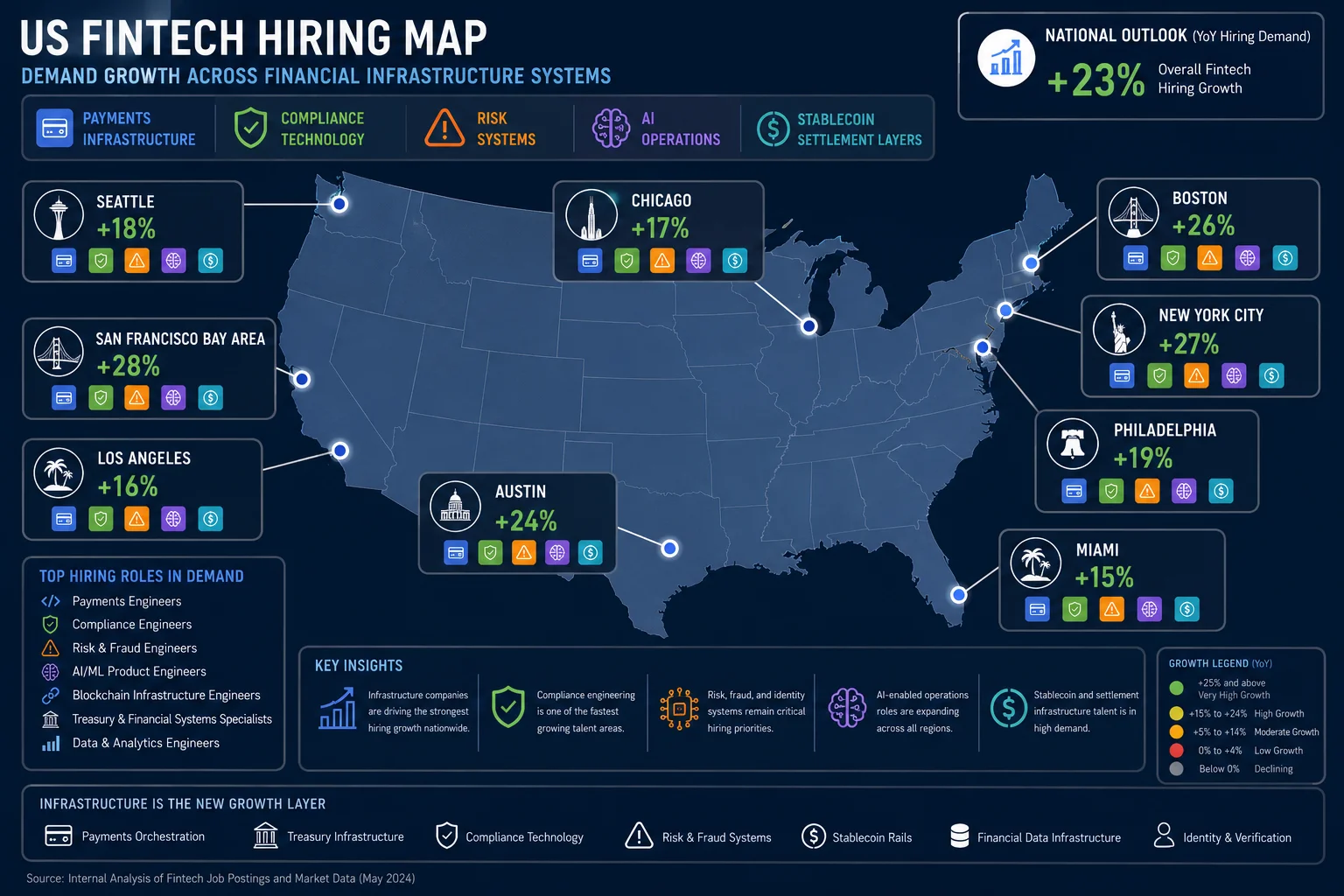
Payments architecture, treasury systems, compliance platforms, identity verification, fraud prevention, stablecoin settlement rails, and financial data infrastructure have become the primary areas attracting both investment and talent.
This shift is changing what companies hire for, how engineering teams are structured, and which candidates command the highest compensation.
The most valuable fintech professionals are no longer simply product builders. Increasingly, they are engineers and operators capable of maintaining reliability, compliance, and scalability across increasingly complex financial systems.
This reflects a broader structural shift across the US financial technology ecosystem.
Financial Infrastructure Has Become The New Growth Layer
The strongest hiring demand is emerging from businesses that provide infrastructure rather than consumer-facing applications.
Investors remain selective, but infrastructure businesses continue attracting capital because they solve foundational problems.
Areas receiving significant attention include:
- Payments orchestration
- Treasury infrastructure
- Banking-as-a-Service platforms
- Compliance technology
- Fraud detection systems
- Stablecoin payment rails
- Financial data infrastructure
- Identity and verification systems
These businesses operate closer to the financial system itself.
As a result, hiring priorities increasingly focus on reliability, scalability, security, and regulatory compliance.
Engineers who understand transaction processing, ledger architecture, settlement systems, and payment routing are becoming significantly more valuable than generalist software developers.
Compliance Is Becoming An Engineering Discipline
One of the most important developments in US fintech hiring is the convergence between compliance and engineering.
Historically, compliance teams operated separately from product and engineering functions.
That separation is disappearing.
Modern fintech companies increasingly embed compliance directly into system architecture.
Engineering teams now build:
- Transaction monitoring systems
- AML automation tools
- Risk scoring engines
- Identity verification workflows
- Regulatory reporting infrastructure
As regulatory scrutiny increases, compliance becomes a technical problem rather than an operational afterthought.
This has created demand for engineers capable of operating at the intersection of software development, risk management, and regulatory frameworks.
The pattern suggests that compliance-heavy infrastructure roles will continue expanding throughout 2026 and beyond.
Stablecoin Infrastructure Is Creating New Hiring Categories
Stablecoins have moved beyond crypto-native applications.
Financial institutions, payment providers, and infrastructure companies increasingly view stablecoins as settlement technology.
This transition is generating new hiring demand across multiple functions.
Companies building stablecoin infrastructure require:
- Payments engineers
- Treasury specialists
- Blockchain infrastructure engineers
- Risk professionals
- Regulatory experts
- Product managers with financial systems experience
The challenge is that candidates with expertise across both traditional financial infrastructure and blockchain systems remain scarce.
As a result, compensation premiums continue to emerge for professionals capable of bridging these environments.
The hiring market increasingly rewards skill adjacency rather than narrow specialization.
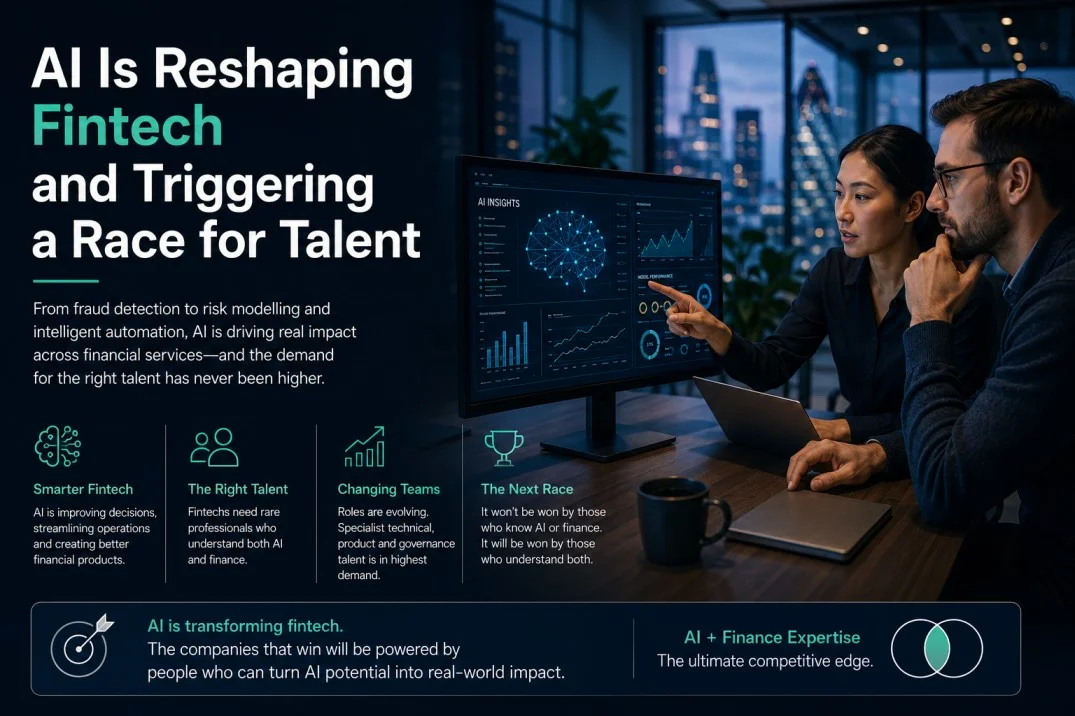
AI Is Restructuring Fintech Operations Teams
Artificial intelligence is influencing hiring, but not in the way many predicted.
Most fintech firms are not replacing employees with AI.
Instead, they are rebuilding operational systems around AI-enabled workflows.
Areas seeing meaningful adoption include:
- Fraud detection
- Customer support automation
- Risk assessment
- Compliance reviews
- Financial analysis
- Internal operations
This creates demand for a different category of talent.
Rather than hiring standalone AI researchers, fintech firms increasingly seek product engineers and infrastructure engineers capable of integrating AI into existing financial systems.
The hiring signal is clear.
Execution-focused AI implementation skills are attracting stronger demand than experimental model development expertise.
The Most Competitive Roles In US Fintech
Several role categories continue to experience significant hiring density.
Payments Infrastructure Engineers
Payment volumes continue growing while reliability expectations remain extremely high.
Companies require engineers capable of designing resilient payment systems, routing infrastructure, and settlement mechanisms.
Salary Range:
$170,000–$300,000+
Risk Engineering Specialists
Risk systems increasingly influence both regulatory outcomes and business performance.
Demand remains particularly strong among payments firms, lending platforms, and digital asset infrastructure providers.
Salary Range:
$160,000–$280,000+
Compliance Technology Leaders
Organizations require leaders capable of translating regulatory requirements into scalable technical systems.
Salary Range:
$180,000–$350,000+
AI Product Engineers
These professionals sit between engineering, data, and product functions.
Their role focuses on deploying practical AI solutions within financial workflows.
Salary Range:
$180,000–$320,000+
Why Hiring Has Become More Difficult
The challenge is not overall talent availability.
The challenge is talent allocation.
Many experienced fintech professionals remain employed and are highly selective about new opportunities.
Candidates increasingly evaluate:
- Regulatory stability
- Profitability
- Product maturity
- Leadership quality
- Technical architecture
- Long-term viability
The result is a market where attracting talent often requires stronger positioning rather than simply higher compensation.
Companies that communicate clear infrastructure strategies consistently outperform competitors in recruitment processes.
What This Means For Founders
Founders planning hiring initiatives during 2026 should recognize that the market has evolved.
Generalist hiring strategies are becoming less effective.
Successful organizations increasingly define hiring needs according to infrastructure layers.
Questions worth asking include:
- Which system constraints create operational bottlenecks?
- Which engineering functions directly impact reliability?
- Which compliance requirements could become scaling limitations?
- Which infrastructure capabilities are difficult to replace?
The answers often reveal where hiring investment should be concentrated.
The Role Of Specialist Recruitment Partners
As hiring requirements become more specialized, many fintech firms struggle to access qualified talent networks.
Traditional recruitment approaches often focus on job titles rather than system expertise.
The strongest candidates frequently possess transferable experience across payments, banking infrastructure, compliance technology, and digital assets.
Identifying these profiles requires market-specific expertise.
Specialist fintech recruiters can help organizations access talent pools that rarely appear on public job boards while reducing time-to-hire for critical infrastructure roles.
Conclusion
US fintech hiring is no longer driven primarily by growth-at-all-costs expansion.
The market is consolidating around financial infrastructure systems.
Payments, compliance, risk management, treasury technology, stablecoin settlement, and AI-enabled operational systems are becoming the primary drivers of talent demand.
Organizations that understand these structural shifts will be better positioned to attract, retain, and deploy the talent required to compete in an increasingly infrastructure-focused fintech environment.
For companies building the next generation of financial systems, hiring strategy is increasingly becoming infrastructure strategy.
FAQs
Which fintech roles are most in demand in 2026?
Payments engineers, compliance technology leaders, risk engineers, AI product engineers, and financial infrastructure specialists.
Are fintech salaries still increasing?
For infrastructure-focused roles, compensation remains highly competitive due to persistent skill shortages.
How is AI affecting fintech hiring?
AI is driving demand for implementation-focused engineers rather than purely research-oriented talent.
Why are stablecoins influencing fintech recruitment?
Stablecoin adoption is creating new infrastructure requirements across payments, treasury, compliance, and settlement systems.