
Blockchain hiring in the UAE is shifting toward compliance and institutional infrastructure
20 May, 202615 mins
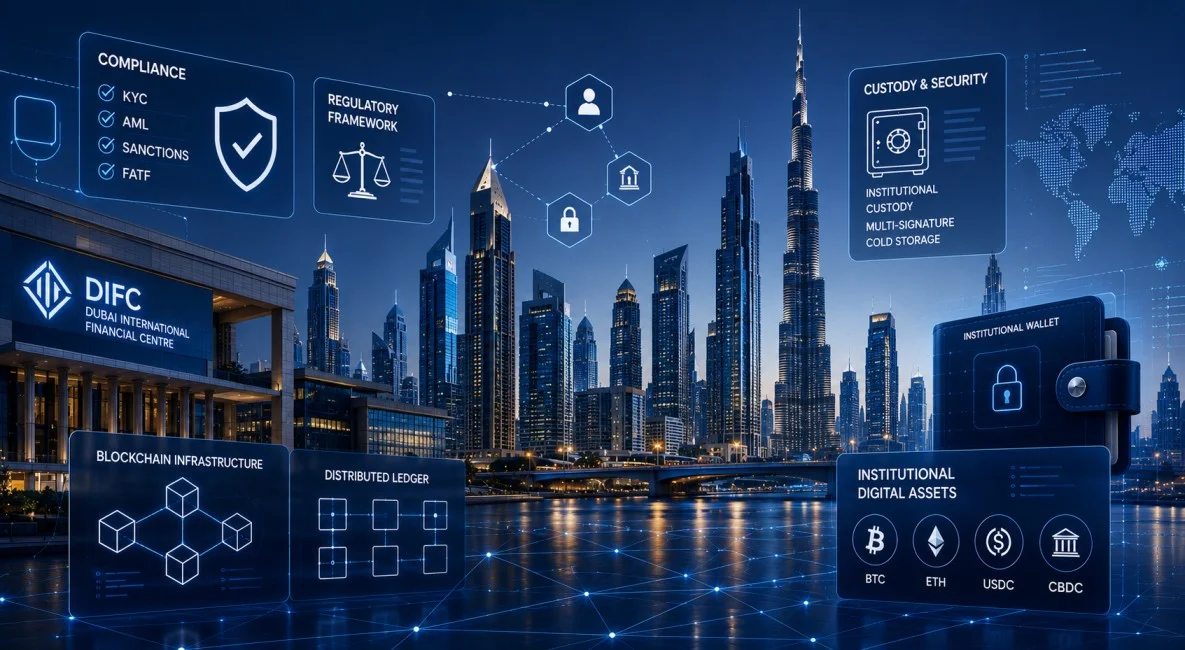
The UAE’s blockchain hiring market is becoming increasingly institutional.
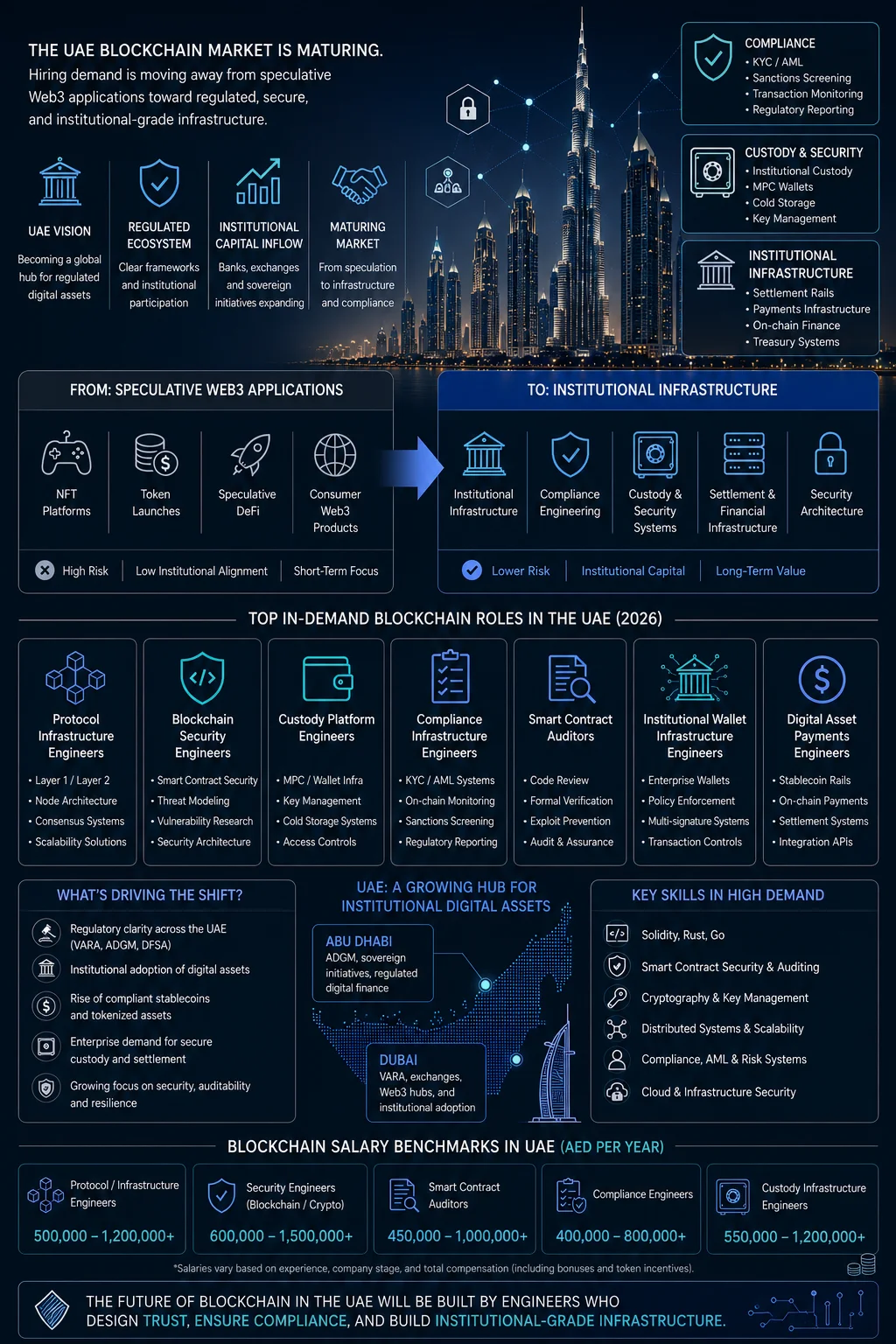
Across Dubai and Abu Dhabi, blockchain recruitment demand is moving away from speculative application-layer development and toward regulated financial infrastructure, custody systems, settlement architecture, and compliance-heavy engineering environments.
This reflects a broader structural transition across global digital asset markets.
In previous cycles, blockchain hiring was heavily concentrated around:
- NFT platforms
- token launches
- speculative DeFi applications
- consumer Web3 products
That environment has changed substantially.
In 2026, the strongest hiring demand across the UAE is increasingly tied to institutional infrastructure.
The market is reorganising around reliability, custody, regulatory architecture, and execution correctness.
Institutional finance is reshaping blockchain engineering demand
Dubai’s digital asset ecosystem is maturing rapidly.
Large financial institutions, sovereign-backed initiatives, regulated exchanges, and infrastructure providers are increasingly entering the market.
This creates very different engineering requirements compared to earlier crypto cycles.
Institutional environments prioritise:
- transaction reliability
- custody security
- compliance systems
- settlement finality
- infrastructure resilience
- auditability
As a result, blockchain engineering roles are becoming increasingly infrastructure-centric.
The highest-demand engineers are now those capable of operating inside regulated financial systems rather than purely speculative crypto environments.
This is creating stronger demand for:
- protocol infrastructure engineers
- blockchain security engineers
- custody platform engineers
- compliance infrastructure specialists
- smart contract auditors
- institutional wallet infrastructure engineers
- digital asset payments engineers
The UAE is positioning itself as a regulated digital asset hub, and hiring behaviour increasingly reflects that ambition.
Dubai’s blockchain market is converging with fintech infrastructure
One of the clearest hiring patterns in the UAE is the convergence between blockchain systems and traditional financial infrastructure.
This is particularly visible across:
- payments infrastructure
- stablecoin systems
- settlement rails
- custody architecture
- compliance tooling
- treasury systems
Many blockchain companies in Dubai now operate under constraints traditionally associated with fintech engineering.
These include:
- regulatory oversight
- transaction traceability
- AML infrastructure
- operational resilience
- security auditing
- reconciliation systems
As these constraints intensify, blockchain hiring increasingly overlaps with fintech hiring.
The strongest engineers often possess hybrid backgrounds spanning:
- distributed systems
- financial infrastructure
- cryptographic systems
- backend architecture
- compliance-heavy environments
This convergence is redefining what blockchain engineering expertise actually means.
Smart contract hiring is becoming more security-focused
The UAE market continues to hire Solidity engineers aggressively, but evaluation standards are changing.
In previous years, many companies prioritised shipping velocity and protocol expansion.
Today, security assurance is becoming the dominant hiring filter.
This is particularly important as institutional capital enters blockchain infrastructure markets.
Hiring managers increasingly prioritise engineers with experience in:
- smart contract auditing
- exploit prevention
- execution correctness
- protocol validation
- formal verification
- access control systems
- upgradeability security patterns
This shift reflects the financialisation of blockchain infrastructure.
As larger pools of institutional capital move on-chain, engineering tolerance for execution failure decreases significantly.
UAE blockchain salaries continue rising for infrastructure specialists
Compensation for senior blockchain infrastructure engineers in Dubai remains highly competitive.
In 2026, senior protocol and infrastructure engineers commonly command compensation packages ranging between AED 500,000 and AED 1.2 million annually depending on protocol complexity, security ownership, and infrastructure scope.
Highly specialised security engineers and cryptographic infrastructure specialists can exceed these levels.
However, compensation inflation is uneven across the market.
Application-layer Web3 roles have experienced slower growth due to reduced speculative hiring activity.
Infrastructure-heavy roles continue attracting the strongest compensation premiums.
This reflects broader market consolidation around execution-critical systems.
Crypto hiring cycles are becoming less speculative
Another important shift across the UAE market is the stabilisation of hiring behaviour.
Earlier crypto cycles were heavily liquidity-driven.
Hiring expanded rapidly during bull markets and contracted sharply during volatility periods.
The market is gradually becoming more infrastructure-oriented.
Institutional infrastructure companies typically operate with:
- longer planning horizons
- stronger balance sheets
- regulatory obligations
- operational continuity requirements
This creates more stable hiring patterns.
While volatility still affects compensation and hiring velocity, infrastructure-focused organisations are less exposed to speculative cycle compression.
This makes Dubai increasingly attractive for long-term blockchain engineering careers.
Why many companies struggle to hire strong blockchain engineers
Despite strong market growth, hiring execution remains difficult across the UAE.
Several issues appear repeatedly.
Generic Web3 hiring frameworks
Many companies still recruit blockchain engineers using outdated startup-era hiring assumptions.
Role definitions frequently lack clarity around:
- protocol ownership
- infrastructure responsibilities
- security expectations
- operational constraints
This weakens candidate alignment.
Overemphasis on token experience
Some hiring teams still prioritise speculative token ecosystem experience over infrastructure capability.
However, many of the strongest blockchain engineers come from adjacent systems markets including:
- distributed backend infrastructure
- cybersecurity
- cloud systems
- fintech engineering
- cryptographic systems
Restricting hiring exclusively to traditional Web3 backgrounds often reduces talent quality.
Weak technical evaluation systems
Technical interviews frequently fail to evaluate production-level infrastructure competence.
Strong blockchain engineers are typically assessed through:
- architecture analysis
- security reasoning
- distributed systems understanding
- execution reliability
- protocol design logic
Tool familiarity alone is rarely sufficient.
How UAE companies are finding stronger blockchain candidates
The strongest hiring teams in Dubai increasingly use infrastructure-focused recruitment strategies.
This includes:
- targeting engineers from adjacent distributed systems markets
- recruiting globally
- evaluating security ownership heavily
- prioritising protocol reliability experience
- using specialised technical recruiters with blockchain infrastructure expertise
Many of the best candidates are passive and globally mobile.
Competition for senior infrastructure engineers remains intense across:
- Singapore
- London
- Dubai
- Zurich
- New York
This means hiring precision matters more than hiring volume.
Blockchain hiring in Dubai is becoming infrastructure-first
The broader signal across the UAE is increasingly clear.
Blockchain hiring is becoming less speculative and more operational.
Demand is consolidating around:
- custody systems
- payments infrastructure
- compliance architecture
- institutional settlement rails
- security engineering
- validation infrastructure
This changes how blockchain teams should be structured.
The market increasingly rewards engineers capable of operating under financial infrastructure constraints rather than purely speculative product environments.
That distinction is becoming one of the defining characteristics of UAE blockchain hiring in 2026.
Final thoughts
Dubai’s blockchain market is entering a more mature infrastructure phase.
The strongest hiring demand is increasingly tied to institutional reliability, compliance-heavy engineering, and execution-critical systems.
This is reshaping both compensation dynamics and technical hiring standards across the UAE.
Companies that continue hiring based on speculative Web3-era assumptions may struggle to attract infrastructure-grade engineering talent.
The organisations that adapt toward institutional infrastructure thinking will likely build more resilient blockchain teams over the next cycle.
Frequently Asked Questions
Q:What blockchain roles are most in demand in Dubai?
Protocol engineers, blockchain security engineers, custody infrastructure specialists, smart contract auditors, and compliance-focused blockchain engineers are currently in highest demand.
Q: Are blockchain salaries high in the UAE?
Yes. Senior blockchain infrastructure engineers can command compensation exceeding AED 1 million annually depending on security expertise and infrastructure ownership.
Q: Why is blockchain hiring becoming compliance-focused?
As institutional finance enters digital asset markets, blockchain systems increasingly operate under regulatory and operational constraints similar to fintech infrastructure.
Q: Is Dubai a strong market for blockchain engineers?
Yes. Dubai continues positioning itself as a global digital asset hub with strong demand for institutional-grade blockchain infrastructure talent.
Q: What skills matter most in blockchain hiring now?
Distributed systems engineering, smart contract security, cryptographic infrastructure, compliance systems, custody architecture, and protocol reliability are increasingly prioritised.