What New York FinTechs Pay Payments Engineers in 2026: A Salary Benchmarking Guide
10 Sept, 202618 mins

New York remains the largest fintech hiring hub in the US, and payments engineering is one of the tightest markets within it. Real-time payments infrastructure, embedded finance, and stablecoin settlement products are all being built out simultaneously, and companies are competing for the same small pool of engineers who understand both software architecture and financial rails. If you're setting a budget for a payments or compliance engineering hire in New York this year, using outdated salary assumptions will cost you candidates. This guide sets out current pay ranges, in-demand skills, and what's driving the competition for talent.
Key Takeaways
Fintech software engineers in New York average around $162,630 a year, with senior hires reaching $225,000+.
Compliance and AML-focused roles are now commanding pay that increasingly rivals core engineering, as regulators tighten oversight of stablecoins and banking-as-a-service.
Stablecoin infrastructure hiring has accelerated since the Genius Act established a federal framework for payment stablecoins in mid-2025.
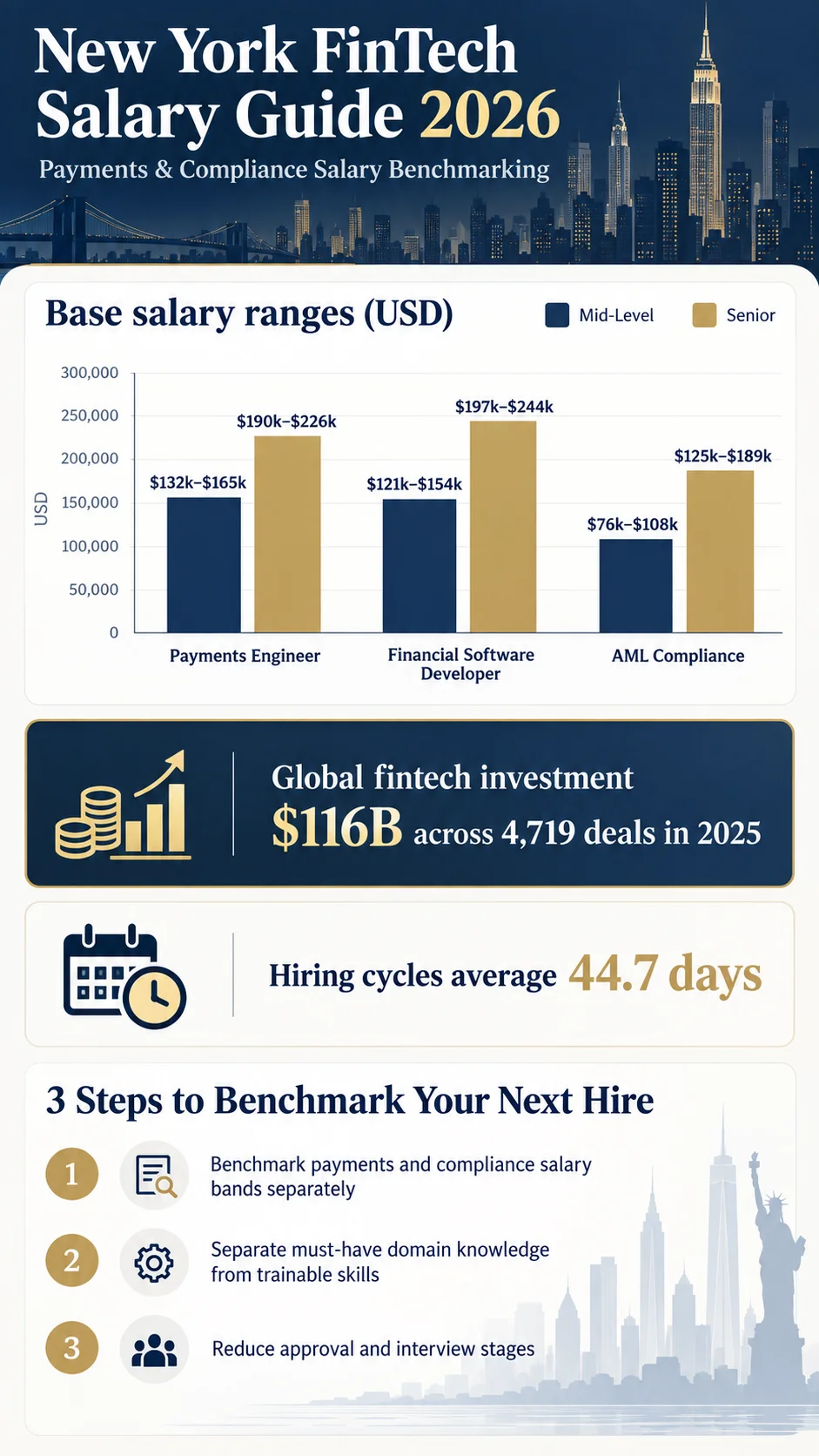
- Global fintech investment reached $116 billion across 4,719 deals in 2025, with digital assets investment nearly doubling to $19.1 billion.
- Average fintech hiring cycles run around 44.7 days, meaning slow processes lose candidates to faster-moving competitors.
Industry and Hiring Overview
New York's advantage in fintech hiring is structural: it sits next to Wall Street, global banks, and the largest concentration of financial talent in the US. That draws B2B fintech companies that need compliance credibility and enterprise relationships, alongside the payments infrastructure providers building the plumbing behind embedded finance.
Three forces are shaping hiring in 2026. First, embedded finance means non-financial companies are adding payments, lending, and card products, and need infrastructure partners with engineering depth. Second, AI is becoming a default layer across fraud prevention and transaction monitoring — 84% of fintech talent leaders plan to expand AI use this year. Third, regulatory frameworks for stablecoins and banking-as-a-service have matured, pushing large banks and fintechs to build stablecoin settlement and custody products, and pulling compliance talent into direct competition with engineering for budget and priority.
In-Demand Roles and Skills
Role | Why It Is in Demand | Important Skills | Typical Experience |
Payments/Backend Engineer | Real-time payments rails and embedded finance products require constant infrastructure build-out | Distributed systems, API design, ledger/settlement logic | 4–8 years |
Stablecoin/Blockchain Infrastructure Engineer | Genius Act clarity has brought banks and fintechs off the sidelines on stablecoin products | Solidity/smart contracts, custody architecture, settlement rails | 3–7 years |
AML/Compliance Engineer | Regulators (SEC, OCC, CFPB) tightened oversight of BaaS, stablecoins, and AI-assisted decisioning through 2025 | Transaction monitoring, BSA/AML frameworks, regulatory reporting tooling | 3–8 years |
Financial Software Developer | General demand for engineers who combine finance domain knowledge with software delivery | Trading/settlement systems, risk modelling, secure coding |
|
Salary Guide
Location: New York, NY. Currency: USD. Basis: Annual base salary. Figures do not include bonus, equity, or benefits unless noted. Source date: 2026.
Role | Mid-Level Base Salary | Senior Base Salary |
Payments/Fintech Software Engineer | $132,000–$165,000 | $190,000–$226,000 |
Financial Software Developer | $121,000–$154,000 | $197,000–$244,000 |
AML/Compliance Analyst–Engineer | $76,000–$108,000 | $125,000–$189,000 |
Blockchain engineers with stablecoin or custody experience can command $200,000+ in a competitive process, according to fintech recruitment data from Pin.com. Compliance pay is climbing fastest of any category as regulatory scrutiny increases — candidates with both AML expertise and digital-asset transaction monitoring experience are seeing the strongest leverage. Total compensation for senior hires often includes equity, which isn't reflected in the base figures above.
Main Hiring Challenges
- Hybrid skill scarcity. Very few candidates combine software engineering fluency with an understanding of payments rails, settlement logic, or regulatory frameworks — generalist engineers often "freeze" when interviews move into domain-specific territory.
- Compliance has become a competitive hire. Companies are now bidding for compliance leaders the way they once competed for senior engineers, which changes budget assumptions for HR teams used to treating compliance as a lower-cost function.
- Slow internal approval processes. With average hiring cycles already around 44.7 days, multi-stage internal sign-offs push good candidates toward competitors.
- Talent pipeline gaps. Few academic programmes combine technical training with financial-domain knowledge, so much of the senior talent pool moves between the same handful of established fintechs and banks.
- Wide title variance. "Fintech Engineer" postings span a huge pay range (from roughly $70,000 to $226,000 by percentile), making it hard for candidates to judge whether a role matches their expectations without clear scope.
Practical Hiring Advice
- Write job descriptions that separate financial-domain knowledge from trainable technical skills. Many strong engineers can learn payments-specific concepts if the core engineering ability is there.
- Benchmark compliance roles against current market data, not last year's budget. Compliance pay has moved up sharply as regulatory scope has widened.
- Use contractors for short-term regulatory projects. If you need to build a stablecoin compliance capability quickly but aren't ready for a permanent headcount commitment, contract hiring can bridge the gap.
- Look beyond traditional fintech backgrounds. Candidates from banks, payments processors, or even gaming/e-commerce backends often have transferable distributed-systems and fraud-prevention experience.
- Move faster through your process. With hiring cycles already averaging 44.7 days industry-wide, cutting even one interview stage can be the difference in landing a candidate with competing offers.
What Employers Should Do Next
Benchmark payments and compliance salary bands separately — they've diverged in the past 12 months.
Separate "must-have" domain experience from skills that can be trained on the job.
Reduce approval and interview stages for senior payments and compliance hires.
Consider contract or fractional compliance support for stablecoin and BaaS regulatory projects.
Explain to candidates how the role connects to licensing, product delivery, or revenue — payments and compliance hires respond well to seeing direct business impact.
How Axiom Can Help
Axiom works with New York fintechs on permanent and contract hiring for payments engineering, compliance, and stablecoin infrastructure roles. We support salary benchmarking against current market data, confidential executive searches for compliance leadership, and talent mapping for companies scaling into new payments products. Whether you're hiring your first payments engineer or building a dedicated stablecoin compliance function, we can help you define the role and reach candidates who aren't actively browsing job boards.
Conclusion
Payments and compliance hiring in New York has become more competitive and more specialised, with compliance pay now rivalling core engineering as regulatory scrutiny of stablecoins and embedded finance increases. Employers who benchmark accurately, write precise job scopes, and move quickly through their process are best positioned to secure talent in this market. If you're planning a payments or compliance hire this year, get your salary bands aligned with 2026 data before you start interviewing.
Salary Figures Used
See Salary Guide table above. Sources: ZipRecruiter (July 2026), Glassdoor (2026), Salary.com and PayScale (2026) — see table below.
Research Sources
Organisation | Report/Article | Date | Claim Supported | URL |
ZipRecruiter | Salary: Fintech Software Engineer in New York, NY | July 2026 | Average and percentile pay for fintech software engineers | https://www.ziprecruiter.com/Salaries/Fintech-Software-Engineer-Salary-in-New-York,NY |
Glassdoor | Salary: Financial Software Developer in New York City, NY | 2026 | Financial software developer pay range | |
ZipRecruiter | Salary: Aml Compliance in New York | July 2026 | AML compliance salary range and percentiles | https://www.ziprecruiter.com/Salaries/Aml-Compliance-Salary--in-New-York |
Salary.com | AML Compliance Analyst Salary in New York, NY | July 2026 | AML analyst-to-manager pay tiers | https://www.salary.com/research/salary/recruiting/aml-compliance-analyst-salary/new-york-ny |
Pin (fintech recruiting) | Recruiting Fintech Talent: Where to Find and How to Win (2026) | April 2026 | $123K mid-level average, 44.7-day hiring cycle, blockchain engineer pay, digital assets investment growth | |
Storm2 | FinTech Salary Guide USA 2026 | November 2025 | Compliance pay rivalling engineering; NY/Chicago/SF as top hubs; AI adoption trend | https://storm2.com/resources/fintech-salary-guides/fintech-salary-guide/ |
TechBullion | FinTech Industry Trends Explained: What It Means for Consumers and Businesses in the USA | 2026 | Genius Act stablecoin framework; McKinsey fintech revenue figures |
Note: salary figures are aggregated from multiple third-party salary-data providers using different methodologies (crowdsourced listings vs. job postings), so ranges should be treated as directional market bands rather than a single precise figure.
FAQs
Q: What does a mid-level payments engineer earn in New York in 2026?
A: Mid-level fintech/payments software engineers in New York typically earn between $132,000 and $165,000 in base salary, based on 2026 market data.
Q: Why is compliance hiring pay increasing so fast in fintech?
A: Regulators including the SEC, OCC, and CFPB have tightened oversight of banking-as-a-service, stablecoins, and AI-assisted decisioning, pushing compliance pay closer to core engineering levels.
Q: How long does it typically take to hire a payments engineer in New York?
A: Fintech hiring cycles average around 44.7 days industry-wide; roles requiring niche payments or stablecoin expertise can take longer without a clearly scoped job description.
Q: Should we hire a contractor or a permanent employee for stablecoin compliance work?
A: If the need is tied to a specific regulatory project or product launch, a contractor can bridge the gap; ongoing compliance obligations usually justify a permanent hire.
Q: Do payments engineers need blockchain experience?
A: Not always — traditional payments rails and stablecoin infrastructure require different (though overlapping) skill sets. Be specific about which one your role needs.
Related Posts


The Infrastructure Layer Is Becoming the Product
03 Jul, 2026