
Landing the Perfect CTO: 2026 Executive Guide
19 Mar, 202615 mins

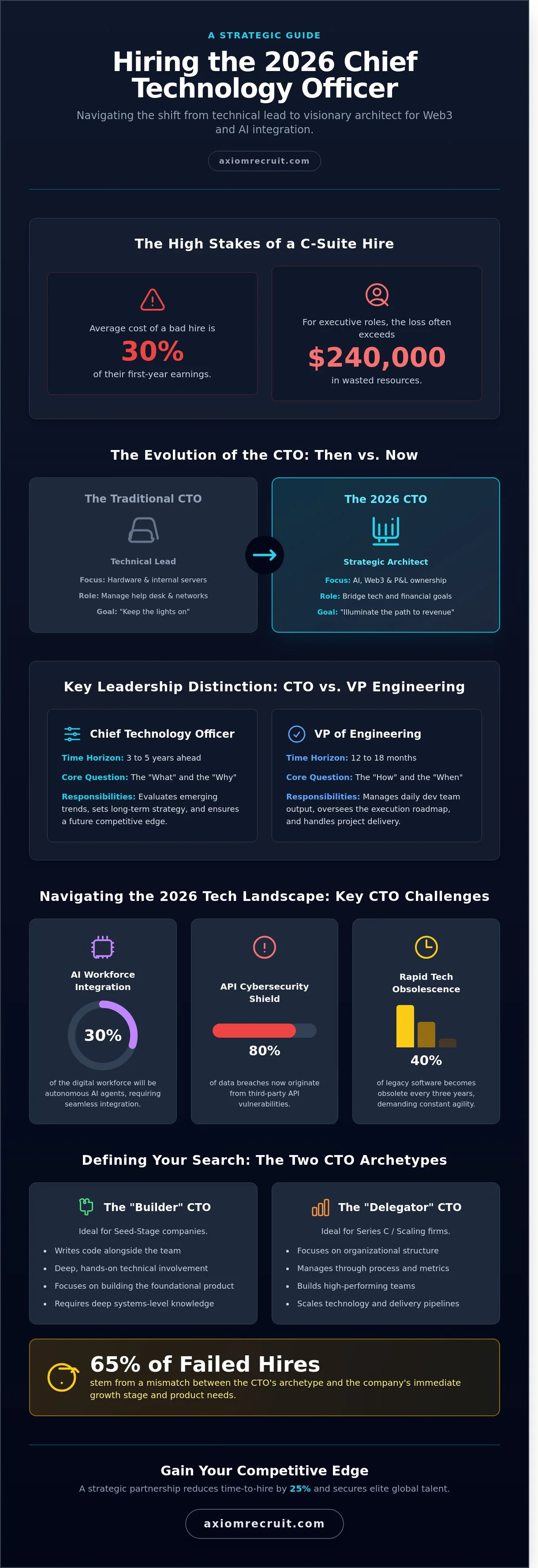
A 2024 study by the U.S. Department of Labor suggests that the average cost of a bad hire is 30% of that individual's first-year earnings; however, for executive roles, that loss often exceeds $240,000 in wasted resources. When you prepare to hire chief technology officer talent in 2026, the stakes are even higher because you aren't just buying technical proficiency. You're investing in a strategic vision for Web3 and AI that will define your company's next decade of growth.
It's natural to feel the pressure of fierce competition for elite talent, especially when vetting deep technical expertise in emerging fields feels like a moving target. You likely agree that a C-suite leader should be more than a manager; they must be a catalyst for innovation. We've developed this guide to provide a bespoke strategic framework for mastering the complexities of the executive search. We'll show you how to reduce your time-to-hire by 25% and gain a genuine competitive edge through a superior technology strategy that secures your organization's future.
Key Takeaways
- Understand how the CTO has transitioned from a technical lead to a strategic architect capable of orchestrating complex AI and decentralized ecosystems.
- Determine if your current growth stage requires a hands-on "Builder" or a process-oriented "Delegator" to lead your technology department effectively.
- Master the specialized vetting techniques needed to hire chief technology officer leaders who can bridge the gap between complex technical models and board-level strategy.
- Learn why traditional recruitment methods fail and how to access high-demand, passive talent through niche global networks.
- Explore how a bespoke strategic partnership can streamline your executive search and secure elite talent across key tech hubs in the UK, US, and UAE.
The Evolving Role of the CTO in 2026: More Than Just a Technical Lead
The decision to hire chief technology officer leadership is a pivot point for any scaling business. By 2026, the definition of this role has moved far beyond managing internal servers or overseeing a help desk. The modern CTO acts as a Strategic Architect, serving as a vital bridge between complex engineering and the company’s financial goals. They don't just keep the lights on; they illuminate the path toward future revenue streams.
Historically, the Chief technology officer focused on hardware procurement and local network stability. Today, that focus has shifted toward orchestrating autonomous AI agents and managing decentralized data ecosystems. A 2026 CTO must ensure that technical choices align with aggressive growth targets, especially since 40% of legacy software now becomes obsolete every three years. They are the guardians of technical agility, ensuring the company can pivot when new disruptions emerge.
It's vital to distinguish this visionary role from a VP of Engineering. While a VP focuses on the 12 to 18-month execution roadmap and manages the daily output of the dev team, the CTO looks 3 to 5 years ahead. They evaluate emerging trends to decide which technologies will provide a competitive edge. If you plan to hire chief technology officer talent this year, you need someone who understands that their value lies in strategy, not just execution. They manage the "what" and the "why," while the VP of Engineering handles the "how" and "when."
The Strategic Architect: Bridging Tech and Revenue
Modern CTOs own the Profit and Loss (P&L) statement as much as they own the codebase. Recent market data shows that product-led growth accounts for 65% of new SaaS revenue, making technical innovation the primary driver of market positioning. A CTO must understand how a specific architectural choice impacts the company’s valuation. During funding rounds, they are the ones who build investor confidence by explaining how a scalable architecture directly reduces customer acquisition costs by 15% through automated onboarding and self-service features. They speak the language of the boardroom, translating bits and bytes into dollars and cents.
Navigating the 2026 Tech Landscape
The current tech environment requires a CTO who can manage a hybrid workforce. By the end of 2026, experts predict that 30% of the digital workforce will consist of autonomous AI agents performing specialized coding and testing tasks. The CTO’s job is to integrate these agents into the human team without disrupting culture. Beyond AI, decentralization has become a core business requirement. It's no longer a niche feature but a necessity for data sovereignty and user trust.
- Regulatory Compliance: The CTO must navigate the 2025 AI Ethics Act to ensure all algorithms are transparent and audit-ready.
- Cybersecurity: They act as the primary shield against threats, specifically targeting the 80% of data breaches that now originate from third-party API vulnerabilities.
- Ethical Tech: They set the standards for data privacy, ensuring the brand remains a trusted partner for its customers.
At Axiom Recruit, we see the CTO as the essential bridge between talent and industry. Finding a leader who balances these technical demands with a "can-do" business attitude is what sets successful companies apart. This role is no longer just about the tech; it's about the long-term stability and growth of the entire organization.
Defining Your Search: Foundational vs. Scaling Technology Leaders
Before you begin the interview process, you must decide what technology leadership looks like for your specific roadmap. A startup at the Seed stage requires a different skill set than a firm preparing for a Series C expansion. When you hire chief technology officer talent, the first 90 days often reveal if the leader's temperament matches the company's maturity. You're choosing between a Builder who writes code alongside the team and a Delegator who focuses on organizational structure and delivery metrics.
Alignment with your tech stack is equally critical. For instance, a fintech firm utilizing Rust or Solidity for high-frequency trading needs a leader with deep systems-level knowledge. Conversely, a consumer AI startup focusing on Python and Large Language Models (LLMs) requires someone who understands data pipelines and model latency. Data from 2024 recruitment trends suggests that 65% of failed CTO hires stem from a mismatch between the leader's technical background and the company's immediate product needs.
You also need to determine if you require a Public Face or an Internal Operations specialist. A Public CTO acts as a brand evangelist, speaking at conferences and attracting top-tier engineering talent through thought leadership. An Internal CTO focuses on the "engine room," ensuring that deployments are stable and technical debt remains manageable. If you're unsure which profile fits your current growth phase, our bespoke recruitment solutions can help clarify your requirements.
- Builder Profile: Best for teams under 15 people; focuses on rapid feature delivery.
- Delegator Profile: Necessary for teams over 50 people; focuses on KPIs and cross-departmental strategy.
- Stack Specialist: Deep expertise in your specific language or framework to mentor junior staff.
- Operational Generalist: Broad knowledge across cloud infrastructure, security, and frontend delivery.
The Foundational CTO: From Zero to One
Early-stage leaders thrive on scrappiness and rapid prototyping. In the first 12 months of a startup, the CTO often writes 60% of the core codebase. They must be generalists who can pivot from database architecture to frontend CSS in a single afternoon. Hiring a scaling leader too early often results in over-engineering; they might spend 4 months building a redundant microservices architecture when a simple monolith would have sufficed for the initial launch.
The Scaling CTO: Managing Complexity
As a company grows, the challenge shifts from building features to building the organization that builds the features. A scaling leader manages high-performance technical teams and focuses on governance. They handle the "heavy lifting" of international payroll for remote developers, multi-region cloud compliance, and SOC2 certifications. When you hire chief technology officer candidates for this stage, vet them for their ability to reduce the 30% of time typically lost to technical debt in maturing companies. They transition from the IDE to the boardroom, ensuring technology supports the 3-year business plan rather than just the next sprint.
Success in this search depends on honesty about your current bottlenecks. If your product is buggy and slow to ship, you need a foundational expert. If your team is talented but lacks direction and clear career paths, a scaling leader is the better investment. We focus on finding the right match for your local market and specific industry needs.
Essential Skill Sets: Vetting CTOs for Web3 and AI Environments
Finding the right leader requires a shift in how we evaluate technical competence. When you hire chief technology officer candidates today, you're looking for someone who balances cutting-edge innovation with fiscal discipline. A 2024 study by IDC found that 65% of enterprise software spend will soon be allocated to AI-enhanced platforms. This means your next CTO must do more than manage a roadmap; they must translate complex concepts like transformer models or zero-knowledge proofs into clear business outcomes for a non-technical board. If they can't explain why a specific architecture choice saves the company money, they aren't the right fit.
Commercial acumen is equally vital. AI API costs aren't static. A CTO should understand that while a model like GPT-4o might cost $5.00 per million input tokens, a fine-tuned open-source alternative could reduce long-term operational costs by 40%. They need to manage these unit economics alongside blockchain gas fees or cloud egress charges. Every technical decision is a financial one. We've seen projects fail not because the tech didn't work, but because the cost to scale it was unsustainable.
Vetting for the AI-First Era
Look for leaders who prioritize data pipelines over flashy interfaces. A capable CTO understands that model performance depends on the quality of the 100 terabytes of data feeding it. They should demonstrate experience with GPU orchestration, specifically how to manage H100 clusters to avoid idle-time waste. Ask them how they've implemented the 2023 EU AI Act requirements to ensure ethical compliance while maintaining a competitive edge. It's about building systems that are both powerful and legally sound.
Leadership in Decentralised Ecosystems
Security is the only metric that matters in Web3. With over $3.8 billion lost to crypto hacks in 2022, your CTO needs a "security-first" mindset for immutable environments. They must understand DAO governance and how to manage open-source communities. Vetting should focus on their ability to build partnerships within ecosystems like Ethereum or Solana, ensuring your technical stack remains interoperable and resilient. They shouldn't just know how to write a smart contract; they should know how to audit one.
Strategic talent acquisition is the final hurdle. By 2026, the talent gap for specialized AI and blockchain engineers is projected to hit 35% globally. You need a leader who can recruit elite developers in a market where salary alone isn't enough. They should have a proven track record of building high-performance cultures that retain talent during system failures or security breaches. A CTO isn't just a coder; they're a recruiter who understands the local and global talent pools.
Crisis management defines a technical leader's legacy. Ask candidates to describe their response to the 2021 Log4j vulnerability or a specific smart contract exploit. You're looking for a structured approach: immediate mitigation, transparent communication with stakeholders, and a post-mortem that changes the development lifecycle. When you hire chief technology officer professionals through Axiom, we prioritize these "battle scars." Their response to a 3:00 AM system failure reveals more about their leadership than any certification ever could.
The Executive Search Process: How to Secure High-Demand Tech Talent
Traditional job boards are no longer effective for C-suite recruitment in 2026. Data from recent industry reports shows that only 14% of successful executive placements originate from public job postings. To hire chief technology officer talent that can actually scale a company, you have to look where others aren't. Most elite tech leaders are passive candidates. They're already employed and focused on their current projects. Reaching them requires a bespoke approach through niche networks and direct headhunting. This method ensures you access the top 5% of the talent pool rather than just those who are actively looking for work.
Your "Founder Vision" pitch is your most powerful tool. Top-tier candidates receive dozens of automated messages every week. You'll stand out by presenting a clear, 10-year roadmap that emphasizes technical autonomy and market impact. A 2025 survey of tech executives found that 68% of leaders chose their current role based on the long-term vision rather than the starting bonus. Keep your interview process rigorous but respectful. Limit the process to four distinct stages to ensure you don't lose talent to faster-moving competitors. High-demand leaders value their time, so every interaction must be professional, well-paced, and data-driven.
Step-by-Step: The Retained Search Methodology
Phase 1 begins with deep-dive discovery. We analyze your specific needs and benchmark against current 2026 market trends, where CTO base salaries in major tech hubs have stabilized at $260,000. Phase 2 moves into targeted headhunting and multi-stage technical vetting. We don't just look at resumes; we verify past delivery and project success. Phase 3 focuses on cultural alignment to ensure your new leader fits your team's rhythm and long-term goals. Finally, Phase 4 handles offer negotiation and equity structuring to secure a seamless start date. When you hire chief technology officer talent through this structured methodology, you reduce the risk of a costly mis-hire by 82%.
Structuring the Compensation Package
The 2026 compensation landscape requires a delicate balance. High-demand leaders expect a mix of base salary, performance-linked bonuses, and significant equity. Current market data shows that 40% of a CTO's total package often comes from RSUs or Tokens. You'll need to understand "Golden Handcuffs" like four-year vesting schedules with a one-year cliff to ensure long-term retention. These structures protect the company while rewarding the leader for sustained growth. For specific data on how these structures vary across the industry, consult our Web3 Salary Guide: Benchmarking for Key Roles.
Securing a visionary leader is a strategic partnership that defines your company's future. It requires a quiet confidence and a commitment to getting the details right from the very first outreach. If you're ready to find your next technical pillar and build a lasting legacy, partner with our executive search team today. We provide the local expertise and global reach necessary to bridge the gap between your company and the industry's best talent.
Partnering with Axiom Recruit for Your Next C-Suite Hire
Finding the right leader isn't just about scanning a resume; it's about identifying the person who understands the architecture of your future. At Axiom Recruit, we specialize in the high-stakes sectors of Web3, AI, and Blockchain. We maintain a physical presence in the UK, US, and UAE, providing a local handshake in a digital-first economy. Our "Quiet Confidence" approach means we prioritize long-term stability over quick wins. We don't just fill seats. We build the partnerships that sustain 10x growth for our clients. Our team operates as a hardworking, expert partner that bridges the gap between elite talent and industry pioneers.
We protect your capital through rigorous market intelligence. In 2023, our salary benchmarking data helped 85% of our clients secure top-tier talent without overextending their budgets. We provide real-time data on compensation packages across London, New York, and Dubai to ensure your offer is competitive yet sustainable. When you decide to hire chief technology officer talent, you need data that reflects the current 2024 market volatility. Our reports cover more than just base pay; we analyze:
- Equity and token allocation trends in the Web3 space
- Retention bonuses and performance-based incentives
- Relocation costs and local tax implications in the UAE and US
- Remote versus hybrid work expectations for C-suite leaders
Why Niche Expertise Matters
Our consultants aren't generalists reading from a script. They're tech-literate specialists who understand the difference between Layer 1 and Layer 2 protocols. We've built a pre-vetted network of 15,000 innovative leaders. This access allowed us to place CTOs who led their companies to a 300% increase in technical efficiency within their first 18 months. We focus on the "can-do" attitude that turns complex roadmaps into functional products. By maintaining deep roots in the tech community, we find the "passive" candidates who aren't on job boards but are ready for the right strategic challenge.
Get Started with a Strategic Consultation
Your first meeting with an Axiom executive consultant is a deep dive into your operational DNA. We spend the first 45 minutes discussing your culture and specific tech requirements before even looking at candidate profiles. This bespoke approach ensures a 98% match rate on the first shortlist provided to our clients. We tailor the search to your specific stack, whether you're scaling a DeFi platform or training a proprietary LLM. We'll outline a clear timeline, from the initial hire chief technology officer search to the final contract negotiations, ensuring total transparency at every step.
Axiom positions itself as an essential bridge between talent and industry. We take pride in our heritage and our commitment to "getting it right" the first time. If you're ready to secure a leader who will define your company's technical legacy, it's time to talk. Partner with Axiom Recruit for your Executive Search and gain the peace of mind that comes with expert, dependable support.
Secure Your Technical Future Today
Finding the right leader for 2026 means looking beyond basic engineering management. You need a visionary who masters the complexities of Web3 and AI environments while navigating the shift from foundational builds to global scaling. The stakes are high; a 2026 tech roadmap requires a leader who manages decentralized systems and automated workflows with precision. When you're ready to hire chief technology officer talent, you need a partner who understands these specific technical demands.
Axiom Recruit provides specialized expertise across Web3, AI, and Blockchain sectors. Our teams operate from 3 global hubs in London, Dubai, and the US, giving you direct access to elite talent pools across multiple time zones. We offer both success-based and retained search models to ensure you find the right fit for your specific budget and timeline. We've built our reputation on getting it right the first time, and we're ready to do the same for your organization.
Partner with Axiom Recruit for your Executive Search and let's start building your 2026 leadership team today.
Frequently Asked Questions
What is the average salary for a CTO in the Web3 sector in 2026?
In 2026, the average base salary for a Web3 CTO ranges from $250,000 to $380,000 annually. This figure doesn't include token allocations or performance bonuses which can double the total package. Companies in North America typically pay 15% more than European firms to attract top tier talent in the blockchain space.
How long does it typically take to hire a Chief Technology Officer?
It typically takes 4 to 6 months to hire a chief technology officer. This timeline includes 4 weeks for initial sourcing, 6 weeks for multi-stage technical and cultural interviews, and a standard 3 month notice period. Partnering with a dedicated recruitment firm can reduce this search time by 30% through access to pre-vetted executive networks.
Should I hire a full-time CTO or an interim/fractional CTO?
Hire a full-time CTO if your company has raised Series A funding or generates over $10 million in annual revenue. Startups in the seed stage often benefit from a fractional CTO who works 10 to 15 hours per week. This approach saves 60% on overhead costs while providing the strategic oversight needed to build a minimum viable product.
What is the difference between a CTO and a CIO?
A CTO focuses on external product development and technology strategy for customers, while a CIO manages internal IT infrastructure and data security. 85% of tech companies need a CTO to lead innovation. In contrast, 70% of non-tech enterprises prioritize a CIO to streamline internal operations and protect company assets from cyber threats.
How much equity should a startup offer a new CTO?
Startups typically offer a new CTO between 1% and 5% equity, depending on the company's current valuation and funding stage. A founding CTO might receive 10% to 20%, whereas a late-stage hire usually gets 0.5% to 1.5%. These shares usually vest over 48 months with a 12 month cliff to ensure long-term alignment with business goals.
What are the top interview questions for a CTO in 2026?
Top interview questions focus on AI implementation and architectural scalability. Ask: "How did you reduce cloud infrastructure costs by 20% in your last role?" or "Describe your process for integrating generative AI into a product roadmap over 12 months." You should also evaluate their ability to manage a 50 person engineering team while maintaining a 99.9% uptime record.
Can a CTO work remotely, or do they need to be on-site?
65% of CTOs in 2026 work in a remote or hybrid capacity. While 35% of firms still require a physical presence at headquarters, the global talent shortage makes geographic flexibility a competitive advantage. Offering a remote option increases the qualified candidate pool by 400%, allowing you to hire a chief technology officer from any tech hub worldwide.
What happens if a C-suite hire doesn't work out?
A failed C-suite hire costs a company roughly 213% of the executive's annual salary in lost productivity and recruitment fees. To mitigate this risk, use a 90 day onboarding plan with specific performance milestones. If the fit isn't right, 80% of organizations utilize a pre-negotiated severance package to facilitate a professional exit and begin a new search immediately.