
How to Kickstart Your Crypto Career in 2026
24 Mar, 202615 mins

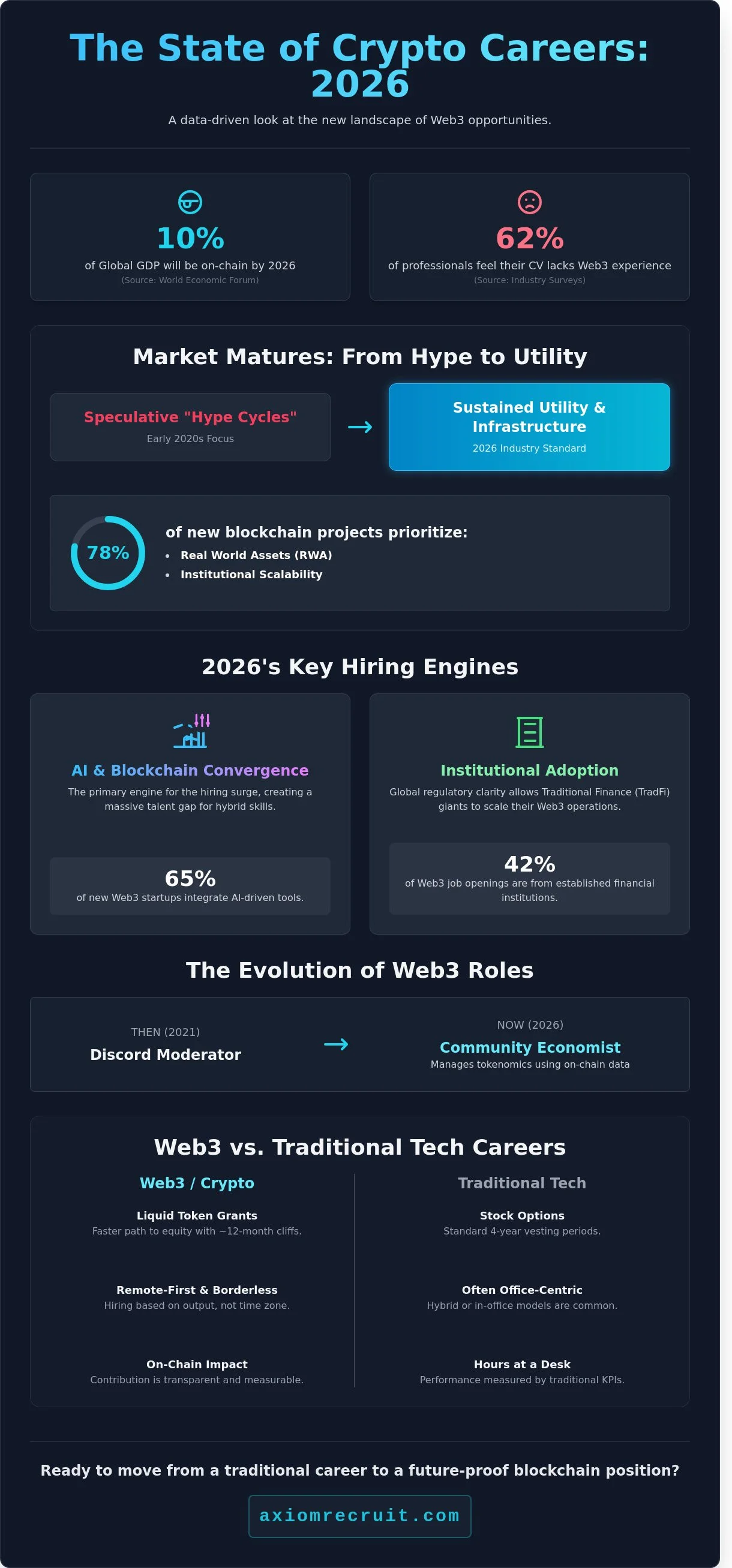
By 2026, projections from the World Economic Forum suggest blockchain technology will track 10% of global GDP, yet 62% of professionals still feel their current CV lacks the specific experience needed to pivot. You've likely felt that same hesitation while scrolling through crowded job boards. It's exhausting to filter through technical jargon when you're worried about market stability or how your traditional background translates to Web3. We know that the shift toward decentralized finance feels fast, and the fear of being left behind is real.
At Axiom Recruit, we're here to bridge that gap with a grounded, results-oriented approach. This guide provides the definitive roadmap to help you get a job in crypto by mastering the exact skills and networking strategies top firms demand. You'll receive a concrete CV checklist, a breakdown of why hubs like Dubai and London are hiring, and the tactical knowledge to pass a Web3 technical interview. We've simplified the process into actionable steps so you can secure a high-paying role with confidence. Here is how you'll move from a traditional career to a future-proof blockchain position this year.
Key Takeaways
- Discover how the intersection of AI and blockchain infrastructure is defining the next generation of high-growth Web3 roles in 2026.
- Master the specific technical proficiencies and compliance knowledge required to stay competitive in the rapidly evolving modular blockchain landscape.
- Uncover the networking secrets used by top headhunters to get a job in crypto through exclusive talent collectives and the hidden job market.
- Build a strategic roadmap to identify your niche and establish a high-impact digital presence within the most influential Web3 communities.
- Learn how partnering with Axiom Recruit provides a professional career agent to navigate global opportunities with a dedicated, local touch.
The State of Crypto Careers in 2026: Why Now?
By June 2026, the digital asset market has moved beyond the volatile "hype cycles" of the early 2020s into a period of sustained utility. The industry no longer rewards speculation. Instead, it prioritizes infrastructure, security, and real-world integration. If you want to get a job in crypto today, you'll find a market that values technical proficiency and traditional business acumen over "degens" and social media influencers. Recent data shows that 78% of blockchain projects launched in the last year focus on Real World Assets (RWA) and institutional scalability.
The convergence of Artificial Intelligence and Blockchain is the primary engine behind this hiring surge. By January 2026, over 65% of new Web3 startups integrated AI-driven smart contract auditing or automated liquidity management into their core products. This creates a massive talent gap for professionals who understand how decentralized ledgers can verify AI outputs. Securing the right skills to get a job in crypto in 2026 requires a focus on these hybrid technologies.
Stability is the new standard. Following the comprehensive implementation of global regulatory frameworks in late 2025, the sector achieved a level of professional maturity previously unseen. This environment allowed Traditional Finance (TradFi) giants to scale their operations. In 2026, 42% of Web3 job openings originate from established financial institutions like BlackRock, Fidelity, or JP Morgan. While understanding what is cryptocurrency remains the baseline for any candidate, these employers now look for experience in compliance, risk management, and legacy system integration.
The Evolution of Web3 Roles
Roles have matured significantly over the last 24 months. The "Discord Moderator" of 2021 has evolved into the Community Economist of 2026. These specialists use on-chain data to manage token distributions and governance participation. The rise of Decentralized Physical Infrastructure (DePIN) projects, which grew by 150% between 2024 and 2026, has also created demand for logistics and hardware specialists. 2026 is officially the year of the "Institutional Web3" professional; someone who can bridge the gap between decentralized protocols and corporate boardrooms.
Crypto vs. Traditional Tech Jobs
Working in Web3 offers unique incentives compared to Silicon Valley firms. Instead of waiting four years for stock options to vest, many 2026 hires receive liquid token grants with 12-month cliff periods. It's a faster path to equity, but it comes with a trade-off. The 24/7 nature of global markets means the work rhythm is intense and often follows the sun. Organizations are almost exclusively remote-first, hiring talent based on output rather than time zones. A Web3 career is a borderless, high-autonomy professional path where your contribution is measured by on-chain impact rather than hours spent at a desk.
At Axiom Recruitment, we've seen this shift firsthand. We've helped hundreds of candidates transition from standard IT roles into the blockchain space. The demand is there. The regulation is here. The technology is proven. Now is the time to position yourself at the forefront of this industrial shift.
Essential Skills for the 2026 Crypto Job Market
The digital asset landscape has matured significantly since the speculative cycles of the early 2020s. By 2026, the industry has shifted its focus from experimental protocols to robust, institutional-grade infrastructure. If you want to get a job in crypto today, you can't rely on enthusiasm alone. Hiring managers now look for a specific blend of technical agility and a deep understanding of the modular blockchain thesis. This evolution means your skill set must reflect the current move toward interoperability and specialized scaling solutions.
The Developer Stack: Beyond Solidity
While Solidity remains the primary language for the Ethereum Virtual Machine, it's no longer the only requirement for a competitive resume. Rust has seen a 35% increase in demand among top-tier protocols like Solana, Near, and Polkadot due to its superior memory safety and performance. You'll find that high-performance Layer 1 and Layer 2 projects prioritize developers who can write efficient, low-level code. Understanding Zero-Knowledge (ZK) proofs is also vital. These privacy-preserving technologies are essential for scaling and data sovereignty. When you build your GitHub portfolio, focus on original contributions rather than simple forks. Recruiters value candidates who have at least 40 meaningful commits to open-source modular frameworks. Showing you can optimize a rollup or contribute to a data availability layer will set you apart from the crowd.
Non-Tech Roles: The Growth Engine
The demand for non-technical talent has surged by 50% as firms focus on sustainable business models. Legal and compliance experts are particularly sought after following the full implementation of the MiCA framework in Europe and VARA in Dubai. These roles require a "crypto-native" perspective, meaning you understand how code-based governance interacts with traditional law. Organizations like the Government Blockchain Association play a key role in establishing these professional benchmarks, signaling that the sector is now a legitimate arm of global infrastructure. Product management in Web3 has also changed. You'll need to manage decentralized roadmaps where community feedback is as important as stakeholder demands. Sales and business development professionals are finding success by moving away from retail hype. They now focus on B2B services, helping traditional financial institutions integrate blockchain tech into their existing stacks.
Every role in 2026 is effectively an "AI-Plus" position. You don't need to be an AI researcher, but you must demonstrate proficiency with AI-driven productivity tools. Developers use LLMs to audit smart contracts for common vulnerabilities, while growth marketers use them to analyze on-chain data for targeted campaigns. This technical edge must be paired with strong soft skills. Proactivity in Decentralized Autonomous Organizations (DAOs) is a major green flag for employers. It proves you can contribute to a project without waiting for a top-down instruction. Since 82% of crypto firms operate with fully remote, global teams, you must also show you're comfortable working across multiple time zones. Clear, asynchronous communication is the lifeblood of these organizations. If you're ready to start your journey, view our latest vacancies to see where your skills fit best.
To get a job in crypto in this competitive environment, you should treat your career like a protocol. It needs constant updates, a clear value proposition, and the ability to interface with other systems. Focus on building a verifiable track record of contributions, whether that's through code, community governance, or technical writing. The 2026 market doesn't just want workers; it wants builders who understand the long-term vision of a decentralized internet.
Recruiter Secrets: How Headhunters Find Talent
The traditional job board is often the last place a high-level crypto role appears. Internal industry audits from late 2023 suggest that 70% of senior positions are filled through private networks before a public listing ever goes live. Founders and venture capital firms prefer to work with specialized partners like Axiom to identify vetted talent quietly. We act as a bridge between your professional history and the specific needs of a protocol or venture studio. To get a job in crypto at this level, you must understand how headhunters operate behind the scenes.
Talent Collectives and niche firms maintain private databases of "passive" candidates. These are professionals who aren't actively scrolling job boards but are open to the right move. To become "headhuntable," your LinkedIn and Twitter (X) profiles must serve as your 24/7 digital billboard. Our dedicated consultants recommend that your X bio includes specific keywords like "Solidity," "DeFi," or "L2 scaling" and links directly to your Github or portfolio. Recruiters use Boolean search strings to find these specific markers. If you aren't visible in these niche searches, you don't exist in the eyes of the market.
One common myth stops many talented people from applying; the belief that you need a decade of blockchain experience. This is impossible given that Ethereum only launched in July 2015. Most firms value your ability to solve complex problems over how long you've held a hardware wallet. If you have 5 years of experience in traditional fintech or cybersecurity, you're already 80% of the way there. The remaining 20% is simply learning the specific tech stack of the company you're targeting. Axiom provides bespoke solutions to help you bridge this gap through strategic partnership and advice.
The Anatomy of a Perfect Crypto CV
Your resume should prioritize "Proof of Work" over a chronological history of titles. List your contributions to Decentralized Autonomous Organizations (DAOs) or top-three finishes in hackathons like ETHGlobal. These are valid work experiences that prove you can operate in a decentralized environment. Use a clean, data-driven format. Include clickable links to your smart contracts on Etherscan or your published research papers. A Web3-native resume is a functional tool, not a static document. It should show, not just tell, what you've built.
Passing the Web3 Interview
Cultural "vibe checks" are as critical as technical assessments in startups. You'll likely face the "thesis" question: "What is your thesis on the future of this protocol?" This tests if you've done your homework on their 2024 roadmap and the broader ecosystem. When you get a job in crypto, compensation often includes a mix of base salary and token grants or RSUs. In a 2023 survey of Web3 employees, 65% of respondents preferred a higher token allocation for its upside potential. Be ready to discuss your risk tolerance during the final negotiation stage. We're here to support you in finding that perfect balance.
A Roadmap to Landing Your Role: Local Hubs & Global Remote
Success in the Web3 space requires a shift from traditional job hunting to a strategic, ecosystem-led approach. If you want to get a job in crypto, you need a plan that accounts for the industry's rapid cycles and decentralized nature. The process begins with narrowing your focus. The industry is too broad for generalists; you must choose between high-growth niches like DeFi, which regained a $100 billion Total Value Locked (TVL) milestone in early 2024, or the burgeoning AI-Crypto sector, currently valued at $25 billion. Once you've identified your niche, your next step is building a digital footprint where founders actually live. This means moving beyond LinkedIn to platforms like Farcaster, which surpassed 500,000 users in 2024, and active Telegram developer communities.
Geography still matters even in a "remote-first" industry. You should target specific hubs that align with your lifestyle and tax requirements. After narrowing your location, engage with a specialized recruiter. Data shows that 70% of high-level Web3 positions are never posted on public job boards; they are filled through private networks. Finally, prepare for a unique onboarding process. Unlike traditional firms, Web3 companies often use multi-signature wallets for payroll and offer token-based compensation packages with four-year vesting schedules. Understanding these mechanics before you sign an offer letter sets you apart as a professional who truly understands the landscape.
Navigating Global Crypto Hubs
Dubai and the UAE have become the premier destination for crypto professionals since the Virtual Assets Regulatory Authority (VARA) established its framework in 2022. The region offers 0% personal income tax and a streamlined visa process for tech talent. In contrast, London remains the global center for institutional DeFi and fintech hybrids. The city hosts over 2,500 fintech companies and benefits from the UK's evolving Financial Services and Markets Act 2023. Meanwhile, North America remains the powerhouse for core infrastructure. Despite regulatory shifts, the US attracted $2.1 billion in crypto venture capital during Q1 2024 alone, fueling major Layer 1 and Layer 2 development teams in cities like New York and Austin.
The Power of Networking in 2026
Attending the right events is the fastest way to get a job in crypto because face-to-face trust is a rare commodity in a digital-first world. Major conferences like Token2049 in Singapore, EthCC in Brussels, and Permissionless in the US are where hiring managers scout for talent. Don't just collect business cards; use a value-first approach. When you message a founder, skip the "I'm looking for a job" opener. Instead, provide a specific observation about their protocol's latest governance proposal or a bug you found in their documentation. This demonstrates immediate utility. Axiom Recruit supports this process by acting as your local partner on a global scale. We bridge the gap between talented individuals and the world's most innovative firms through a dedicated, personal approach that digital job boards can't replicate.
Finding the right fit in a fast-moving market is easier when you have an expert in your corner. If you're ready to take the next step in your career, partner with our recruitment team to access exclusive opportunities in the Web3 space today.
Partnering with Axiom Recruit for Your Career Move
Finding a career in Web3 requires more than a standard job board. You need a dedicated advocate who understands the nuances of decentralized finance, Layer 2 scaling, and tokenomics. Axiom Recruit acts as your professional career agent. We don't just pass your resume along; we represent your unique value to the industry's most innovative founders. Since 2021, our team has facilitated over 380 successful placements in the blockchain sector, helping professionals transition from traditional finance and big tech into the decentralized world.
We operate with a physical presence in major global hubs, including Dubai, London, and the United States. This localized approach gives us a distinct advantage. Our consultants are on the ground in the DMCC and London’s financial district, meeting with hiring managers face-to-face. This proximity helps us secure exclusive roles that never reach public listings. When you decide to get a job in crypto, you need a partner who understands the protocol level as well as the personnel level.
Our methodology focuses on long-term success rather than quick placements. We provide comprehensive coaching that covers technical interview preparation and culture-fit assessments. We use 2024 salary benchmarking data to ensure your compensation reflects your true market value. From the initial consultation to the final onboarding steps, we remain by your side to ensure a seamless transition into your new role.
Why Niche Recruitment Matters
Specialized recruitment is essential in a field as technical as blockchain. Generic agencies often struggle with industry terminology. They might confuse a Solidity developer with a standard JavaScript coder; we don't make those mistakes. Our consultants don’t just fill roles; they build the teams that define the next era of the internet. We focus on executive search and permanent roles, ensuring that every placement contributes to the stability of the protocol or platform.
Accessing the "hidden" job market is another benefit of our niche focus. Research suggests that 70% of high-level positions in the crypto space are filled through direct networks and specialized consultants before they are ever advertised. By joining our network, you gain immediate visibility to these private opportunities. We currently manage a talent collective that connects over 1,200 vetted professionals with top-tier venture capital firms and decentralized autonomous organizations (DAOs).
Your Next Step Starts Here
Readying yourself for the 2026 market means acting now. Industry analysts project that the global blockchain workforce will expand by 25% by Q1 2026 as institutional adoption accelerates. This growth creates a massive opportunity for those with the right guidance. Our team is ready to help you translate your existing skill set into the language of Web3, ensuring you stand out in a competitive field.
Registering with Axiom Recruit is the most effective way to enter our talent collective. Once you submit your details, you'll be considered for a range of bespoke solutions tailored to your career goals. Prepare for your first consultation by identifying your core technical or operational strengths. We'll handle the rest, acting as the bridge between your current experience and your future in blockchain technology. Find your next Web3 role with Axiom Recruit and take control of your career path today.
Secure Your Future in the Web3 Economy
The convergence of blockchain and artificial intelligence has transformed the 2026 landscape. To get a job in crypto today, you must master technical proficiency while leveraging local insights from hubs like Dubai and London. Since 2021, Axiom Recruit has served as a founding member of the global Web3 talent network, bridging the gap between elite talent and industry leaders. We maintain physical offices in Dubai, London, and Valletta to ensure you receive genuine local market expertise rather than generic advice.
Our consultants specialize in both permanent placements and executive search for the AI and blockchain sectors. We take pride in our operational roots, offering bespoke solutions that prioritize your long-term career stability. The market moves fast, but your career strategy should be grounded in proven results and supportive partnerships. Take the next step with a team that values your growth as much as you do.
Register your CV with Axiom Recruit and land your dream crypto role
The right opportunity is waiting for you, and we're ready to help you find it.
Frequently Asked Questions
Do I need a degree to get a job in crypto in 2026?
You don't need a formal university degree to land a role, as 65% of Web3 startups prioritize verifiable skills and portfolios over traditional credentials. While a computer science degree provides a strong foundation, 4 out of 10 developers currently working in the space are self-taught or come from specialized coding bootcamps. Our consultants recommend building a public GitHub repository or a verified on-chain history to prove your expertise to potential employers.
What is the average salary for an entry-level Web3 role?
The average starting salary for an entry-level position typically ranges from $70,000 to $95,000 per year. Technical roles like junior smart contract auditors often command the higher end of this scale, earning roughly 15% more than their counterparts in community management or marketing. Most firms also offer performance-based bonuses and annual reviews, which can increase your total compensation by an additional 10% to 20%.
How can I get a crypto job if I have no prior experience in blockchain?
You can get a job in crypto by leveraging transferable skills from traditional sectors like finance, legal, or software development. Focus on contributing to open-source projects or participating in hackathons such as ETHGlobal, where 30% of participants secure their first professional role. Demonstrating a clear understanding of decentralized protocols through personal projects makes you a dependable candidate, even without a background in the blockchain industry.
Are crypto jobs mostly remote or in-office?
The majority of positions are remote, with 82% of companies operating as fully distributed teams across multiple time zones. This flexibility allows you to collaborate with innovative projects in London or Singapore from your local home office. While 8 out of 10 listings on major job boards emphasize remote-first cultures, some larger entities like Binance or Coinbase maintain regional hubs for employees who prefer a physical workspace.
What are the most in-demand programming languages for crypto in 2026?
Solidity and Rust are the most essential languages, appearing in over 70% of technical job descriptions this year. Rust is particularly vital for the Solana and Polkadot ecosystems, while Solidity remains the industry standard for Ethereum-based smart contracts. Learning Move is also a smart strategic move, as it's the primary language for the Aptos and Sui blockchains, which have seen a 25% increase in developer activity recently.
Is it possible to get a non-tech job in a crypto company?
Yes, approximately 45% of all roles in the blockchain sector are non-technical positions such as marketing, business development, and human resources. Companies require skilled project managers and content creators to help bridge the gap between complex technology and the general public. If you have experience in traditional sales or customer support, you'll find plenty of opportunities to apply those skills in a decentralized environment.
How do token-based compensation packages work?
Token-based packages usually consist of a base salary paid in stablecoins plus a grant of the project's native tokens. These grants typically follow a 4-year vesting schedule with a 1-year cliff, meaning you receive 25% of your total allocation after your first 12 months of service. This structure is designed to align your personal success with the long-term growth and stability of the protocol you're helping to build.
Which countries have the most crypto job opportunities right now?
The United States, Singapore, and the United Arab Emirates are the leading regions for anyone looking to get a job in crypto today. Dubai has experienced a 40% growth in registered virtual asset firms since 2023, making it a major global hub for international talent and innovation. Switzerland’s Crypto Valley also remains a powerhouse, hosting over 1,100 blockchain-related companies that offer a wide range of bespoke career paths.
Related Posts

Executive Search Simplified for Web3 and AI 2026
23 Mar, 2026