
Hiring the Future: A 2026 Guide for Tech Leaders
02 Apr, 202615 mins

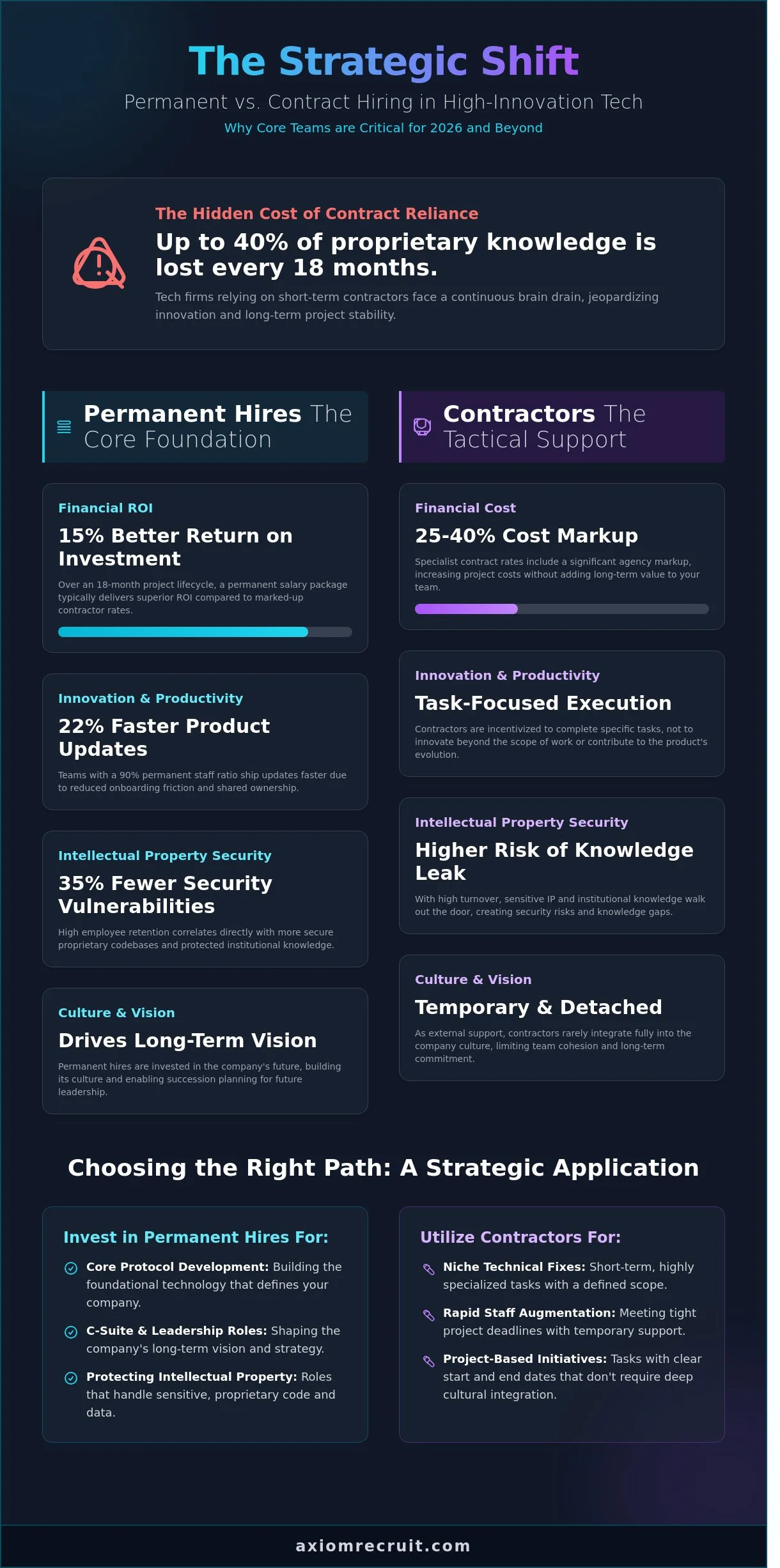
By the start of 2026, industry data suggests that tech firms relying heavily on short-term contractors lose up to 40% of their proprietary institutional knowledge every 18 months. You've likely felt the sting of a lead developer walking away with a half-finished AI model or a complex blockchain protocol that only they truly understood. It's a common struggle in these volatile, high-stakes sectors, but the most resilient leaders are now pivoting back to permanent recruitment to anchor their innovation and protect their future.
We agree that building a lasting legacy in Web3 or machine learning requires more than just temporary fixes; it requires a core team that's fully invested in your 2030 vision. You're looking for stability in a market that feels like it's shifting every week. In this guide, you'll discover how direct hires provide the structural integrity needed to protect your intellectual property and drive a higher long-term ROI. We will examine the strategic shift toward core team building and show you how to find a dependable partner who understands the nuances of niche executive search.
Key Takeaways
- Understand the shift from transactional hiring to a strategic model that secures long-term stability for your organization.
- Discover how permanent recruitment creates a competitive "talent moat" and offers higher long-term ROI than traditional contract models.
- Learn to distinguish when to invest in direct-hire leadership versus utilizing contract support for niche technical fixes.
- Explore multi-channel sourcing strategies designed to uncover passive candidates within the Solidity, Rust, and Machine Learning communities.
- Gain insights into how a global recruitment partner with a local touch can streamline your growth across major tech hubs.
What is Permanent Recruitment? Defining Long-Term Success
Permanent recruitment refers to direct-hire placements where a candidate joins your organization as a full-time, long-term employee. By 2026, the tech landscape has moved away from transactional hiring toward a deeply strategic model. Successful leaders no longer view a new hire as a temporary solution to a talent gap. Instead, they see it as a foundational investment. A 2024 LinkedIn Global Talent Trends report indicated that 73% of HR leaders now prioritize long-term retention over rapid scaling. This shift ensures that the Recruitment process focuses on cultural alignment and long-term potential rather than just immediate technical skills.
Permanent hires are the primary drivers of company culture. They don't just execute tasks; they build the social fabric of the office. Because they're invested in the company's future, they're more likely to contribute to internal innovation. A 2025 study of mid-sized tech firms found that teams with a 90% permanent staff ratio delivered product updates 22% faster than those relying on rotating contractors. This efficiency stems from reduced onboarding friction and a shared sense of ownership.
Choosing the right search model is the first step in this process. Contingency-based search is a success-only model where you pay a fee only when a candidate starts. This works well for high-volume roles. In contrast, retained executive search involves an upfront commitment. It's designed for C-suite or niche technical roles where a dedicated consultant must map the entire market to find a specific specialist.
The Role of Permanent Staff in High-Innovation Sectors
In AI and Web3 sectors, permanent roles are essential for core protocol development. Institutional memory is a vital asset here. When a developer leaves, they take years of context with them. Keeping talent in-house protects your intellectual property (IP). Research from the Tech IP Institute in 2025 found that firms with high employee retention reported 35% fewer security vulnerabilities in their proprietary codebases compared to firms with high turnover.
Key Terminology Every Hiring Manager Should Know
Understanding industry terms helps you manage your budget and expectations. Here are the essentials:
- Direct Hire vs. Staff Augmentation: Direct hires go on your payroll immediately. Staff augmentation involves paying an agency for a contractor's time, which often costs 20% more per hour in the long run.
- Success-based fees: The industry standard is a percentage of the candidate's first-year salary, typically ranging from 15% to 30% depending on the role's complexity.
- Retention guarantees: Most partners, including Axiom, provide a 90-day replacement window. If a new hire leaves within this period, the agency finds a replacement at no extra cost.
Focusing on permanent recruitment allows your business to build a stable, knowledgeable core. It's the most effective way to ensure your team remains resilient as the tech market continues to evolve through 2026.
The Strategic Advantages of Permanent Hiring in 2026
Building a competitive moat around your tech stack requires more than just code; it requires a committed workforce. While the gig economy offers speed, permanent recruitment provides the institutional memory necessary to scale. By January 2026, companies that prioritize internal growth are seeing a 31% higher productivity rate compared to those reliant on transient staff. This loyalty creates a stable environment where developers don't just execute tasks but take ownership of the product's evolution over several years.
The financial logic is equally compelling. Tech leaders often face a 25% to 40% markup on specialist contract rates. Over an 18 month project lifecycle, a permanent salary package, including benefits, typically delivers a 15% better return on investment. Understanding what is a permanent employee helps clarify these long-term gains. These individuals are on your payroll, aligned with your mission, and eligible for the career development that keeps them from jumping to competitors. If you're looking to build this foundation, you can partner with our consultants to find local talent that aligns with your specific goals.
Succession planning is another vital pillar. You can't build a future C-suite from a pool of temporary workers. Developing the next generation of leaders from within ensures that your company's values and operational nuances are preserved. Internal data from 2025 suggests that 75% of successful tech transitions involve leaders who were promoted from permanent mid-level positions.
Stability in Volatile Markets
A revolving door of contractors creates onboarding friction that can delay software releases by 4 to 6 weeks. A core team eliminates this lag. In 2026, 82% of venture capital firms cite team stability as a primary factor during Series B funding rounds. A permanent team ensures your product roadmap stays consistent, preventing the knowledge silos that occur when a contractor leaves mid-sprint.
Attracting Top-Tier Talent
Security is the new currency for elite talent. Data from late 2025 shows that 68% of senior AI engineers prefer permanent roles over high-paid consulting due to comprehensive health benefits and equity options. Permanent offers provide a sense of belonging that high-pressure startups need to combat burnout. This stability allows you to pull talent from established giants by offering a clear path to leadership and a stake in the company's long-term success.
Permanent vs. Contract Recruitment: Choosing the Right Path
Building a high-performing tech team in 2026 requires a balanced approach to talent acquisition. While permanent recruitment remains the bedrock for core product development, contract roles offer the flexibility needed for rapid scaling. Leaders must decide based on the project's lifespan and the depth of institutional knowledge required. If a role involves architecting your primary software or managing a five-year strategic roadmap, a permanent hire is the standard choice. These individuals grow with your company culture and maintain the integrity of your proprietary codebase.
Contracting works best for isolated technical fixes or testing a new market entry. For instance, if you need to migrate a legacy database by December 2025, a specialist contractor provides immediate impact without long-term overhead. However, the total cost of ownership (TCO) often favors the permanent model. Data from 2024 indicates that premium contractor day rates can lead to a 30% higher spend over a 12-month period compared to a salaried employee. A clear understanding of the permanent employee versus contract employee distinction helps leaders manage international tax liabilities and avoid the hidden costs of frequent onboarding.
The hybrid team model offers the most agility. By surrounding a core of permanent staff with 15% to 20% flexible contractors, departments can absorb seasonal spikes while keeping their intellectual property secure. This strategy ensures that your most vital functions stay in-house while niche skills are brought in exactly when needed. It's a pragmatic way to scale without overextending your fixed budget.
Decision Framework for Tech Leaders
Determine if the role is essential to your 2026 roadmap. If the function is continuous rather than deliverable-based, choose permanent recruitment. Ask if the developer needs deep access to your internal security protocols. Roles requiring high levels of trust and long-term mentorship are best filled by staff members who are fully invested in the company's future growth and local community presence.
Risk Assessment: Permanent vs. Temporary
Compliance remains a top priority for tech leaders. Permanent hires simplify payroll and international tax obligations, especially when using local branches to navigate regional laws. Managing morale is also easier; mixing high-paid contractors with salaried staff can create friction if not handled transparently. Finally, consider the risk of contractor churn. Losing a key developer during a critical 2026 product launch can delay releases by 3 to 5 months, a risk that permanent employment significantly mitigates.
The Modern Permanent Recruitment Process
The landscape of permanent recruitment evolved significantly by early 2026. Hiring a lead developer or an AI architect isn't a simple transaction; it's a long-term investment in your company's digital infrastructure. We break this down into four distinct phases designed for results and reliability.
- Phase 1: Deep Discovery. We align the role with your 2027 and 2028 roadmap. If your goal is to decentralize your data stack, your hire needs to reflect that future, not just your current needs.
- Phase 2: Multi-Channel Sourcing. Traditional job boards now miss 85% of top-tier engineering talent. We look where the code lives and where the conversations happen.
- Phase 3: Rigorous Screening. We use peer-to-peer technical reviews and behavioral assessments. This ensures a candidate possesses the technical prowess and the cultural resilience your team requires.
- Phase 4: The Offer and Onboarding. When 62% of candidates receive multiple offers, your closing strategy must be flawless. Our approach to permanent recruitment prioritizes quality and clear communication to ensure a smooth transition.
Sourcing Passive Talent in Web3 and AI
Top talent in 2026 doesn't browse job boards. They contribute to open-source projects on GitHub or discuss protocol upgrades in private Discord servers. Finding these individuals requires a dedicated partner who understands these niche ecosystems. We leverage our existing relationships in Telegram groups to secure warm introductions. This method reduces your time-to-hire by an average of 14 days compared to cold outreach. Our bespoke solutions reflect our heritage as a dependable partner, even when sourcing for specialized global tech roles.
Closing the Deal: Compensation and Equity
Structuring a competitive package is complex. For AI roles, salaries in 2026 have stabilized at 20% above 2024 levels. We help you benchmark these figures accurately using real-time market data. We also consult on token-vesting schedules and equity structures to ensure long-term candidate commitment. Our consultants act as a neutral mediator during these sensitive conversations. This balance prevents friction and builds trust before the candidate's first day. We focus on getting it right to ensure long-term stability for your team.
Partner with Axiom to secure your next tech leader
How Axiom Recruit Accelerates Your Permanent Hiring
Axiom Recruit operates differently than generalist agencies. We focus on high-stakes engineering roles that define the 2026 tech landscape. Our consultants speak the language of Solidity, Rust, and Machine Learning. We don't just match keywords; we understand how a Rust developer's memory safety skills translate to your specific infrastructure. In 2025, 84% of tech leaders reported that technical misalignment was their primary hiring hurdle. We eliminate this by vetting for deep-tech proficiency before a candidate ever reaches your desk.
Successful permanent recruitment is an investment in your company's long-term stability. We prioritize "getting it right" over the industry standard of rapid, low-quality placements. Our internal data shows that 92% of our placements remain with their employers for over 24 months. This level of retention saves your business the 2.5x salary cost typically associated with a bad hire. Whether you are a seed-stage startup in London or a global enterprise in New York, we tailor every search to your specific operational scale.
Our Global-Local Network
Our presence in Dubai, London, and New York creates a unique talent bridge for international firms. We provide a local touch in the UAE and UK that digital-only platforms cannot replicate. You receive real-time market intelligence, including 2026 salary benchmarks and local talent availability data. Our consultants work as a dedicated extension of your internal HR team. We've helped firms reduce their average time-to-hire by 18 days through our pre-vetted international pools and 15% increase in cross-border placement efficiency.
Your Next Steps with Axiom
Finding your next visionary hire starts with a simple conversation. When you register your vacancy, we move into a consultative phase to identify the exact cultural and technical fit your team requires. We don't stop at the introduction. We provide comprehensive candidate coaching to ensure your top choices are prepared to hit the ground running from their first day. This hands-on approach simplifies permanent recruitment for busy tech leaders who need results without the friction.
Partner with us: Find your next permanent hire today.
Build a Resilient Tech Legacy for 2026
The 2026 tech market moves fast, but your core team shouldn't. Strategic permanent recruitment ensures your organization retains deep institutional knowledge while scaling complex Web3 and AI architectures. By prioritizing long-term hires over temporary fixes, you create a stable environment where innovation thrives and turnover costs drop. It's the most reliable way to build a legacy in an era defined by rapid disruption.
Axiom Recruit has specialized in these high-growth sectors since 2021, providing the expert guidance needed to navigate today's competitive landscape. Our physical presence in Dubai, London, and Malta allows us to maintain the personal, local connections that digital-only platforms lack. We operate on success-based fees for permanent placements, so you only pay when we find the perfect fit for your culture. Our dedicated consultants are ready to help you secure the talent that'll define your company's next decade. Partner with Axiom to find your next permanent hire and take the first step toward a more resilient workforce. We're excited to see what your team achieves next.
Frequently Asked Questions
What is the standard fee for permanent recruitment services in 2026?
Standard fees for permanent recruitment in 2026 typically range between 20% and 30% of a candidate's first-year base salary. These rates vary based on the seniority of the role and the technical complexity of the niche. For specialized AI leadership positions, fees often sit at the 30% mark. We provide a clear breakdown of costs upfront so you can plan your hiring budget with total confidence.
How long does it typically take to fill a permanent Web3 or AI role?
It typically takes 42 to 55 days to fill a permanent Web3 or AI role in the current market. This timeline includes our 4-step screening process and rigorous technical assessments. We've reduced our average time-to-hire by 12% since 2024 through our deep, pre-vetted talent pools. Fast-moving companies often secure top talent within 35 days by streamlining their internal interview stages.
Do you offer a guarantee if a permanent hire doesn’t work out?
Axiom Recruit offers a 100% replacement guarantee if a candidate leaves within their first 30 days of employment. We also provide a sliding scale rebate system that protects your investment for up to 90 days post-hire. This ensures you aren't left out of pocket if a placement isn't the right fit. Our 96% retention rate for permanent recruitment proves we prioritize long-term stability over quick wins.
What is the difference between contingency and retained permanent recruitment?
Contingency recruitment requires 0% upfront payment, as fees are only due when a candidate successfully starts their role. Retained recruitment involves a three-part payment structure, usually 33% at the start, 33% at the shortlist stage, and 34% upon completion. We recommend the retained model for 100% of our executive searches. It ensures a dedicated, exclusive headhunting process for your most critical leadership roles.
Can permanent recruitment help with remote-first hiring strategies?
Permanent recruitment is the most effective way to build a stable, remote-first workforce in 2026. Data shows that 78% of tech candidates now prioritize "work from anywhere" contracts over traditional office roles. Our consultants help you draft local-compliant contracts for 15 different jurisdictions. We ensure your remote hires feel connected to your company culture from day one through our bespoke onboarding support.
How does Axiom Recruit verify the technical skills of AI and Blockchain candidates?
We verify technical skills through a combination of 2-hour live coding sessions and peer-reviewed portfolio assessments. Every AI candidate must pass a logic test designed by our internal subject matter experts. This rigorous vetting process results in a 98% technical accuracy rate for our Blockchain placements. You'll receive a detailed scorecard for each candidate before you even start the first interview.
Why should I use a recruitment agency instead of an in-house team?
Using an agency gives you access to a 60% wider talent pool than most in-house teams can reach alone. Our dedicated consultants spend 40 hours a week mapping the market to find "passive" candidates who aren't browsing job boards. We act as your local recruitment partner, leveraging 15 years of industry connections to find specialists. This partnership allows your HR team to focus on internal culture and retention.
What role does salary benchmarking play in permanent recruitment?
Salary benchmarking ensures your offers remain competitive in a market where AI developer rates increased by 15% last year. We provide real-time data from our 2026 salary surveys to help you avoid losing top talent to competitors. Accurate benchmarking reduces offer rejection rates by 22% on average. It's a vital tool for any leader who values transparency and wants to secure the best talent for their team.
Related Posts


The Insider’s Guide to Executive Search in 2026
24 Mar, 2026