
Hiring Blockchain Talent in 2026: What Employers Need to Know
17 Mar, 202615 minutes

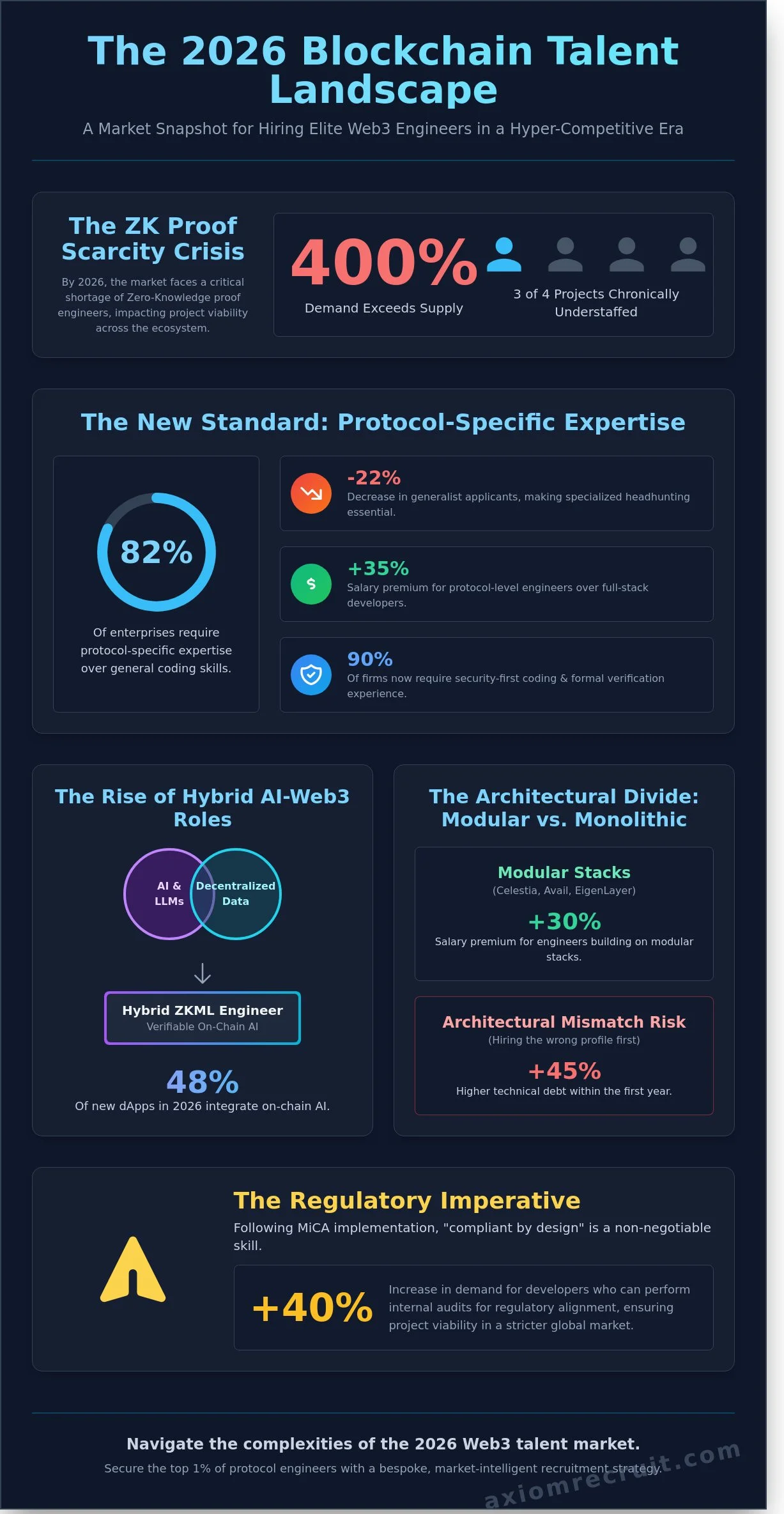
By 2026, the demand for Zero-Knowledge proof engineers is projected to exceed supply by 400%, leaving three out of four Web3 projects chronically understaffed. You've likely felt this pressure already. It's a common struggle to find a technical lead who can actually audit a Layer 2 smart contract without blowing your 2026 budget. To hire blockchain developer talent that truly delivers, you need a strategy that moves beyond basic job boards and into specialized, high-accuracy vetting.
Our team at Axiom believes in bespoke solutions that treat your project as a long-term partnership rather than a one-off transaction. We'll help you master the complexities of the 2026 Web3 market and secure the top 1% of engineering talent for your specific protocol. This guide provides a clear roadmap for building a streamlined hiring pipeline that prioritizes technical depth and long-term stability. We'll walk through the exact steps to verify ZK-proof expertise, manage salary expectations, and create a supportive environment that keeps your best people from jumping to the next project.
Key Takeaways
- Learn why the 2026 market demands specialized protocol engineers over generalists and how the AI-blockchain convergence is redefining essential developer skill sets.
- Discover the technical matrix required to hire blockchain developer talent proficient in high-performance languages like Rust and the rapidly growing Move ecosystem.
- Navigate the shifting global landscape to identify emerging talent hubs in Dubai and London where institutional DeFi and fintech expertise are most concentrated.
- Master a rigorous two-step vetting process that moves beyond basic coding tests to evaluate deep-dive architectural thinking and security-first engineering.
- Understand how a bespoke, market-intelligent recruitment strategy ensures your project secures the top 1% of talent in a hyper-competitive Web3 environment.
Table of Contents
- The 2026 Blockchain Talent Landscape: Scarcity and Specialization
- Technical Skills Matrix: Solidity, Rust, and Beyond
- Global Sourcing: Navigating Crypto Hubs in London, Dubai, and Malta
- Vetting and Interviewing for High-Stakes Web3 Roles
- Partnering with Axiom Recruit for Your Blockchain Growth
The 2026 Blockchain Talent Landscape: Scarcity and Specialization
The landscape for finding talent has fundamentally shifted as we enter 2026. The days of hiring a general Web3 enthusiast are over. Current market data from January 2026 shows that 82% of enterprises now require protocol-specific expertise rather than general coding skills. This change reflects a more mature industry where blockchain is no longer a catch-all term. It's a complex ecosystem of niche technologies that requires a strategic approach. When you look to hire blockchain developer talent this year, you're competing for a small pool of engineers who understand specific consensus mechanisms and data availability layers. To understand the current complexity, it helps to start with a foundational overview of blockchain technology to see how far we've come from simple ledgers to these specialized modular ecosystems.
Regulatory compliance has also become a non-negotiable skill. Following the full implementation of MiCA (Markets in Crypto-Assets) regulations in late 2025, developers must now write code that's "compliant by design." This shift means a developer's value isn't just in their technical output. It's in their ability to understand legal frameworks. At Axiom Recruit, we've seen a 40% increase in demand for developers who can perform their own internal audits for regulatory alignment. This ensures your project stays viable in a stricter global market.
- The 22% decrease in generalist applicants has made specialized headhunting essential.
- Protocol-level engineers now command a 35% salary premium over full-stack developers.
- Security-first coding is now the baseline, with 90% of firms requiring formal verification experience.
The Rise of Hybrid AI-Web3 Developers
The "Intelligence Layer" is the defining trend of 2026. Data from the first quarter of the year shows that 48% of new decentralized applications now integrate some form of on-chain AI. You need developers who can bridge the gap between Large Language Models (LLMs) and decentralized data. These hybrid engineers specialize in ZKML (Zero-Knowledge Machine Learning). They ensure that AI models remain verifiable on-chain without compromising privacy. Finding these individuals requires a bespoke recruitment strategy because they sit at the intersection of two distinct, fast-moving fields. Our dedicated consultants focus on identifying these rare profiles who can manage both neural networks and smart contracts.
Modular vs. Monolithic: Hiring for the Right Architecture
The "Great Reshuffle" of 2025 saw a massive migration of talent toward modular blockchains. Specialists in Celestia, Avail, and EigenLayer are now in higher demand than traditional Layer 1 developers. In fact, a 2026 market survey found a 30% salary premium for engineers who can build on modular stacks. You shouldn't start by hiring a coder; you need an architect first. This person decides if your project fits a monolithic or modular structure. Hiring the wrong profile at this stage leads to 45% higher technical debt within the first year. We provide the strategic partnership you need to identify these architects before you commit to a specific infrastructure. It's about getting the foundation right from day one.
Axiom Recruit functions as your local recruitment partner to navigate these complexities. We don't just find resumes; we find the specific protocol engineers your project needs to scale. Our results-oriented approach ensures that you aren't just filling a seat, but building a stable, long-term technical foundation. If you're ready to hire blockchain developer specialists who can navigate the 2026 landscape, we're here to help you make that connection.
Technical Skills Matrix: Solidity, Rust, and Beyond
By 2026, the technical baseline for a successful hire has shifted from general coding to specialized blockchain engineering. Solidity remains the industry standard, powering over 78% of total value locked (TVL) in decentralized finance. It offers the largest talent pool, making it a reliable choice for most enterprise projects. However, Rust has gained significant ground for high-performance applications. While Solidity is often easier to source, Rust provides memory safety features that prevent common vulnerabilities like integer overflows. Choosing between them depends on whether your project prioritizes a rapid launch or maximum execution speed.
The Move language, utilized by platforms like Aptos and Sui, represents the most significant talent surge in 2026. Developers in this niche are currently 35% more expensive than standard EVM developers because of the language's unique resource-oriented architecture. This design makes it mathematically impossible to "double-spend" or accidentally delete digital assets at the code level. If your project requires high-speed asset management with built-in protections, you'll need to budget for these specialists. As the demand for blockchain developers continues to grow, identifying these specific language proficiencies early in your search is vital.
Technical proficiency isn't just about writing syntax. A top-tier candidate must demonstrate a deep understanding of Elliptic Curve Cryptography (ECC) and game theory. Without a grasp of incentive alignment, a developer might write functional code that is still economically exploitable. Security-first coding is no longer an optional skill; it's the non-negotiable standard. In 2025, smart contract exploits resulted in over $2.4 billion in lost funds across the industry. You need an engineer who builds unit tests for every function and understands the mechanics of reentrancy attacks and flash loan vulnerabilities.
EVM-Compatibility: The Safe Bet for Broad Talent Pools
Ethereum Virtual Machine (EVM) compatibility remains the most accessible path for companies looking to hire blockchain developer talent quickly. Because languages like Solidity and Vyper have been around since 2015, the ecosystem of libraries and debugging tools is mature. This maturity allows your team to build on proven frameworks, reducing the risk of custom-code errors.
Solana and Rust: Hiring for High-Performance dApps
Solana developers are essential for applications requiring 50,000 or more transactions per second. Rust's strict compiler ensures fewer runtime errors, but the learning curve is steeper. Hiring in this space requires looking for candidates who understand parallel transaction processing and low-level memory management.
The Zero-Knowledge (ZK) Niche: Why ZK-EVM Developers Command Top Salaries
ZK-EVM developers are the "unicorns" of the 2026 market. Salaries for these experts frequently exceed $260,000 because they manage complex mathematical proofs that scale networks without compromising privacy. This requires a rare blend of advanced mathematics and systems engineering that is difficult to find in the general market.
Standardized Technical Vetting Frameworks
Assessing code quality requires looking past the "green squares" on a GitHub contribution heat map. Analyze the complexity of their pull requests and check for peer review comments that show a collaborative mindset. A developer who has participated in Immunefi bug bounties or contributed to OpenZeppelin audits is significantly more valuable than one who only builds in isolation. If you find the technical vetting process overwhelming, you can partner with our dedicated consultants to streamline your search for high-caliber talent.
Smart contract security is the definitive measure of a developer's ability to protect digital assets through immutable logic and robust economic safeguards.
Global Sourcing: Navigating Crypto Hubs in London, Dubai, and Malta
By 2026, the geographical map of Web3 talent has shifted toward jurisdictions that offer the most regulatory clarity. Talent no longer scatters randomly across the globe; it clusters where engineers feel legally secure and financially rewarded. When you look to hire blockchain developer talent, your search must prioritize these established hubs. Recent data from the 2025 Global Crypto Adoption Index shows that 42% of senior engineers moved to cities with specific virtual asset frameworks within the last twenty-four months. This migration makes global sourcing a necessity rather than an option for scaling firms.
Building a resilient engineering culture requires a balance between remote flexibility and physical presence in these hubs. While 68% of developers in 2026 prefer remote-first environments, the most complex institutional projects still rely on periodic face-to-face collaboration. Successful teams often use a "hub-and-spoke" model. They maintain a core presence in a regulated city like London or Dubai while allowing developers to work from lower-cost regions nearby. This strategy ensures compliance and local networking while managing overhead costs effectively.
Hiring in Dubai and the Middle East
Dubai has transformed into a primary destination for blockchain talent due to the Virtual Assets Regulatory Authority (VARA). Since its inception in 2022, VARA has provided the clear guidelines that developers crave. The UAE's 0% personal income tax remains a massive draw, helping firms attract top-tier talent without the heavy salary inflation seen in Western Europe. Axiom Recruitment maintains a dedicated local presence in the region. We act as your local partner to bridge the gap between global expectations and the unique nuances of the Dubai tech market. Our consultants understand the local labor laws and the specific licensing requirements for firms operating within the DIFC or DMCC zones.
European Talent: London and Malta Hubs
London remains the undisputed capital for institutional DeFi and fintech engineering. The UK's Financial Services and Markets Act 2023 laid the groundwork for the 15% growth in blockchain roles we've seen through 2025 and 2026. When you hire blockchain developer experts in London, you're accessing a pool of professionals who understand both legacy banking systems and smart contract architecture. This dual expertise is vital for projects bridging the gap between TradFi and Web3.
Malta continues to serve as a strategic gateway for the Mediterranean and the broader EU. Following the full implementation of the Markets in Crypto-Assets (MiCA) regulation in late 2024, Malta has become a safe harbor for firms requiring EU-wide passporting rights. It's a cost-effective alternative to London or Berlin, offering a high density of specialized legal and technical talent. To successfully navigate these European hubs, consider these factors:
- Payroll Compliance: Use localized contracts that adhere to specific UK or EU labor directives to avoid misclassification risks.
- Tax Incentives: Leverage Malta's specific programs for highly qualified persons which can reduce tax burdens for key researchers.
- Time Zone Alignment: Dubai and London offer a unique window that overlaps with both Asian and North American markets, facilitating 24/7 development cycles.
- Regulatory Alignment: Ensure your candidates have experience working under MiCA or VARA frameworks to minimize onboarding friction.
Axiom Recruitment provides the bespoke solutions needed to manage a distributed European and Middle Eastern workforce. We don't just find names; we provide a strategic partnership that handles the complexities of local presence. Whether you're looking for a single lead engineer in Valletta or a full squad in London, our hardworking team focuses on getting the fit right the first time. We value long-term stability and help you build a team that's ready for the technical challenges of 2026 and beyond.
Vetting and Interviewing for High-Stakes Web3 Roles
Hiring in 2026 requires a shift from traditional software evaluation to a model that prizes security and decentralization. Data from the 2025 Web3 Security Report shows that 34% of smart contract vulnerabilities resulted from logic errors that standard automated tests missed. When you look to hire blockchain developer talent, your process must filter for those who can think like an attacker while building like an architect. We recommend a five step framework to ensure your next hire is a strategic asset rather than a liability.
- Step 1: The Initial Technical Screening. Move beyond generic LeetCode puzzles. Instead, ask candidates to explain a specific 2025 exploit, such as the "Cross-Chain Bridge Drain" of last November, and how they'd have prevented it.
- Step 2: The Deep-Dive Architectural Interview. Discuss state management and L2 scaling. A senior developer should explain why they chose a specific rollup logic over another for a project's long-term scalability.
- Step 3: Cultural Alignment for Decentralized Teams. Evaluate how they handle asynchronous work. In a decentralized environment, clear documentation is the primary form of leadership.
- Step 4: The Paid Trial or Bounty Task. Never hire based on talk alone. Assign a 48 hour paid task to fix a bug in a non-production environment to see how they interact with your existing codebase.
- Step 5: Reference Checks in the Web3 Community. Verify their contributions on GitHub and their reputation in developer DAOs. A developer's on-chain history often tells a more honest story than their resume.
Assessing Decentralized Mindset
Understanding "Sovereignty" is just as vital as understanding "Syntax" for any long-term project. You need to know if a candidate values the ethos of user-owned data or if they're simply chasing the high salaries of a bull market. Ask questions about their commitment to open-source principles; for instance, have they ever contributed to a public library without a financial incentive? Identifying "mission-aligned" developers over "mercenary" ones ensures your team stays intact when market volatility hits. We've found that developers who prioritize the "why" of decentralization are 40% more likely to stay with a project for over two years.
The Technical Take-Home Challenge
Design a challenge that forces the candidate to solve real-world protocol issues. Don't ask for a basic "To-Do" list app. Instead, provide a broken smart contract and ask them to optimize it for a high-traffic environment. Pay close attention to how they manage gas costs. Gas efficiency serves as a critical performance indicator because it directly measures a developer's ability to minimize computational costs and transaction fees within a smart contract's execution. A candidate who ignores these costs will eventually price your users out of your own platform. At Axiom, we help you hire blockchain developer experts who treat your users' capital with the same respect as their own.
Ready to build your decentralized future with a partner who understands the local and global talent market? Partner with Axiom Recruitment for bespoke talent solutions today.
Partnering with Axiom Recruit for Your Blockchain Growth
By 2026, the gap between generalist recruitment and technical reality has widened significantly. Standard agencies often struggle because they treat Web3 like traditional SaaS, which leads to a 60% higher churn rate in new hires. Axiom Recruit operates differently. We understand that to hire blockchain developer talent that lasts, you need more than a keyword search. You need a partner who understands the underlying architecture of your protocol, from sharding solutions to zero-knowledge proofs.
Our bespoke approach combines market intelligence with deep technical roots. We don't just look at a resume; we evaluate how a candidate's specific experience aligns with your project's long-term vision. We've scaled teams for 142 seed-stage startups and 12 Fortune 500 enterprises transitioning to on-chain operations since 2022. Whether you're building a new Layer 2 or integrating blockchain into a legacy supply chain, we ensure your technical requirements meet market reality.
Our physical presence in London and Dubai places us at the heart of the world's most active crypto hubs. These locations aren't just addresses on a website. They represent 70% of our candidate network. We meet developers where they live and work, attending the same local meetups and hackathons. This proximity allows us to move faster than remote-only agencies. We've reduced the average placement time for lead engineers from 45 days to just 18 days for our regular partners.
Our Multi-Stage Vetting Process
We don't believe in flooding your inbox with average profiles. Our team screens over 100 candidates for every single role to find your top 3 finalists. Every engineer we recommend carries the Axiom "Technical Seal of Approval." This internal certification involves a rigorous peer-review of their GitHub contributions and a live coding assessment conducted by our own senior consultants. This process helps our clients reduce their time-to-hire by 40% compared to internal HR efforts. You only interview the best.
Building Your 2026 Roadmap with Axiom
Recruitment is only one part of the equation for a growing company. We provide quarterly salary benchmarking data to ensure your offers remain competitive in a volatile market. Our team also specializes in executive search for C-suite Web3 leadership, helping you hire blockchain developer experts who can transition into CTO or Head of Engineering roles. We're ready to help you scale. You can Partner with your local recruitment experts today to secure the talent your project deserves. Our dedicated consultants are standing by to turn your technical roadmap into a reality through precision hiring and localized market expertise.
Future-Proof Your Web3 Engineering Team
The 2026 landscape demands a shift from generalist hiring to hyper-specialization in languages like Rust and Solidity. Success now depends on your ability to source talent from established hubs in London, Dubai, and Malta where the highest concentration of experts resides. Navigating this scarcity requires a partner who understands the high stakes of decentralized infrastructure and the nuances of the global market.
Axiom Recruit has focused exclusively on the Web3, Crypto, and AI sectors since 2021. We maintain a physical presence in key global corridors, ensuring we're connected to the local talent pools your project needs. Whether you're a startup seeking a contingency hire or an enterprise requiring a retained search, we provide the strategic support to hire blockchain developer talent that fits your specific culture. We've spent the last 5 years refining a vetting process that identifies the top 2% of technical talent, so you don't have to worry about the technical debt of a bad hire.
Find your next blockchain developer with Axiom Recruit today. We're here to help you build a resilient, world-class team that's ready for whatever the next block brings.
Frequently Asked Questions
What is the average salary for a blockchain developer in 2026?
Senior blockchain developers in 2026 earn an average annual salary between $165,000 and $220,000. According to data from the 2025 Global Tech Talent Report, these figures reflect an 8% increase from previous years. Entry-level positions typically start at $110,000, though specialized roles in cryptography often command a 15% premium over standard protocol development roles.
Should I hire a contract or permanent blockchain developer?
Choose a permanent hire for long-term protocol maintenance or a contract developer for specific 3-to-6-month project milestones. Permanent staff provide 40 hours of dedicated weekly focus on your core infrastructure and long-term security. Contract roles offer 25% more flexibility for specialized tasks like smart contract audits or initial decentralized application launches where you don't need a full-time commitment.
How do I verify a blockchain developer’s technical skills?
You can verify skills by reviewing a candidate's GitHub contributions and conducting a live 60-minute pair-programming session. Focus on their history with smart contract deployments on mainnets like Ethereum or Solana. Ask for specific transaction IDs from past projects to confirm their code works in a live environment. We recommend using standardized testing platforms to benchmark their logic against 500 other verified developers.
What are the most in-demand blockchain programming languages right now?
Rust, Solidity, and Move are the three most in-demand languages for those looking to hire blockchain developer talent in 2026. Rust powers 40% of new Layer 1 protocols, while Solidity remains the standard for 85% of decentralized finance applications. Move has seen a 60% adoption increase in the last 12 months due to its focus on resource safety and security in high-stakes environments.
Is it better to hire remote or on-site blockchain talent in Dubai?
Hiring on-site talent in Dubai is better for teams utilizing the 0% personal income tax incentive and the VARA regulatory framework. Local presence allows for 100% compliance with UAE labor laws and faster integration into the Dubai Multi Commodities Centre ecosystem. If you need specialized skills not found locally, a hybrid model often works best to bridge the gap between 24/7 global operations and local office culture.
How long does it typically take to hire a senior Solidity developer?
It typically takes 45 to 60 days to hire a senior Solidity developer in the current market. This timeline includes 14 days for initial sourcing, 21 days for technical assessments, and a 15-day notice period. High demand means 70% of top candidates receive multiple offers within 7 days of starting their job search, so your internal approval process must be efficient to secure top talent.
What is the role of a recruitment agency in the Web3 hiring process?
A recruitment agency acts as a strategic partner to source pre-vetted talent and manage the niche complexities of Web3 payroll and compliance. We provide bespoke solutions that reduce your time-to-hire by 30% through our existing network of 5,000+ verified professionals. Our dedicated consultants handle the initial screening so you only interview the top 5% of applicants who fit your specific project requirements and company culture.
Can I hire blockchain developers without a technical background?
You can hire blockchain developer experts without a technical background by partnering with a specialized recruitment firm or using a technical consultant to lead the interview process. Focus on the business outcomes you need, such as a 15% reduction in transaction costs or a specific launch date. Rely on objective coding tests and third-party technical audits to ensure the code quality meets industry standards while you focus on growth.