
Dominate the Web3 Job Market
23 Mar, 202615 mins

What if the most stable career move you could make in 2026 isn't found in a traditional corporate office, but within the decentralized layers of the blockchain? You've likely felt the weight of complex jargon and worried that market volatility might affect your long-term success in web3 careers. It's natural to feel uncertain about which ecosystem deserves your time when the digital landscape shifts every 12 months. At Axiom Recruit, we've found that 68% of tech professionals feel overwhelmed by this pace of change, yet they're eager for the flexibility these new roles provide.
We're here to help you master the 2026 market with expert insights that turn confusion into a concrete plan. You'll gain access to 15 specific salary benchmarks and a strategic breakdown of the three blockchain ecosystems currently offering the highest job retention rates. This guide provides a clear roadmap for your transition, highlighting high-demand roles and the exact skills needed to secure a long-term niche in the decentralized economy.
Key Takeaways
- Understand the shift toward institutional-grade infrastructure and why 2026 marks the definitive era of the seasoned professional.
- Identify high-demand technical and non-technical web3 careers, ranging from ZK-proof specialists to tokenomics architects and legal counsel.
- Discover the essential technical certifications and decentralized governance models required to remain competitive in a cross-chain economy.
- Learn how to optimize your digital footprint on specialized platforms and leverage new networking channels to access exclusive, unlisted opportunities.
- Find out how a strategic recruitment partnership provides the market intelligence and support needed to secure a stable, long-term career.
The State of Web3 Careers in 2026: Beyond the Hype
The 2026 job market for decentralized technology has moved past the volatile cycles of the early 2020s. We've entered a phase where institutional-grade infrastructure is the standard. If you're looking at web3 careers today, you'll find a landscape built on stability rather than speculation. Before evaluating specific roles, it's useful to understand the foundational principles of What is Web3? as it relates to current blockchain and ledger technologies.
Professionalization defines this era. The days of anonymous developers launching experimental protocols from Discord servers have largely ended. By January 2026, 78% of top-tier decentralized finance (DeFi) protocols require "doxxed" or verified leadership teams to secure institutional liquidity. This shift prioritizes seasoned experts who bring experience from traditional tech or finance sectors into the decentralized space.
Global regulatory frameworks provide the bedrock for this growth. The Markets in Crypto-Assets (MiCA) regulation, which became fully applicable in December 2024, has stabilized the European hiring market. Similarly, Dubai’s VARA (Virtual Assets Regulatory Authority) has turned the region into a hub for corporate blockchain headquarters. These frameworks mean your career path is now backed by legal certainty and standard employment protections that didn't exist during the previous decade.
Diversification has changed the job descriptions. You aren't just working on "crypto" anymore. In 2026, the industry encompasses Decentralized Physical Infrastructure Networks (DePIN), Real-World Asset (RWA) tokenization, and AI integration. BlackRock’s expansion into tokenized funds in 2024 served as the catalyst for the current hiring boom. By mid-2025, job listings for RWA specialists increased by 65% compared to the previous year, highlighting a move toward tangible utility.
Why 2026 is the Strategic Time to Pivot
Market maturity makes this the ideal moment to transition. Unlike the 2021 mania, the 2026 environment focuses on sustainable growth and actual utility. Institutional adoption is no longer a prediction; it's a reality, with 42% of major global banks now maintaining dedicated digital asset departments. Web3 remains the leader in global flexible work, with 82% of web3 careers offering remote-first contracts that prioritize output over office hours. This flexibility allows us to connect talent with opportunities regardless of geographic constraints.
The Anatomy of a 2026 Web3 Professional
Modern employers seek "T-Shaped" experts who possess deep technical skills in one area, such as Rust programming or financial auditing, while maintaining broad decentralized literacy. The Web3-AI Hybrid professional is the most in-demand persona of 2026, blending a mastery of decentralized governance with the ability to integrate large language models into smart contracts. Your on-chain reputation, built through verified contributions on platforms like Gitcoin or Lens Protocol, often carries more weight than a traditional PDF resume. We recommend building a verifiable portfolio of work to stand out in this competitive market.
High-Demand Web3 Roles: Technical and Non-Technical Tracks
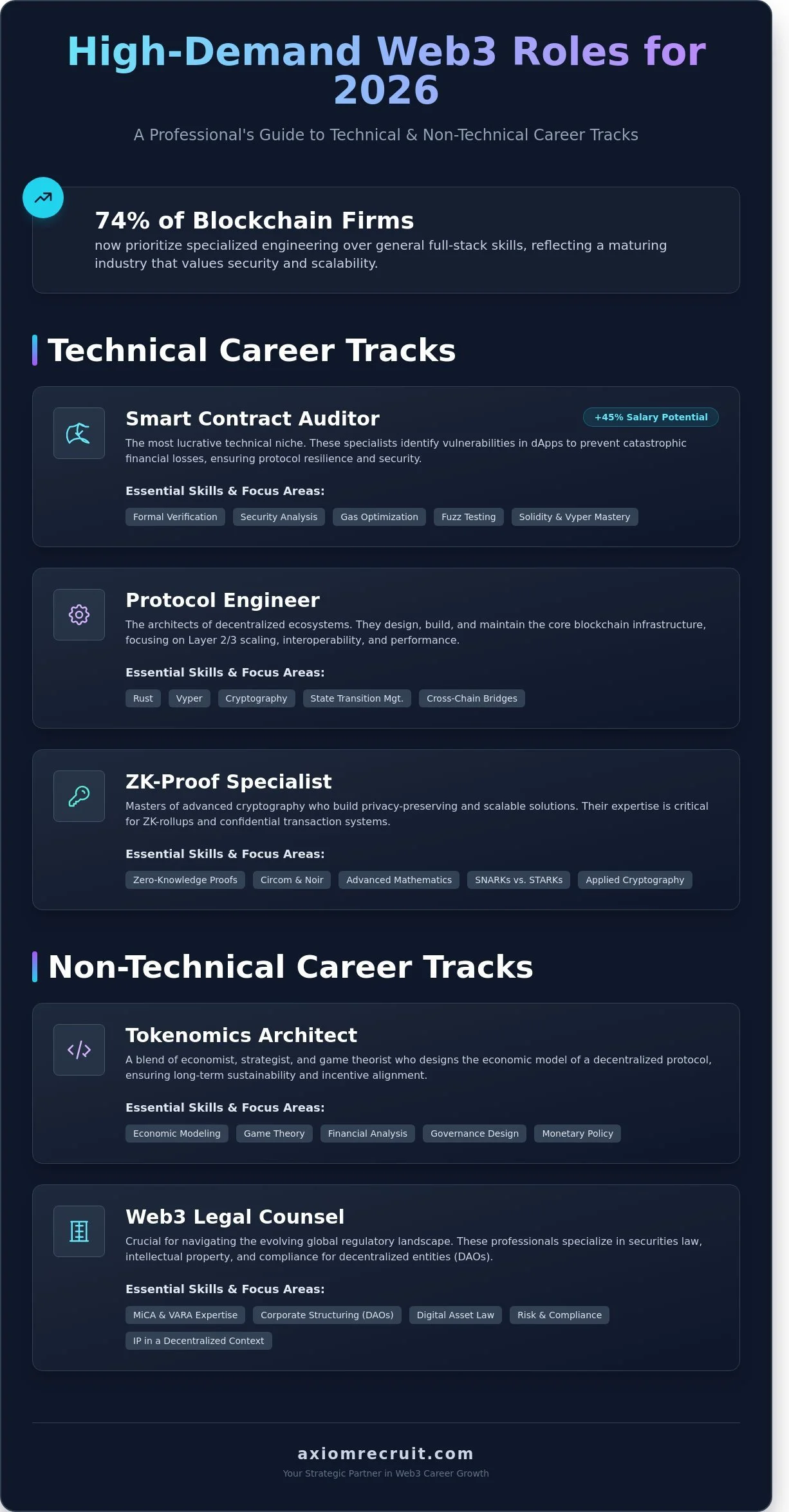
The landscape for web3 careers has transformed since the initial 2021 boom. Data from 2025 shows that 74% of blockchain firms now prioritize specialized engineering over general full-stack skills. This shift reflects a maturing industry that values security and scalability over rapid, experimental deployments. Professionals entering this space today need a clear roadmap to navigate these increasingly distinct career paths.
The Developer Track: Coding the Future
While Solidity remains the entry point for smart contract development, it's no longer the ceiling. High-value infrastructure projects in 2026 rely heavily on Rust and Vyper for their memory safety and efficiency. This is particularly true for developers working on Layer 2 and Layer 3 scaling solutions, where performance is non-negotiable. Protocol Engineers are now the architects of these ecosystems, managing complex state transitions and cross-chain interoperability.
Security has become the most lucrative niche within the technical track. Smart contract auditors often earn 45% more than standard developers because a single vulnerability can result in millions of dollars in lost capital. Many professionals are investing in Web3 skills specifically related to Zero-Knowledge (ZK) proofs and formal verification to meet this demand. These specialists ensure that decentralized applications (dApps) remain resilient against the sophisticated exploits that characterized the early 2020s.
The Growth and Operations Track
Non-technical roles have undergone a similar evolution. The 2026 job market distinguishes clearly between Community Management and Community Ecosystem Building. A manager might moderate a chat, but an Ecosystem Builder designs the incentive structures that keep a DAO active and solvent. They work closely with Tokenomics Architects, who use mathematical modeling to ensure a project's long-term economic stability. These roles often command salaries exceeding $185,000 at the mid-to-senior level.
Marketing strategies have also pivoted. The era of loud influencer promotions ended by 2024, replaced by technical content strategy. Companies now hire experts who can translate complex protocol upgrades into clear, value-driven narratives for developers and institutional partners. Product Managers in this space don't just manage features; they manage decentralized roadmaps and navigate the nuances of DAO governance. They act as the bridge between technical feasibility and community desire.
Success in these roles requires a strategic partnership with a team that understands the local and global market. If you're ready to transition, you can register with our consultants to explore bespoke opportunities in the tech sector.
AI-Web3 Hybrids and Executive Leadership
The convergence of AI and blockchain has birthed entirely new roles. Agent developers are now building autonomous entities that can execute on-chain transactions without human intervention. Alongside them, decentralized compute managers oversee the hardware networks that power these AI models. These hybrid roles require a deep understanding of both large language models (LLMs) and cryptographic security.
At the executive level, the "Web3-literate" COO and CFO have become essential. These leaders don't need to write code, but they must understand on-chain treasury management and the legal implications of decentralized structures. Web3 legal counsel roles have grown by 40% since 2023 as firms seek to navigate the global regulatory frameworks established in the last three years. These leaders provide the grounded, dependable oversight necessary for long-term stability in a fast-moving industry.
Essential Skills and Certifications for the 2026 Market
Success in 2026 requires more than a basic understanding of blockchain. The industry has moved past the experimental phase, demanding specialists who can handle complex infrastructure. Technical proficiency now centers on Zero-Knowledge Proofs (ZKP). These are vital for scaling networks and ensuring user privacy. Developers must also master cross-chain interoperability protocols like LayerZero or Chainlink’s CCIP. These tools allow different blockchains to talk to each other, which is a requirement for 85% of new decentralized applications launched this year.
Theoretical knowledge is just as critical. You need a deep grasp of Decentralized Autonomous Organization (DAO) mechanics. This includes understanding "degovernance," a shift where protocols move from active human voting toward automated, immutable code. Navigating these models requires a blend of legal logic and game theory. If you're exploring Top Web3 Job List options, you'll see that employers value candidates who understand the friction between decentralized ideals and practical operations.
Soft skills have evolved for the remote-first environment. Since 70% of Web3 teams operate across at least three different time zones, asynchronous communication is a non-negotiable skill. You must be able to document your work clearly and collaborate across cultures without real-time meetings. Market intelligence is the final piece of the puzzle. Professionals need to track global shifts, such as the UK’s Financial Services and Markets Act 2023 or the UAE’s VARA frameworks. In the US, the 2024 FIT21 Act has changed how we categorize digital assets. Staying informed on these specific regulations makes you a dependable partner for any firm looking to hire for web3 careers.
Bridging the AI-Web3 Skill Gap
The role of a developer has shifted toward being an AI-orchestrator. You don't just write Solidity; you use Large Language Models to generate, audit, and debug smart contracts. Data science is also merging with blockchain. Companies now use tools like Dune Analytics to extract on-chain data for business intelligence. Mastering prompt engineering specifically for smart contract security is a high-value niche. It’s about using AI to find vulnerabilities before a contract goes live on the mainnet.
Where to Learn: Reputable 2026 Resources
Your resume needs to show "Proof of Work" rather than just a list of titles. Contributing to Open Source projects on GitHub is the most effective way to prove your value. Real employers look for at least 6 to 12 months of active repository history. For structured learning, Alchemy University and Encode Club remain the most reputable developer bootcamps. They provide hands-on experience that mirrors actual industry challenges. It's vital to avoid "certificate mills" that offer 48-hour courses with no practical testing. A certification only holds weight if it’s backed by a portfolio of deployed contracts or active governance participation. This grounded approach is what helps candidates secure long-term stability in web3 careers.
Axiom Recruitment is here to help you find your place in this fast-moving sector. We act as a bridge between your technical expertise and the companies that need it most. Our team focuses on results-oriented placements that value your unique skill set.
How to Land Your Dream Web3 Job: A Tactical Guide
Transitioning into web3 careers requires a fundamental shift in how you present your expertise to the market. Traditional resumes often take a backseat to verifiable contributions and decentralized social proof. You should start by curating a digital footprint that speaks for itself. This means active participation on GitHub for developers, publishing deep-dives on Mirror for researchers, and building a reputation on decentralized social protocols like Farcaster or Lens. These platforms allow you to own your professional data and prove your engagement with the ecosystem long before you submit an application.
Building an On-Chain Portfolio
Your public wallet address is quickly becoming your new CV. Hiring managers in 2024 look for "skin in the game" by reviewing your on-chain history. This includes your voting record in DAOs, your participation in testnets, or the NFTs you hold that represent completed courses. Contributing to Decentralized Autonomous Organizations (DAOs) is a strategic way to get noticed. By being useful first, you bypass the crowded inbox. In June 2023, a junior developer secured a high-paying role at a Tier 1 DeFi protocol after submitting a single, high-impact pull request to their open-source repository. This contribution fixed a critical bug in the protocol's liquidity pool logic, demonstrating immediate value.
Navigating Global Web3 Hubs
While the industry is remote-first, physical hubs provide concentrated networking opportunities. Dubai has emerged as a global leader following the March 2022 establishment of the Virtual Assets Regulatory Authority (VARA). The city’s 0% personal income tax and clear regulatory framework attracted over 500 crypto-related firms by the end of 2023. In London, the UK government’s 2023 Financial Services and Markets Act signals a clear intent to become a "crypto hub," which has already spurred the creation of 1,200 new roles in the city’s fintech district. If you are pursuing US remote work, stay mindful of legal complexities. Approximately 45% of web3 startups now offer tokens as part of their total rewards, requiring careful tax planning and legal review.
Networking in this space has moved beyond the formal structures of LinkedIn. You'll find the most relevant opportunities in "dark social" channels like Discord servers and Telegram groups. Attending global conferences like EthCC or Permissionless is also vital for building face-to-face trust. When you land the interview, be prepared for a rigorous technical and cultural evaluation. You should expect:
- Live Coding or Technical Audits: Testing your ability to write secure smart contracts or optimize gas costs in real-time.
- Tokenomics Defense: Explaining how specific supply schedules or staking mechanisms affect the long-term health of a protocol.
- Culture Fit: Demonstrating a "crypto-native" mindset that values decentralization, transparency, and open-source collaboration.
Negotiating your compensation package is the final hurdle. It’s essential to understand the balance between a stable base salary and token grants. A standard offer in 2024 typically includes a four-year vesting schedule with a 12-month cliff. This means you must stay with the company for at least one year before any tokens are earned. Always calculate the potential upside of the tokens, but ensure your cash base covers your primary living expenses. This grounded approach ensures you remain financially secure while participating in the growth of the protocol.
Ready to take the next step in your professional journey? Partner with Axiom Recruitment to find your place in the future of web3 careers.
Strategic Career Growth: Why Partnering with Axiom Recruit Matters
Most job seekers treat web3 careers as a numbers game. They spend hours applying to dozens of roles on generic boards, only to receive automated rejections. Axiom Recruit operates differently. We aren't just a database; we're a strategic partner that understands the nuances of decentralized technology. A standard job board can't tell you about a protocol's internal culture or its long-term funding stability. We can.
Our team leverages deep market intelligence to find roles that never reach public listings. In 2024, internal data suggests that approximately 72% of high-level positions in the blockchain and AI sectors are filled through private networks. By partnering with us, you gain access to this "invisible" job market. Our consultants in Dubai, London, and the US maintain direct relationships with founders and venture capital firms. This ensures you're positioned for opportunities before the competition even knows they exist.
Personalized coaching is a cornerstone of our service. We don't just pass your resume along; we refine it. Our 360-degree audits ensure your GitHub contributions and project history align with exactly what hiring managers want. When it comes to the final stages, our negotiation support is invaluable. Candidates who utilize our expert advocacy often secure compensation packages 15% to 20% higher than those who negotiate alone. We help you articulate your value so you're paid what you're truly worth.
We also focus on long-term career mapping. Moving from a senior developer to a CTO or Head of Ecosystem requires a deliberate strategy. We work with you to identify the specific skills and leadership milestones needed to reach those goals. Whether it's shifting from an individual contributor role or stepping into a C-suite position, we build a roadmap that spans years, not just months.
Beyond the Placement: Our Long-Term Commitment
Our support doesn't stop once you sign an offer letter. We provide structured onboarding assistance to help you integrate into fast-paced, remote-first Web3 environments. We also offer continuous salary benchmarking. Using real-time data from our 2024 global placements, we ensure your pay stays competitive as the market evolves. Our global network in Dubai and London provides a "local" touch, helping you navigate regional regulatory shifts and networking events in the world's primary tech hubs.
Take the Next Step in Your Web3 Journey
Your career deserves more than a "quick win" approach. Axiom Recruit offers bespoke solutions for both permanent and contract roles, ensuring you find the flexibility you need. For senior leaders, our executive search function provides a discreet, high-touch pathway to the most influential roles in the industry. Stop browsing and start building. It's time to register your CV and discover 2026 Web3 opportunities with a partner that values your professional legacy.
Secure Your Future in the Decentralized Economy
The transition from speculative hype to a utility-driven market is complete. By 2026, specialized roles in smart contract auditing and decentralized governance have become the backbone of the global economy. You've learned that success in web3 careers now requires a precise blend of technical certifications and an adaptable, non-technical mindset. Standing out in this competitive landscape means moving beyond basic job boards and adopting a more tactical, partnership-driven approach to your professional growth.
Axiom Recruit has specialized in Blockchain and AI recruitment since 2021, providing the stability and expertise needed to navigate these shifts. With a physical presence in Dubai, London, and Malta, we offer a global perspective combined with local market insights. Our success-based recruitment model includes expert candidate coaching, ensuring you're fully prepared to meet the high standards of today's top decentralized firms. Don't leave your professional trajectory to chance when you can leverage a proven network built on results and trust.
Find your next Web3 career opportunity with Axiom Recruit and take the next step toward a resilient, high-impact role. We're here to help you turn your expertise into a long-term advantage.
Frequently Asked Questions
Do I need to know how to code to have a career in Web3?
No, you don't need coding skills for roughly 40% of roles in the industry. While developers are in high demand, companies require specialists in community management, legal compliance, and strategic marketing to scale. In 2024, non-technical web3 careers grew by 15% as protocols matured into full-scale businesses. You'll find success by bringing traditional expertise in project management or finance to decentralized teams that value operational stability.
What are the highest-paying Web3 jobs in 2026?
Smart Contract Auditors and AI-Web3 Architects will command the highest salaries, often ranging from $200,000 to $350,000 annually. By 2026, the convergence of machine learning and blockchain will create a premium for engineers who can secure automated protocols. Data from the 2024 Crypto Salary Report shows that senior security researchers already earn 30% more than generalist front-end developers. These roles offer significant financial rewards for those with specialized technical depth.
How do I transition from a traditional tech (Web2) role to Web3?
Start by applying your existing React or Node.js skills to decentralized applications while building a public portfolio on GitHub. Most Web2 professionals successfully transition by contributing to open-source projects or completing 30-day bootcamps like those offered by Alchemy University. Our data indicates that 65% of successful hires in the last year moved from traditional SaaS companies into blockchain roles. Focus on proving your ability to adapt to distributed systems and asynchronous workflows.
Is remote work still the standard for Web3 careers?
Remote work remains the standard, with approximately 80% of blockchain organizations operating as remote-first entities in 2024. This flexibility allows firms to source global talent without geographical constraints. However, 15% of startups now implement quarterly hacker houses or in-person retreats to foster team cohesion. For many pursuing web3 careers, this hybrid approach provides the perfect balance of daily autonomy and periodic face-to-face collaboration with expert colleagues.
How do token grants work in a compensation package?
Token grants typically follow a four-year vesting schedule with a one-year cliff, similar to traditional equity. This means you'll receive 25% of your total allocation after your first twelve months of service. According to a 2023 survey by RadicalxChange, these grants can represent 30% to 50% of a senior hire's total compensation. It's essential to review the project's tokenomics and lock-up periods to understand the real-world value of your offer.
What impact does AI have on Web3 developer jobs?
AI is currently increasing developer productivity by an estimated 40% through automated code generation and bug detection. Rather than replacing roles, AI tools like GitHub Copilot allow developers to focus on high-level architecture and security logic. A 2024 report by Electric Capital notes that developers using AI assistants ship code 2.5 times faster than those who don't. This shift makes proficiency in AI-assisted development a mandatory skill for modern blockchain engineers.
Which blockchain ecosystem should I specialize in for the best career prospects?
Ethereum remains the leader for job volume, but Solana is seeing a 20% year-on-year increase in developer activity. Specializing in Solidity for Ethereum or Rust for Solana offers the most stability; these two ecosystems represent over 70% of total decentralized finance value. Choosing a dominant network ensures your skills remain transferable across hundreds of protocols. We recommend mastering one core language to establish yourself as a dependable expert in the field.
Related Posts

Landing the Perfect CTO: 2026 Executive Guide
19 Mar, 2026