Digital asset hiring in the US is shifting toward operational resilience and regulated infrastructure
27 May, 202615 mins

The US digital asset hiring market is entering a different operational phase.
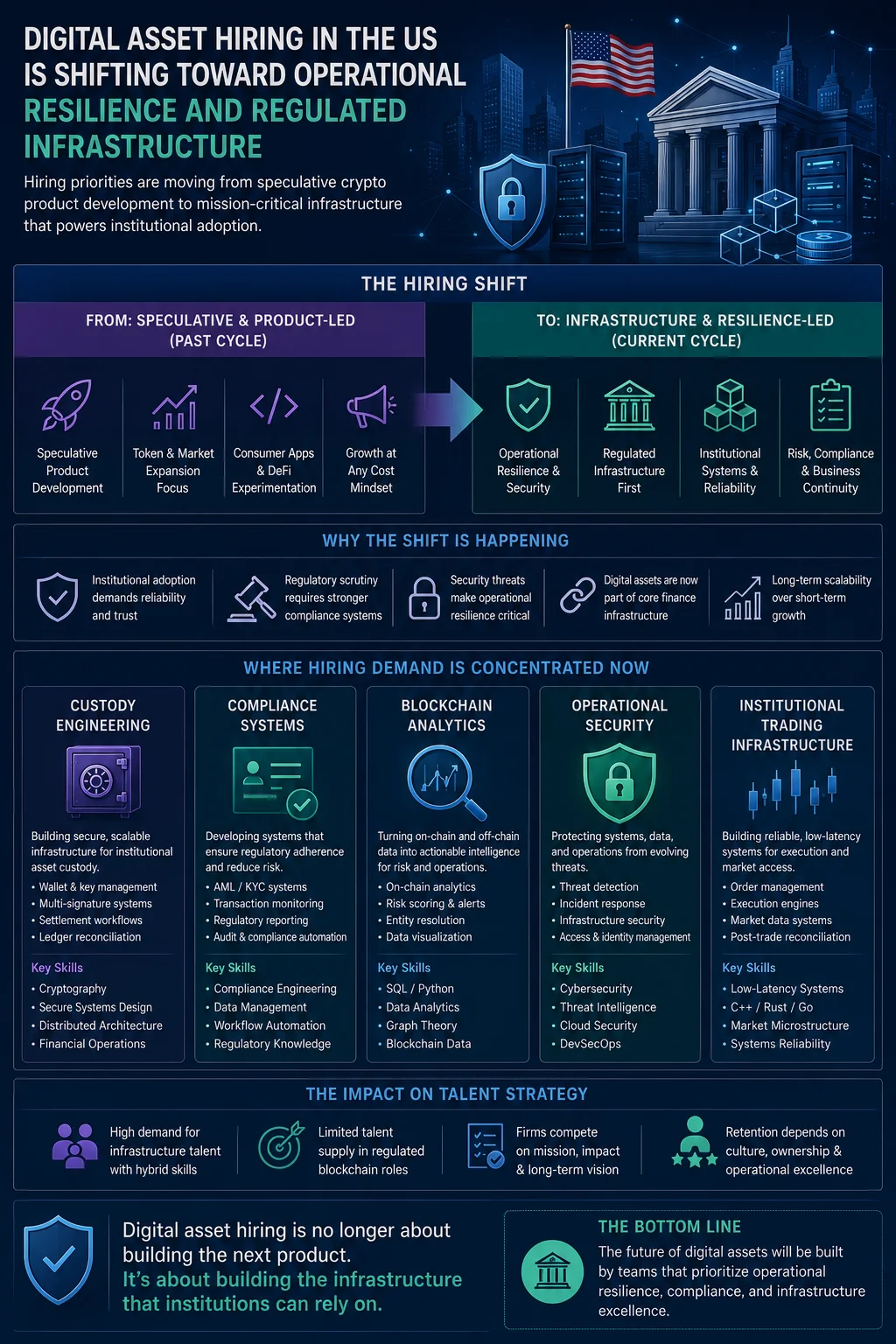
Previous hiring cycles were largely shaped by expansion velocity, token liquidity, and speculative product development. The current environment is increasingly shaped by operational resilience, infrastructure reliability, compliance systems, and institutional risk management.
That shift is reorganising how firms build teams across blockchain and digital asset infrastructure.
The hiring signal is becoming increasingly clear.
Institutional firms no longer view blockchain systems as isolated innovation layers. They are increasingly integrating digital asset infrastructure into broader financial operations environments where reliability, execution correctness, and compliance obligations directly impact business continuity.
This changes the structure of hiring demand across the United States.
The strongest hiring activity is increasingly concentrated around infrastructure-heavy functions rather than speculative application development. That includes:
- Custody systems
- Transaction monitoring
- Stablecoin infrastructure
- Financial reconciliation architecture
- Blockchain data systems
- Institutional trading infrastructure
- Compliance engineering
- Operational security systems
The implications for recruitment are significant because the available candidate market remains structurally limited.
The digital asset market is becoming operationally mature
Hiring behaviour often reveals where industries are structurally evolving before broader narratives catch up.
That pattern is now visible across digital assets.
The operational priorities of firms entering or expanding within blockchain markets increasingly resemble traditional financial infrastructure environments. Firms are prioritising system stability, regulatory survivability, and infrastructure scalability over aggressive product experimentation.
This is particularly visible among:
- Institutional custodians
- Trading infrastructure firms
- Stablecoin issuers
- Payment platforms
- Banking-adjacent fintech companies
- Enterprise blockchain infrastructure providers
In practice, the market is converging around a common infrastructure requirement:
Digital asset systems must now operate under institutional-grade reliability constraints.
That operational shift changes which candidates become strategically valuable.
The strongest hiring demand is now infrastructure-led
The hiring market increasingly rewards engineers and operators capable of maintaining reliability under complex operational conditions.
This differs significantly from earlier blockchain hiring cycles.
The strongest institutional demand now sits inside roles responsible for execution integrity and infrastructure continuity.
Custody infrastructure engineers
Custody systems have become one of the most strategically important infrastructure layers across institutional digital assets.
The reason is relatively straightforward.
Institutional participation depends heavily on secure asset management, operational transparency, and reliable transaction controls. Any failure within custody infrastructure creates both financial and regulatory exposure.
As a result, firms are aggressively hiring engineers capable of building:
- Multi-signature systems
- Secure wallet architecture
- Key management infrastructure
- Ledger reconciliation systems
- Institutional settlement workflows
These roles increasingly require experience across both blockchain systems and financial infrastructure environments.
The strongest candidates often come from adjacent industries such as:
- Cybersecurity
- Banking infrastructure
- Payment systems
- High-security cloud environments
- Financial operations engineering
This reflects a broader shift toward infrastructure discipline over crypto-native familiarity.
Compliance infrastructure specialists
Regulated infrastructure hiring is expanding rapidly across US digital asset markets.
This includes demand for engineers and operational specialists capable of supporting:
- AML systems
- KYC infrastructure
- Audit architecture
- Transaction surveillance
- Reporting automation
- Regulatory monitoring systems
The challenge for many firms is that these roles now require hybrid capability across both blockchain infrastructure and regulated financial systems.
That combination remains relatively rare.
Most traditional fintech compliance professionals lack exposure to blockchain transaction architecture, while many blockchain-native engineers lack operational familiarity with regulated infrastructure environments.
This creates persistent hiring friction across the market.
Blockchain data and monitoring infrastructure
Blockchain observability has become increasingly important as institutional adoption expands.
Firms are investing heavily in systems capable of:
- Monitoring on-chain activity
- Analysing transaction flows
- Detecting operational anomalies
- Supporting compliance reporting
- Managing blockchain analytics pipelines
This is driving demand for engineers experienced in:
- Data infrastructure
- Distributed systems
- Monitoring architecture
- Financial analytics systems
- Blockchain indexing environments
The hiring market for these profiles remains highly competitive across the US.
Why many firms struggle to hire effectively
The largest hiring issue in digital assets is not necessarily compensation.
It is calibration.
Many firms still evaluate candidates using outdated assumptions from earlier crypto cycles. They frequently over-prioritise broad blockchain exposure while underestimating operational infrastructure experience.
That approach increasingly creates hiring mismatches.
The current market rewards candidates capable of operating under institutional constraints including:
- Reliability requirements
- Regulatory obligations
- Security-critical environments
- Financial controls
- Infrastructure scalability
This means the strongest candidates are not always the most visibly “crypto-native.”
In practice, many high-performing institutional hires now come from:
- Capital markets infrastructure
- Cloud reliability engineering
- Cybersecurity systems
- Payment infrastructure
- Enterprise data systems
The hiring market is therefore becoming increasingly adjacent-skill-driven.
This changes how recruitment should operate.
Why specialist recruitment partners matter more in digital assets
Institutional digital asset hiring has become structurally difficult for generalist recruiters.
The reason is not simply technical complexity.
It is systems fragmentation.
The category “blockchain engineer” now includes multiple operationally distinct specialisations including:
- Infrastructure engineering
- Smart contract security
- Compliance architecture
- Distributed systems reliability
- Trading infrastructure
- Blockchain analytics
- Settlement systems
- Custody engineering
A recruiter who cannot distinguish between these operational layers will struggle to evaluate candidate suitability accurately.
This creates downstream hiring risk for firms scaling infrastructure-heavy teams.
Specialist recruiters therefore increasingly provide value through interpretation rather than sourcing volume alone.
The most effective recruitment partners understand:
- Infrastructure role adjacency
- Engineering compensation structures
- Hiring market fragmentation
- Systems-level technical environments
- Institutional operational constraints
This improves hiring precision significantly.
What firms should evaluate in a digital asset recruitment partner
Most firms evaluate recruiters based on candidate speed alone.
That is becoming a weaker hiring metric in infrastructure-heavy environments.
The more valuable signal is whether a recruitment partner understands the operational systems behind the roles themselves.
Infrastructure understanding
A strong recruitment partner should understand how blockchain infrastructure interacts with:
- Financial systems
- Compliance environments
- Distributed architecture
- Security operations
- Trading infrastructure
This allows stronger candidate calibration and reduces hiring mismatch risk.
Access to passive infrastructure talent
The strongest infrastructure engineers are rarely applying directly to jobs.
Most operate inside operationally mature environments where they are already highly compensated.
That means successful hiring increasingly depends on targeted relationship networks rather than inbound recruitment channels.
This is especially important for:
- Custody infrastructure
- Trading systems
- Security engineering
- Distributed reliability systems
Compensation intelligence
Digital asset compensation remains structurally volatile.
Compensation varies significantly depending on:
- Institutional exposure
- Security responsibility
- Infrastructure criticality
- Regulatory complexity
- Remote flexibility
- Equity versus token structures
Recruitment partners who understand these dynamics can help firms benchmark more realistically against competing infrastructure markets.
Where Axiom supports institutional digital asset hiring
Axiom operates across blockchain infrastructure, fintech systems, AI infrastructure, and institutional engineering markets.
That positioning reflects how the hiring market itself is evolving.
The strongest institutional candidates increasingly move across adjacent infrastructure systems rather than remaining inside narrow industry categories.
Axiom’s recruitment model focuses on infrastructure capability and systems alignment rather than purely surface-level blockchain exposure.
This supports hiring across:
- Custody systems
- Blockchain infrastructure
- Compliance-heavy engineering
- Institutional trading architecture
- Financial operations systems
- Distributed reliability engineering
The advantage for clients is improved hiring calibration within increasingly fragmented infrastructure markets.
The US market is becoming increasingly selective
The broader digital asset hiring environment is also becoming operationally selective.
Institutional firms are hiring more cautiously than during previous cycles. Smaller teams are being expected to operate larger infrastructure environments with higher reliability expectations.
This increases pressure on hiring quality.
Firms now prioritise:
- Operational maturity
- Reliability engineering
- Infrastructure scalability
- Security discipline
- Compliance survivability
rather than broad expansion hiring.
This is likely to remain the dominant hiring pattern across institutional digital assets throughout the next market cycle.
Final thoughts
Digital asset hiring in the United States is increasingly behaving like institutional infrastructure hiring rather than speculative technology hiring.
That shift is reshaping:
- which roles matter most,
- which candidates command premium compensation,
- and which recruitment strategies remain effective.
The strongest hiring demand now sits around operationally critical systems responsible for reliability, security, compliance, and institutional execution.
For firms scaling infrastructure-heavy blockchain teams, recruitment quality increasingly depends on whether hiring partners understand the systems architecture behind the roles themselves.
That is where infrastructure-focused recruitment partners become operationally valuable.
Axiom supports institutional digital asset hiring across blockchain infrastructure, fintech systems, compliance-heavy engineering, and distributed financial architecture environments.
Frequently Asked Questions
Q: What roles are most in demand in digital asset hiring?
Infrastructure engineers, custody specialists, compliance engineers, blockchain data engineers, and institutional trading infrastructure professionals remain among the highest demand roles.
Q: Why is digital asset hiring becoming more infrastructure-focused?
Institutional adoption requires operational reliability, regulatory survivability, and infrastructure maturity rather than speculative product expansion alone.
Q: Why do firms struggle to hire blockchain infrastructure talent?
The strongest candidates often operate in adjacent infrastructure markets such as fintech, cloud systems, cybersecurity, and trading infrastructure rather than purely crypto-native environments.
Q: How does Axiom support digital asset hiring?
Axiom helps firms hire infrastructure and operational talent across blockchain systems, fintech infrastructure, institutional trading architecture, compliance engineering, and distributed systems environments.