
Building Your ML Team: Your 2026 Strategy Playbook
23 Mar, 202615 mins

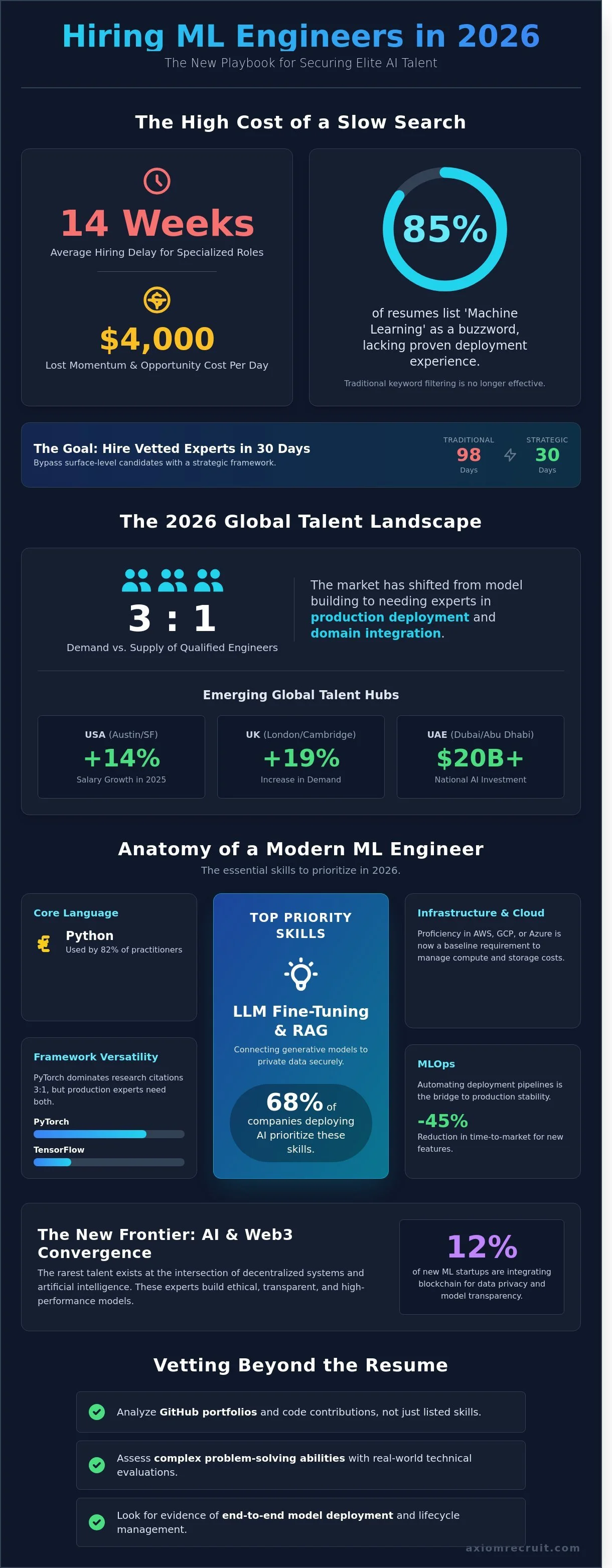
What if the stack of 250 resumes on your desk contains plenty of Python users, but not a single expert capable of deploying a production-ready model? You aren't alone; many CTOs currently face 14 week hiring delays because they can't find specialists who truly grasp the convergence of AI and decentralized systems. When you need to hire machine learning engineer talent in 2026, the standard recruitment filters often fail to catch the nuances of technical depth and cultural fit.
We understand that a slow hiring process doesn't just stall a project; it costs your business an average of $4,000 per day in lost momentum. This guide provides a strategic roadmap to identify and secure a vetted ML expert within 30 days. You'll learn how to bypass surface-level candidates and leverage local market intelligence in hubs like Dubai and London to build a resilient, future-proof team.
We'll walk through our proprietary vetting framework, the specific skills required for AI-Blockchain integration, and the retention strategies that keep your top performers engaged for the long haul.
Key Takeaways
- Understand the shift in the 2026 talent landscape, where deployment and domain integration are now as critical as model building.
- Explore the modern ML stack to prioritize candidates with specialized expertise in LLM fine-tuning and Retrieval-Augmented Generation (RAG).
- Master a technical evaluation framework to hire machine learning engineer experts by looking beyond resumes to GitHub portfolios and complex problem-solving.
- Evaluate strategic hiring models to decide between long-term permanent growth and project-based scaling for your specific AI roadmap.
- Gain a competitive edge by accessing the "hidden" talent market through niche recruitment strategies tailored for the Blockchain and AI sectors.
The State of Machine Learning Talent in 2026
The market for artificial intelligence has shifted from experimental pilots to heavy industrial deployment. By early 2026, the demand to hire machine learning engineer experts has outpaced the supply of qualified software developers by a 3:1 margin in major tech hubs. Companies no longer look for someone who can merely train a model in a vacuum. They want engineers who can bridge the gap between abstract mathematics and production-ready code. Understanding The State of Machine Learning Talent in 2026 requires recognizing that the early "AI gold rush" created a significant noise problem; 85% of resumes now include machine learning as a buzzword, regardless of the candidate's actual ability to deploy scalable systems.
Market trends show a clear geographical divide in talent movement. In the US, salary growth for specialized roles hit 14% in 2025, specifically in cities like Austin and San Francisco. The UK market, centered on the London-Cambridge corridor, has seen a 19% increase in demand for engineers with deep-tech academic backgrounds. Meanwhile, the UAE has invested over $20 billion into its National Strategy for AI. This massive capital injection has turned Dubai and Abu Dhabi into primary destinations for talent seeking tax-free incentives and high-scale infrastructure projects. If you want to hire machine learning engineer talent that actually moves the needle, you have to look beyond local borders and tap into these emerging global hubs.
Traditional keyword-based recruiting has become obsolete. Finding a Python expert doesn't help if they can't manage a vector database or optimize inference costs for a mobile application. Specialized niches are now the standard. An engineer who excels in Computer Vision for autonomous vehicles often lacks the specific knowledge required for Natural Language Processing in a legal-tech context. You need a recruitment partner who understands these granular distinctions and can vet candidates based on their architectural contributions rather than a list of libraries on a LinkedIn profile.
The Evolving ML Job Description
Modern ML roles are inherently multi-disciplinary. You're no longer hiring for a single skill set; you're looking for full-stack data awareness. This includes MLOps to ensure models stay accurate after deployment and Research Science to create proprietary architectures. Before reaching out to a consultant, you must define if you need a generalist to build foundational pipelines or a specialist to refine a specific vertical. Axiom Recruit's bespoke solutions help you identify these needs early, ensuring you don't waste time on candidates who don't fit your technical stack.
AI and Web3 Convergence
Decentralized AI is the newest frontier for top-tier talent. By 2026, roughly 12% of new ML startups are integrating blockchain to ensure data privacy and model transparency. These roles require a rare mix of cryptographic knowledge and neural network expertise. Axiom Recruit acts as a strategic partner here, identifying professionals who understand both distributed ledgers and large language model fine-tuning. We bridge the gap between these two high-growth sectors, helping you find the rare talent capable of building ethical, decentralized systems that protect user data while delivering high-performance intelligence.
Defining the Modern ML Stack: Skills to Prioritize
When you start the process to hire machine learning engineer talent, the baseline requirements have shifted significantly since 2022. Python remains the primary language for 82 percent of practitioners according to recent industry surveys, providing the essential foundation for any robust AI project. While PyTorch has overtaken TensorFlow in research citations by a margin of three to one, a dependable engineer should be comfortable with both to handle diverse production environments. This versatility allows your team to adapt when a specific project requires the massive ecosystem of TensorFlow or the flexible debugging of PyTorch.
Today's stack requires more than just building models from scratch. Expertise in Large Language Model (LLM) fine-tuning and Retrieval-Augmented Generation (RAG) has become a top priority for 68 percent of companies deploying AI in 2024. These skills allow your team to connect generative models to your private data safely. Without this expertise, models often lack the specific context needed to provide business value, leading to generic outputs that don't solve your specific industry challenges.
Infrastructure knowledge is now just as vital as mathematical prowess. Your engineers must be proficient in cloud ecosystems like AWS, GCP, or Azure to manage the high costs of compute and storage. MLOps is the bridge between model development and production stability. A candidate who understands how to automate deployment pipelines can reduce the time-to-market for new features by up to 45 percent, ensuring that your models don't just sit in a notebook but actually serve users in real-time.
Technical Proficiencies for Senior Roles
Senior roles demand a deep understanding of distributed training to manage datasets that exceed the memory of a single machine. By 2026, a candidate's familiarity with specialized hardware like NVIDIA's H100 GPUs or Google's TPU v5p will be essential for maintaining performance at scale. This technical depth ensures that your Building Your AI Team: Strategic Hiring Models strategy is supported by individuals who can navigate the complexities of modern hardware constraints while optimizing for both speed and cost efficiency.
Emerging Skills to Watch
Privacy is becoming a central pillar of AI development. Knowledge of zero-knowledge proofs (ZKP) is an emerging requirement for engineers working on private AI applications, particularly in regulated industries like finance. If you want to hire machine learning engineer candidates who can future-proof your operations, look for experience with autonomous agent frameworks and multi-agent systems, which are projected to handle 30 percent of routine enterprise tasks by 2027. Often, deep domain knowledge in areas like Fintech or Healthcare outweighs general coding speed, as it leads to a 20 percent reduction in logic errors during the initial design phase.
Technical skills are only half the battle. Your hire must possess the soft skills to translate complex math into business value for non-technical stakeholders. They need to explain why a specific model architecture was chosen and how it impacts the bottom line. This level of communication prevents silos and ensures that AI initiatives remain aligned with your company's broader strategic goals. We take pride in finding these well-rounded experts through our bespoke recruitment solutions, ensuring your next hire is both a technical powerhouse and a cultural fit for your local team.
How to Vet ML Engineers: A Technical Evaluation Framework
Vetting talent requires more than a quick glance at a CV. In 2023, data from technical hiring platforms showed that 72% of machine learning candidates fail at the practical application stage despite having strong academic credentials. When you hire machine learning engineer experts, start your evaluation with their GitHub repositories and portfolios. Look for a consistent commit history over at least 12 months rather than a single, massive project upload. A strong portfolio doesn't just show a finished model; it demonstrates how the engineer handled data preprocessing and why they chose specific architectural paths.
The technical interview must move beyond basic algorithms. While live coding helps assess syntax knowledge, it often fails to measure how a candidate thinks about probability or linear algebra. Reference materials like Stanford's Machine Learning Course (CS229) provide a benchmark for the foundational theory every senior engineer should master. You're looking for someone who understands the "why" behind a specific loss function, not just someone who can import a library and run a script. This deep theoretical knowledge ensures they can troubleshoot when a model behaves unexpectedly in production.
System design challenges are the true test for scale and reliability. Ask the candidate to map out an architecture that handles 10,000 requests per second with sub-100ms latency. This reveals their understanding of model deployment, monitoring, and infrastructure. Cultural alignment is equally vital for a successful partnership. A researcher who thrives in a five-year lab cycle might struggle in a fast-paced retail startup where features ship every 14 days. We prioritize matching an engineer's work rhythm with your company's specific operational needs to ensure a strategic, long-term fit.
Designing the Perfect Technical Test
Forget generic coding puzzles. Instead, provide a dataset with 15% missing values or inconsistent labels. This tests how they handle "dirty" data, which occupies 80% of an engineer's time according to a 2022 Anaconda survey. We've found that a 48-hour paid trial project is the most reliable predictor of success. It allows you to see their work ethic and communication style in a real-world scenario before you commit to a permanent hire machine learning engineer contract.
Red Flags to Watch For
- Over-reliance on pre-trained models: Be wary of candidates who use GPT-4 or ResNet without explaining the underlying math.
- Poor documentation habits: If their research code lacks version control, they'll likely create technical debt that costs your business thousands later.
- Ignoring ethics and bias: An engineer who doesn't check for demographic parity in their training data can expose your company to significant legal risks.
By focusing on these practical markers, you move from guesswork to a data-driven hiring process. This grounded approach ensures your new hire can build models that are not only accurate but also scalable and ethically sound.
Building Your AI Team: Strategic Hiring Models
Choosing the right engagement model defines your technical velocity and long-term stability. In the 2026 market, the demand for specialized AI talent outpaces supply by approximately 22 percent. This scarcity requires a bespoke approach to recruitment. You must decide whether to embed talent deeply into your culture or tap into the agility of the global gig economy. Our dedicated consultants help you weigh these options against your current burn rate and product milestones.
Global markets offer distinct advantages depending on your operational base. Dubai has become a primary hub due to the National Strategy for Artificial Intelligence 2031, attracting top-tier talent with tax-free incentives. London remains the European epicenter for R&D, while US hubs like Austin and Seattle continue to set the pace for high-scale engineering. If you need to hire machine learning engineer experts, we bridge the gap between these local communities and your specific project requirements.
Leadership roles require an even more nuanced touch. Finding a Head of AI or a Lead Architect isn't just about vetting technical skills; it's about securing a visionary who can execute your 2026 roadmap. These executive-level hires drive the institutional standards that attract junior talent. We use a results-oriented search process to identify leaders who have successfully moved models from experimental notebooks to production environments at scale.
Financial planning for 2026 requires updated benchmarks to remain competitive. Current data indicates the following salary ranges for senior-level roles:
- London: £135,000 to £185,000 base plus equity.
- Dubai: $155,000 to $210,000 (tax-free) with housing allowances.
- United States: $215,000 to $310,000 depending on the tech hub.
The Case for Permanent Recruitment
Building institutional knowledge is the primary benefit of permanent hires. When you bring an engineer on staff, they take full ownership of the model lifecycle, from data ingestion to long-term maintenance. Axiom’s contingency model minimizes your risk here; we handle the heavy lifting of sourcing and initial vetting. You only invest when we find the perfect cultural and technical fit for your long-term growth.
Flexible Workforce: Contract and RPO
Scaling quickly for a Series B funding round or a specific product launch requires a different set of tools. Using contractors allows you to inject specialized skills, such as Natural Language Processing or Computer Vision, without the long-term overhead of a full-time salary. Our Recruitment Process Outsourcing (RPO) services manage the compliance and payroll for international talent in over 15 countries, letting you focus on the code. Finding the right time to hire machine learning engineer contractors can save your project timeline when internal resources are stretched thin.
Ready to scale your technical capabilities with a partner who understands the local and global market? Partner with Axiom Recruitment to find your next AI leader.
Partner with Axiom: Specialist ML Recruitment for AI & Web3
Finding the right fit for a high-stakes technical role requires more than a standard search. At Axiom, we focus exclusively on the intersections of Blockchain, Web3, and Artificial Intelligence. This narrow specialization ensures we don't waste your time with generalist candidates who lack the deep mathematical or architectural knowledge required for high-level machine learning roles. Since our founding in 2017, we've built our reputation on understanding the specific friction points of these emerging sectors.
The talent you need often remains invisible to traditional recruiters. Our internal database contains over 18,500 vetted professionals, and 82% of our successful placements come from this "hidden" network of passive candidates who aren't active on job boards. When you decide to hire machine learning engineer talent through Axiom, you're accessing a pipeline built through years of networking at global conferences and technical forums. We've successfully placed lead engineers in 22 different countries, bridging the gap between talent in established hubs like London and the rapidly growing demand in Dubai's tech districts.
Our track record reflects our commitment to precision. In 2023, we helped a London-based fintech startup scale their engineering department by 120% in just six months, focusing on specialists in predictive modeling and natural language processing. For a Dubai-based enterprise, we reduced the average time-to-hire by 35%, securing three senior researchers for their proprietary LLM project. We handle the heavy lifting of technical vetting so your internal teams can focus on building products rather than sifting through mismatched resumes.
- Niche Expertise: We only operate in AI, Web3, and Blockchain, ensuring deep market knowledge.
- Global Infrastructure: Physical offices in Dubai and London provide a local touch with a global reach.
- Vetted Talent: Every candidate undergoes a rigorous screening process tailored to your specific tech stack.
- Proven Stability: We prioritize long-term placements, with a 94% candidate retention rate after the first year.
Our Consultative Process
We provide more than resumes; we deliver market intelligence. Our journey begins with a deep dive into your specific tech stack, whether you're working with PyTorch, TensorFlow, or specialized Web3 frameworks. We act as your local recruitment partner in key hubs, providing real-time data on candidate expectations and regional hiring trends. Because our consultants speak the language of neural networks and distributed systems, we filter for technical excellence and cultural alignment before the first interview starts. This bespoke approach ensures a seamless onboarding experience for every new hire.
Get Started with Axiom Recruit
Planning for your 2026 hiring needs requires foresight and accurate data. We offer partners access to our latest 2024-2025 salary benchmarks and regional market insights to help you remain competitive in a candidate-driven market. Whether you're a seed-stage startup or a global enterprise, we provide the stability and expertise needed to secure top-tier talent. It's time to build a team that can handle the complexities of tomorrow's technology. Partner with Axiom to find your next ML powerhouse and ensure your project has the technical foundation it deserves.
Future-Proof Your Team for the 2026 AI Shift
Success in the 2026 landscape depends on your ability to identify talent that masters the full ML lifecycle. You've seen how technical vetting must move beyond basic algorithms to focus on model optimization and real-world deployment. When you're ready to hire machine learning engineer experts, you need a partner who understands these specific technical demands. Axiom Recruit specializes in AI, Web3, and Blockchain sectors, providing a success-based permanent recruitment model that ensures you only pay for results. With our 3 physical offices in Dubai, London, and Malta, we maintain a direct pulse on global talent hubs to find your perfect match. It's time to stop settling for generalists and start building with specialists who understand the 2026 tech stack. Our dedicated consultants are standing by to transform your recruitment strategy into a long-term competitive advantage. Let's build something incredible together.
Find Your Next Machine Learning Expert with Axiom Recruit
Frequently Asked Questions
How much does it cost to hire a machine learning engineer in 2026?
In 2026, the average annual cost to hire a machine learning engineer ranges from $165,000 to $210,000 for mid-level roles. This reflects a 12% increase from 2024 rates due to intense competition for generative AI specialists. Total compensation packages typically include an additional 15% in performance bonuses. Our dedicated consultants provide bespoke salary benchmarking to ensure your offer remains competitive in this fast-moving market.
What is the average time-to-hire for an ML engineer through a specialist agency?
You can expect an average time-to-hire of 18 to 24 days when you partner with a specialist agency like Axiom. This is significantly faster than the 55-day industry average for internal HR departments. We maintain a pre-vetted talent pool of 5,000 plus technical professionals. This readiness allows us to present a qualified shortlist within 72 hours of your initial request, accelerating your project timeline.
Should I hire a remote ML engineer or prioritize local talent in hubs like Dubai?
Choosing between remote and local talent depends on your collaboration needs, but 65% of UAE-based firms now prioritize a hybrid model for sensitive ML projects. While remote hiring expands your pool, local talent in hubs like Dubai offers 100% alignment with regional data residency laws and time zones. We act as your local recruitment partner to find candidates who balance office presence with remote flexibility.
What is the difference between an AI engineer and a machine learning engineer?
A machine learning engineer focuses on building and scaling predictive models, while an AI engineer typically integrates these models into broader applications using APIs and LLMs. ML roles require deep expertise in linear algebra and statistical modeling. AI roles often prioritize software engineering and prompt engineering skills. Understanding this distinction helps you hire a machine learning engineer with the exact technical depth your infrastructure requires.
How can I verify the technical skills of an ML candidate if I am not an expert?
You should use standardized 48-hour coding challenges and third-party technical audits to verify skills without being an expert yourself. We provide clients with detailed technical scorecards that rank candidates across 10 core competencies. These reports include a review of their GitHub contributions and past project deployments. This data-driven approach removes guesswork and ensures you only interview candidates with proven, high-level capabilities.
Is it better to hire a permanent ML engineer or a contractor for a new project?
Hire a contractor for 3 to 6-month development sprints, but choose a permanent employee if you're building core intellectual property. Contractors offer immediate 40-hour-per-week availability for specific tasks like model optimization. Permanent hires provide long-term stability and deep institutional knowledge. We offer bespoke solutions for both models, helping you scale your team based on your current 12-month roadmap and budget constraints.
What are the most in-demand ML frameworks in 2026?
The most in-demand ML frameworks in 2026 are PyTorch 3.0, JAX, and Mojo for high-performance model training. PyTorch remains the dominant choice for 78% of research-to-production workflows. JAX has seen a 40% growth in adoption for large-scale transformer models due to its speed. Our consultants track these shifts to ensure the candidates we source are proficient in the latest tools driving the industry forward.
How does Axiom Recruit vet candidates for specialized AI and Web3 roles?
Axiom Recruit vets candidates through a rigorous 5-stage screening process that includes a 30-minute technical interview with a subject matter expert. We verify specific experience in decentralized protocols and neural network architecture for AI and Web3 roles. Only 5% of applicants pass our initial assessment to reach the final shortlist. This strategic partnership ensures you receive high-quality talent that's ready to deliver results from day one.
Related Posts

Landing the Perfect CTO: 2026 Executive Guide
19 Mar, 2026