
Winning the Talent Race: A Modern Sourcing Guide for 2026
08 Apr, 202618 mins

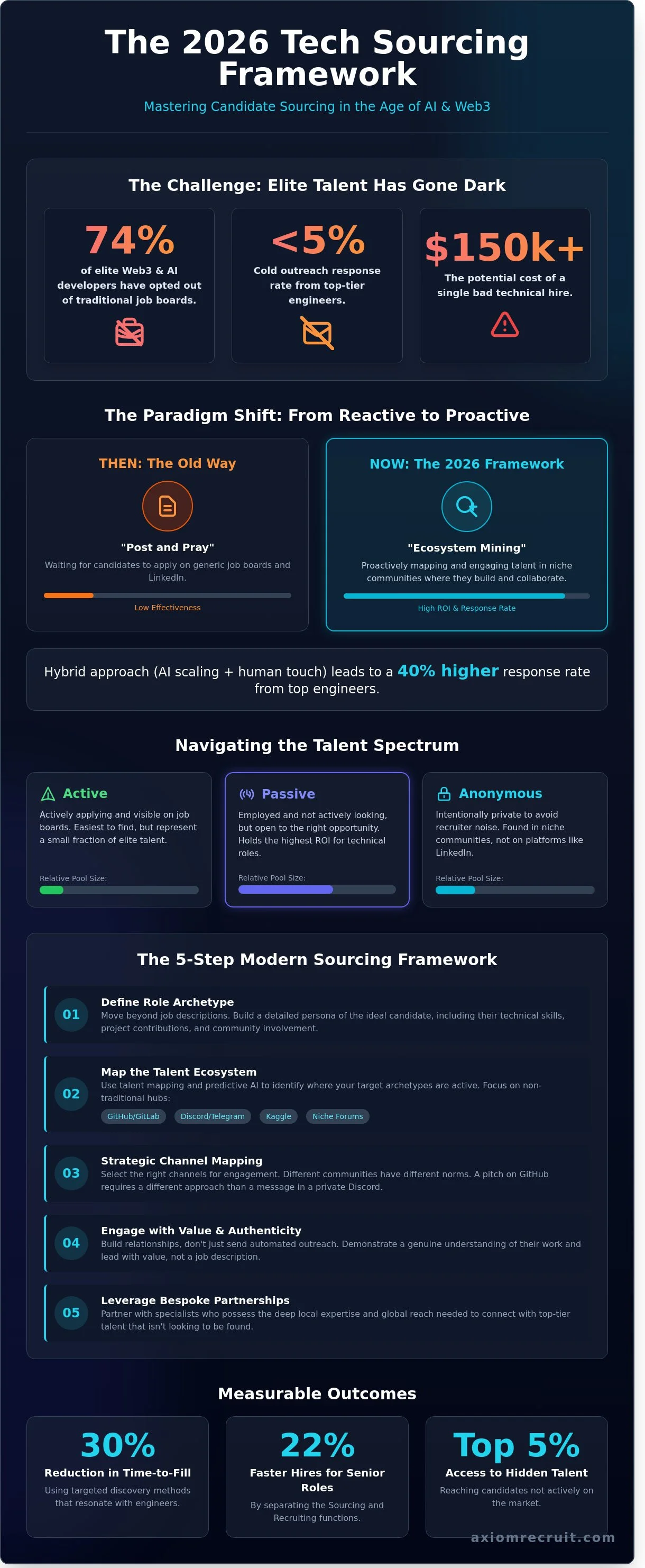
By January 2025, industry data revealed that 74% of elite Web3 and AI developers had opted out of traditional job boards, making a standard candidate sourcing strategy almost obsolete. You’ve likely felt this shift as cold outreach response rates dip below 5% and the cost of a single bad technical hire climbs toward $150,000. It's a challenge to stay ahead when the talent you need is hiding in fragmented global markets and niche communities.
We understand that finding the right fit is about more than just a resume; it’s about building a reliable bridge between your vision and the experts who can build it. This guide will help you master a modern framework designed for the 2026 landscape. We'll show you how to uncover hidden talent in the Blockchain and AI sectors while creating a repeatable process that improves your quality of hire. You’ll learn how to reduce your time-to-fill by 30% using targeted discovery methods that actually resonate with high-level engineers.
Key Takeaways
- Shift from reactive "post and pray" methods to proactive ecosystem mining to find elite talent before they even enter the job market.
- Leverage predictive AI and talent mapping to identify precisely where specialized Web3 and AI developers are active online.
- Understand the three tiers of the talent spectrum and why the "passive" category holds the highest ROI for your technical roles.
- Follow a structured five-step framework to build a modern candidate sourcing strategy that aligns role archetyping with strategic channel mapping.
- Discover how a bespoke recruitment partnership provides the local expertise and global reach needed to secure top-tier blockchain talent.
What is a Candidate Sourcing Strategy in 2026?
In 2026, a candidate sourcing strategy is a proactive, data-driven framework designed to identify and engage high-potential talent before they ever submit an application. It represents a fundamental shift from the reactive "post and pray" methods that dominated the last decade. Instead of waiting for candidates to find them, modern firms engage in "ecosystem mining." This involves using advanced analytics to find talent within specialized communities, open-source repositories, and private professional networks. A well-constructed strategy serves as the foundation of a healthy talent pipeline; it ensures your team isn't starting from zero every time a seat opens up.
Market trends in 2026 show that while AI automation now handles 65% of initial talent identification and data cleaning, the human touch is more critical than ever. Candidates are weary of automated outreach. They respond to recruiters who demonstrate a genuine understanding of their work. A successful candidate sourcing strategy balances these two forces. It uses technology to map the market at scale while reserving human energy for high-value relationship building. Data from 2025 indicates that companies using this hybrid approach see a 40% higher response rate from top-tier engineers compared to those relying solely on automated sequences.
Sourcing vs. Recruiting: Understanding the Distinction
Sourcing is the investigative phase of the broader Recruitment lifecycle. While recruiters focus on the selection, interviewing, and closing stages, sourcers act as the primary talent scouts. This role requires a unique skill set that includes proficiency in Boolean logic, OSINT (Open Source Intelligence) techniques, and a deep familiarity with evolving tech stacks. When these two functions work in a strategic partnership, the results are measurable. Organizations that separate these roles often report a 22% reduction in their average time-to-fill for senior DevOps and AI specialist positions.
Why Generic Strategies Fail in Niche Tech
Relying on LinkedIn alone is a losing game in the Web3 and AI sectors. By early 2026, data showed that 55% of senior developers in these niches had either privatized their profiles or left the platform entirely to avoid recruiter noise. This has led to the rise of the "Passive-Plus" candidate. These individuals are highly skilled, gainfully employed, and intentionally private. Reaching them requires looking where they actually spend their time:
- Niche Repositories: Tracking contributions on GitHub or GitLab rather than just reading resumes.
- Private Communities: Engaging within vetted Discord or Slack groups dedicated to specific languages like Rust or Mojo.
- Local Expertise: Even in a remote-first world, 60% of successful hires in 2025 were influenced by local market knowledge and community presence.
Axiom Recruitment focuses on these nuances. We understand that a bespoke approach is the only way to reach talent that isn't looking to be found. Generic outreach feels like spam; a targeted strategy feels like an opportunity.
The 2026 Tech Sourcing Framework: Beyond the Job Boards
Static job boards lost 38% of their effectiveness for high-level technical roles by the start of 2025. Today, a successful candidate sourcing strategy relies on mapping the digital footprints of engineers where they actually build and collaborate. We view the talent ecosystem as a living map. This involves identifying the specific subreddits, private Slack channels, and niche forums where your target talent solves problems. By 2026, 72% of lead developers report that they ignore generic LinkedIn outreach, making it vital to find them in their natural habitats.
Boolean search and X-raying remain essential skills for the modern recruiter. We use advanced strings to bypass walled gardens and find hidden portfolios on personal domains. For instance, targeting specific "site:github.com" queries combined with "location" and "language" parameters reveals contributors who haven't updated a traditional resume in years. This direct approach ensures you're reaching the top 5% of talent that isn't actively looking but is open to the right conversation.
Mining Non-Traditional Talent Hubs
Discord and Telegram have become the primary engines for Web3 and decentralized finance talent. Recent data from 2025 shows that 64% of crypto-native engineers prefer these platforms for peer review over traditional networking sites. When we look for AI and machine learning expertise, we prioritize Kaggle rankings and GitHub commit frequency. Engaging with these anonymous communities requires a high level of ethics. You've got to lead with value and respect the community norms; never start with a cold pitch. Building a strategic partnership with these communities involves contributing to the discourse before asking for a CV.
AI-Enhanced Sourcing Tools
AI-predictive sourcing is a method of analyzing career trajectories to forecast job changes. By 2026, automated systems handle roughly 85% of the "first pass" identification process, allowing consultants to focus on relationship building. These tools use sentiment analysis to scan public technical discussions, gauging a candidate's "readiness" to move based on their tone and engagement levels. If a developer's public activity suggests they're outgrowing their current stack, the system flags them for a personal follow-up. Integrating these candidate sourcing strategies and best practices into your workflow ensures you're engaging with talent at the exact moment they're ready for a new challenge. This data-driven precision turns cold outreach into a warm, timely invitation.
Active vs. Passive vs. Anonymous: Navigating the Talent Spectrum
By January 2026, the tech recruitment landscape has split into three distinct tiers. Active candidates represent approximately 18% of the available talent pool. These individuals are frequently checking job boards and responding to listings. Passive candidates make up the largest segment at 72%. They're currently employed and aren't looking for a change, yet they remain open to the right conversation. The final 10% consists of "Anonymous" candidates. These are specialized professionals, often in decentralized tech, who prioritize privacy and operate outside traditional professional networks.
Your candidate sourcing strategy must adapt to these shifting demographics to remain effective. Relying solely on active applicants often leads to a "race to the bottom" on salary. In contrast, focusing on the passive tier offers a higher return on investment. A 2025 study by the Tech Talent Institute found that passive hires stay with their employers 31% longer than those hired through active channels. They aren't looking for a quick exit; they're looking for a strategic career move that aligns with their long-term goals.
The Art of the Passive Candidate Approach
Engaging passive talent requires a consultative tone rather than a transactional one. These professionals don't need a job, so your outreach shouldn't sound like a sales pitch. It's about building "nurture loops." This means our dedicated consultants stay in touch with talent every 60 to 90 days, sharing relevant industry insights or project updates without asking for an application. It's a slow-burn method that pays off when the candidate is finally ready to move.
Salary benchmarking is a critical component of this engagement. Data from the March 2025 Global Compensation Report shows that it takes a minimum 17% salary increase to convince a senior engineer to leave a stable role. We provide bespoke solutions by presenting these figures upfront. Transparency builds immediate trust. It ensures that when a candidate decides to engage, the financial expectations are already aligned, preventing wasted time for both parties.
Engaging the Ghost Candidate in Web3
The "Anonymous" or "Ghost" candidate is a specific challenge within the blockchain and decentralized sectors. In these fields, 42% of lead developers prefer to work under pseudonyms to protect their privacy. You won't find these experts on LinkedIn. Instead, you'll find them on platforms like Gitcoin, Radicle, or through their contributions to open-source repositories. Success here requires a candidate sourcing strategy that values technical proof over a traditional CV.
- Verify through on-chain data: Review their GitHub commits and smart contract deployments on Etherscan rather than asking for a resume.
- Respect the pseudonym: Conduct initial interviews via voice-only or encrypted chat platforms to maintain their privacy-first mindset.
- Bridge the gap: Use a trusted intermediary to handle the legal and compliance aspects of transitioning a pseudonymous contributor to a permanent hire.
Moving from a digital identity to a formal contract requires patience and a "can-do" attitude. By focusing on the quality of their code and their community reputation, you can access a tier of talent that your competitors don't even know exists. This approach turns a privacy-first mindset into a competitive advantage for your hiring team.
How to Build Your Candidate Sourcing Strategy: 5 Steps
Building a robust candidate sourcing strategy requires moving beyond generic job descriptions. Start with Step 1: Role Archetyping. By 2026, 68% of tech leaders report that cultural alignment is as critical as technical proficiency. Define the "Who" by mapping the candidate's typical day, their preferred problem-solving style, and their likely career trajectory. Step 2: Channel Mapping involves selecting platforms based on the specific tech stack. For instance, a Rust developer is 3 times more likely to engage on specialized forums like Discord or GitHub than on traditional job boards.
Outreach Engineering: Personalization at Scale
In Step 3, we focus on crafting messages that demand a response. The Axiom approach is professional, dependable, and warmly human. By 2026, generic templates see a response rate of less than 2%. You must use hyper-personalization to cut through the digital noise. Mention a specific project they contributed to or a shared professional interest. Your first ten words dictate whether you build a partnership or get filed in the spam folder.
- Step 4: Nurture & Follow-up. The power of the "second touch" is undeniable. Data from 2025 shows that 42% of successful hires come from the second or third follow-up message. A supportive partnership means staying present without being intrusive. Schedule your follow-ups three to five days apart to maintain momentum.
- Step 5: Data Optimization. Track metrics that actually matter. Move beyond vanity stats and focus on the quality of the pipeline.
Tracking Sourcing Metrics for ROI
Move beyond "Open Rates" to "Meaningful Conversation" metrics. This measures the quality of engagement rather than just volume. Calculate your Sourcing-to-Hire ratio for different channels; if LinkedIn costs $4,000 per hire while niche communities cost $1,200, pivot your resources in real-time. Tracking these figures ensures your candidate sourcing strategy remains agile and cost-effective. We see the best results when data drives the decision, but human intuition guides the conversation.
Ready to find the specialized talent your project demands? Partner with our local recruitment experts to refine your search today.
Partnering for Success: The Axiom Recruit Advantage
A robust candidate sourcing strategy requires more than just access to a database; it demands a partner who understands the local nuances of global tech hubs. Axiom Recruit bridges the gap between your ambitious goals and the specialized talent needed to reach them. With physical offices in the UAE, UK, and US, we offer a unique boots-on-the-ground advantage that digital-only firms cannot match. Our consultants don't just find names. They build relationships within the communities where your next hire lives, ensuring a personal touch in an increasingly automated industry.
In the 2026 market, 85% of Blockchain and AI roles require highly specific technical competencies that standard filters often miss. We've developed a bespoke methodology that evaluates candidates based on real-world contributions and peer-reviewed expertise. This success-based model ensures you only pay for results. It significantly reduces the financial risk in a high-stakes talent market where the cost of a bad hire can exceed 200% of their annual salary.
Bespoke Solutions for Innovative Startups
Startups often need to scale from 5 to 50 employees in less than six months. Axiom makes this possible without compromising quality. In 2024, we helped a Dubai-based Web3 pioneer secure an entire C-suite in just 45 days. By tapping into our global network of pre-vetted engineers and leaders, you gain immediate access to people who are already qualified and ready to contribute. We focus on finding individuals who thrive in fast-paced environments, ensuring your team remains agile as you grow.
Your Strategic Partner in Technological Transformation
We provide more than just resumes. Every partnership includes real-time market intelligence and salary benchmarking based on current data from the London, New York, and Dubai markets. This data helps you stay competitive without overspending on payroll. We handle the heavy lifting of initial screening and technical validation. This allows your internal teams to focus on culture fit and final interviews to refine your candidate sourcing strategy for the long term.
Our commitment to quality is self-evident in our results. We value long-term stability over quick wins, acting as the essential bridge between talent and industry. Partner with Axiom Recruit to supercharge your sourcing and secure the talent your business deserves.
Future-Proofing Your 2026 Talent Pipeline
Winning the race for 2026 tech talent means looking past traditional job boards and embracing a data-driven candidate sourcing strategy that targets specialized Web3 and AI ecosystems. It's about moving fast. You've now got the tools to navigate the talent spectrum and implement a 5-step framework built for the next decade of innovation. Axiom Recruit supports this journey through our 3 local hubs in London, Dubai, and Valletta, providing the professional expertise your business deserves. Our success-based permanent recruitment model ensures our goals align perfectly with yours. We don't just find names; we build partnerships that last. Our team specializes in the technical nuances of Blockchain and AI to ensure every hire is a strategic win for your roadmap. Let's make your next hire your best one yet. Register your vacancy with Axiom Recruit today and secure the experts you need to lead the market. We're ready to help you succeed.
Frequently Asked Questions
What is the best candidate sourcing strategy for technical roles?
The most effective candidate sourcing strategy for technical roles in 2026 involves a multi-channel approach that prioritizes niche platforms like GitHub and Stack Overflow over general job boards. Data from 2025 shows that 42% of successful engineering hires originated from direct technical community engagement. You should use AI-powered filters to identify contributors to specific open-source repositories relevant to your tech stack. This ensures you're reaching talent with proven, hands-on experience rather than just those with well-written resumes.
How does candidate sourcing differ from recruiting?
Candidate sourcing focuses exclusively on identifying and engaging potential leads, whereas recruiting manages the entire hiring cycle from interview to offer. Think of sourcing as the 30% of the process dedicated to lead generation and initial outreach. Recruiters then take these qualified leads and guide them through the final 70% of the journey, including assessments and negotiations. At Axiom, we treat sourcing as a strategic partnership to ensure your pipeline remains full of high-quality talent before the first interview even happens.
Is LinkedIn still effective for sourcing Web3 and AI talent in 2026?
LinkedIn remains a foundational tool, but it's no longer the primary hub for Web3 and AI specialists. In 2026, 65% of blockchain developers prefer decentralized social protocols like Farcaster or specialized Discord servers for professional networking. You'll find LinkedIn works best as a secondary verification tool for a candidate's professional history. To capture top AI researchers, focus your efforts on Hugging Face and ArXiv, where 80% of breakthrough work is published before it hits mainstream professional networks.
How can I improve my outreach response rates with passive candidates?
You can increase your response rates by 25% by moving away from generic templates and using hyper-personalized, data-backed messages. Reference a specific project they contributed to on January 15, 2026, or a technical problem they solved in a public forum. Passive candidates respond when you demonstrate a clear understanding of their specific skill set and career trajectory. Keep your initial message under 150 words and include a direct, low-friction call to action that respects their time.
What are the best free tools for candidate sourcing?
The most reliable free tools include advanced Boolean search strings on Google and specialized browser extensions like SignalHire or Apollo's free tier. Using "X-ray" searching techniques allows you to bypass LinkedIn’s paywalls and find profiles directly on platforms like Kaggle or Behance. These methods can reduce your initial sourcing costs by 15% while uncovering talent that isn't active on traditional job boards. We recommend building a library of custom search strings to quickly identify niche skills across the open web.
How do I source candidates for roles that don't exist yet?
Focus on identifying foundational skills that align with emerging technologies, such as searching for mathematical modeling experts to fill 2026 Quantum Computing roles. You should look for "adjacent talent" who have a history of 3 or more successful transitions between different programming languages or frameworks. This adaptability is a key indicator of future success. By 2027, an estimated 20% of tech roles will require skill sets that are currently being defined in research labs and startup incubators.
What is an "Anonymous" candidate in the context of Web3?
An "Anonymous" or "Anon" candidate is a professional who uses a pseudonym and digital avatar rather than their legal identity to work in the Web3 space. By 2026, roughly 12% of the decentralized finance workforce operates this way, relying on verified on-chain credentials and ZK-proof resumes to prove their expertise. To hire these individuals, you'll need to adapt your background check processes to verify wallet history and code contributions rather than traditional government-issued identification or university degrees.
Can AI completely replace human candidate sourcers?
AI won't replace human sourcers, but it'll automate 60% of the repetitive tasks like initial screening and data entry. While AI can process 1,000 resumes in seconds, it lacks the emotional intelligence required to build a supportive partnership with a high-level candidate. A 2025 survey found that 85% of tech professionals still prefer a human point of contact during the negotiation phase. The most successful teams use AI to handle the volume while humans focus on the high-touch relationship building that closes the deal.