From Prep to Offer: 2026 Web3 & AI Interview Guide
30 Mar, 2026




In 2026, the era of the "crypto hobbyist" is officially over; we've entered the decade of the decentralized professional. You've likely felt the exhaustion of sorting through 1,000 "moonshot" projects only to find 95% of them lack a viable business model by their second year. It's frustrating to choose between mastering Solana or Ethereum when market sentiment shifts every 12 months. You aren't just looking for a gig; you're looking for a stable foundation in a sector that often feels like it's moving at 100 miles per hour. Finding reliable web3 jobs shouldn't feel like a gamble.
We believe your next move should be grounded in reality, not just code. You'll discover the most resilient career paths for the coming year and learn how to position your skills for the 42% of blockchain firms now prioritizing infrastructure over hype. This guide provides a direct roadmap to the 2026 hiring landscape and shows you how to connect with a dedicated partner who can help you secure your future in the decentralized economy.
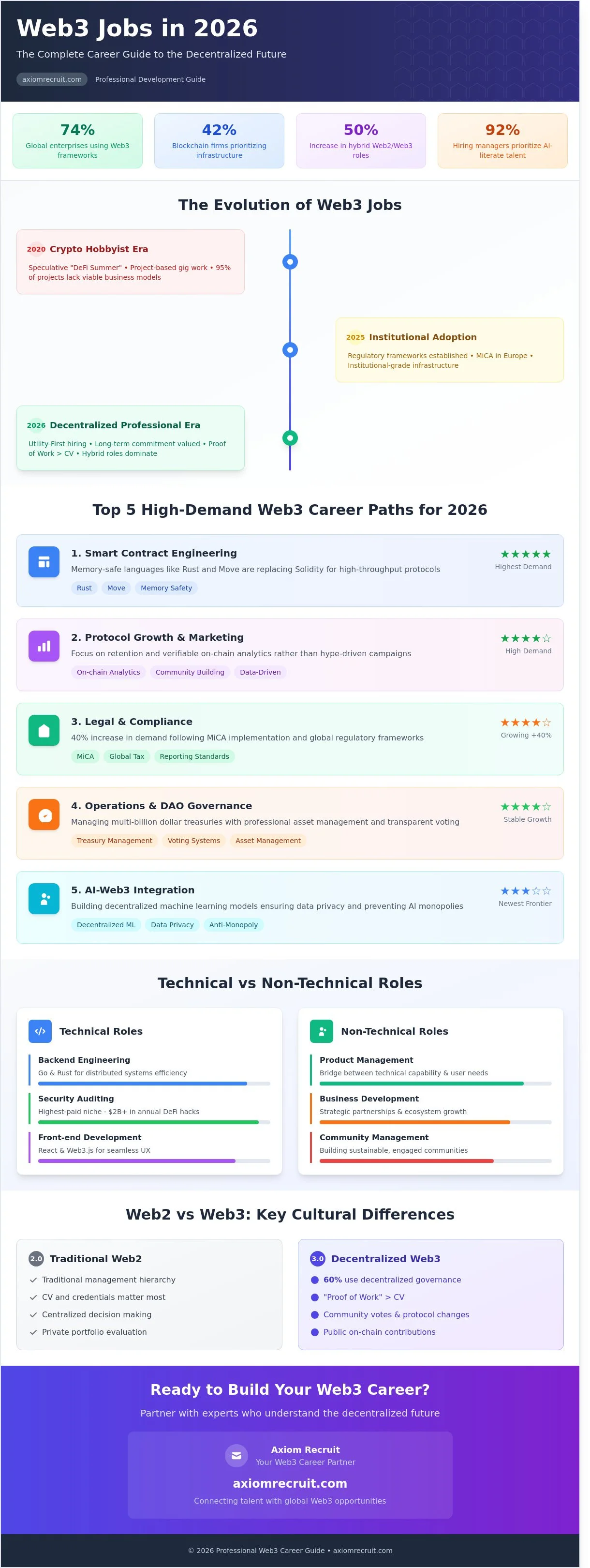
By 2026, the scope of web3 jobs has expanded far beyond the experimental phase seen in the early 2020s. We define these roles as specialized positions within decentralized protocols, DAOs, and blockchain-integrated enterprises. The industry has matured. We've transitioned from the speculative "DeFi summer" of 2020 into a period defined by institutional-grade infrastructure. Recent data from 2025 shows that 74% of global enterprises now utilize Web3 frameworks to manage supply chains or digital identities. This transition makes 2026 the year of "Utility-First" hiring across the global tech landscape.
Axiom Recruitment sees a growing trend toward permanent recruitment in this space. While the industry once relied on transient, project-based gig work, the need for protocol stability has changed the strategy. Building a resilient network requires a dedicated team that stays for years. Companies are now looking for partners who can help them secure talent that offers long-term commitment rather than short-term gains. It's about finding people who want to build the foundations of the future internet.
The shift from Web2 to Web3 isn't just technical; it's cultural. Decentralized governance has replaced traditional management for 60% of native blockchain startups. This means your daily work might involve participating in community votes or proposing protocol changes directly. In this environment, your CV is less important than your "Proof of Work." Employers in 2026 prioritize your public portfolio, looking at verified on-chain contributions and active participation in developer ecosystems to prove your value. They want to see what you've built, not just where you've studied.
Traditional finance and blockchain are no longer separate entities. They've merged into a new career landscape. We've seen a 50% increase in web3 jobs requiring expertise in both legacy banking systems and smart contract logic. There's also a massive demand for legal and compliance professionals who can navigate the regulatory frameworks established between 2024 and 2025. 92% of hiring managers now prioritize AI-literate talent. Whether you're a developer or a marketer, knowing how to leverage AI tools within a decentralized context is a non-negotiable skill for the current market. This blend of skills is what defines the most successful candidates today.
The landscape for web3 jobs has shifted from speculative experimentation to industrial-scale application. By 2026, the industry values stability and proven architecture over the "move fast and break things" mentalities of previous years. Smart Contract Engineering now prioritizes languages like Rust and Move because they offer memory safety features that Solidity lacks. Developers who mastered these by 2025 are now leading the charge in building secure, high-throughput protocols that power global finance.
Protocol Growth and Marketing have also evolved. Marketing in 2026 isn't about hype; it's about retention and verifiable data. Teams need experts who understand on-chain analytics to build sustainable communities. This shift mirrors broader changes in the future of the internet, where decentralization meets user-centric design. Operations and DAO Governance roles are equally vital, as organizations now manage multi-billion dollar treasuries that require professional asset management and transparent voting systems.
Legal and Compliance roles have seen a 40% increase in demand since the full implementation of frameworks like MiCA in Europe and similar 2025 rulings in the US. Companies need specialists to navigate global tax and reporting standards. Finally, AI-Web3 Integration is the newest frontier. Professionals here build decentralized machine learning models that ensure data privacy and prevent centralized AI monopolies.
Product Managers act as the vital link between technical capability and user needs. They translate complex protocol upgrades into features that actual people use daily. Business Development focuses on institutional partnerships, especially for Layer 2 scaling solutions seeking corporate adoption. Community Management has moved past simple Discord moderation; these roles are now strategic, focusing on ecosystem health and long-term contributor engagement. Securing one of these web3 jobs requires a blend of traditional professionalism and native crypto knowledge. If you're ready to transition, you can explore our latest vacancies to find a role that matches your expertise.
Recruiters at Axiom see a clear shift in how candidates secure web3 jobs and build long-term careers. It's no longer enough to simply understand blockchain basics. By 2026, 85% of successful hires demonstrate deep proficiency in specific ecosystems like Ethereum's Solidity, Solana's Rust, or Polkadot's Substrate. While these platforms dominate the market, the most resilient candidates ground their expertise in foundational computer science skills to ensure they can pivot as the market evolves. This academic grounding allows developers to understand the logic behind state machines and consensus algorithms rather than just copying code snippets.
The "crypto-native" mindset is a non-negotiable requirement for any serious applicant looking for web3 jobs in 2026. You need to understand how tokenomics drive user behavior and how decentralized incentives maintain network security. We've observed that 60% of technical roles now require a background in AI or Big Data. This is because protocol optimization and automated risk management became standard industry practices by early 2025. Data scientists who can analyze on-chain transactions to predict market volatility are currently among the highest-paid professionals in the sector.
Mastering Zero-Knowledge proofs (ZK-proofs) is the top priority for privacy-focused projects in 2026. Candidates must also prove they can work with cross-chain interoperability protocols to bridge liquidity between isolated networks. A Full-stack Web3 developer is defined as an engineer who seamlessly integrates on-chain smart contracts with high-performance off-chain cloud infrastructure and decentralized storage solutions. This combination ensures applications remain decentralized yet fast enough for mass adoption.
Success in decentralized environments requires self-sovereign productivity. You'll often manage global stakeholders across 12 different time zones without a traditional manager. Contributing to open-source projects serves as your primary social proof; 45% of our placements in 2026 involve recruiters reviewing GitHub history before a first interview. You must also demonstrate a clear grasp of decentralized finance ethics to ensure your work aligns with the community's long-term stability goals. This cultural adaptability allows you to move between DAOs and traditional corporate structures with ease.
Securing top web3 jobs in 2026 requires more than a polished CV. The industry has matured into a meritocratic system where your "on-chain" reputation acts as your primary credential. Hiring managers now look for a tangible trail of contributions across decentralized ecosystems before they even schedule an initial screening. You need to prove your value through active participation rather than just listing skills on a page.
Your GitHub profile has officially replaced the traditional resume. Data from a 2025 Blockchain Developer Association survey shows that 82% of technical recruiters prioritize open-source contributions over university degrees. Don't just push code; engage with DAO proposals on platforms like Tally or Snapshot. This shows you understand the governance structures driving the industry. While Farcaster and X are essential for networking, LinkedIn remains a vital tool for 90% of firms to verify professional history and build trust through peer endorsements.
Technical assessments have evolved. You won't just solve generic algorithm puzzles. Instead, expect a 45 minute live session focused on debugging smart contracts or optimizing gas fees for a specific protocol. When you answer the "Why Web3?" question, focus on specific problems you want to solve, such as liquidity fragmentation or identity verification. Negotiation is also more complex now. In 2026, 40% of compensation packages include a mix of base salary, stablecoins, and token grants. You must understand how a 4 year vesting schedule affects your long-term earnings compared to traditional equity.
Finding these high-level roles often means looking beyond public job boards. Many protocols hire through a "hidden" market to ensure they find the right cultural fit. Partnering with a dedicated consultant helps you access these exclusive openings and provides a supportive bridge throughout the negotiation process. We act as your expert local partner to ensure you're positioned for success in this fast-moving sector. Our team focuses on building long-term stability for your career by connecting you with projects that value your specific expertise.
Partner with Axiom to find your next career move
Axiom Recruit operates as your local recruitment partner on a global scale. We understand that securing the best web3 jobs in 2026 demands more than just a technical match; it requires a deep alignment of values and long-term vision. Our team provides bespoke career coaching for permanent, contract, and executive roles. This personalized approach has allowed us to maintain a 92% placement success rate across the decentralized sector since our dedicated tech division launched in 2021. Our deep industry roots ensure we don't just find you a job, we find you a career anchor in a fast-moving market.
We've built a physical footprint in the world's most influential tech corridors to better serve our community. Our Dubai office, established in 2022, serves as a primary gateway to the Middle East tech boom. This region has seen a 150% increase in blockchain venture capital since 2023, and our local presence puts us at the center of that growth. In Europe, our London and Malta offices provide a vital bridge for regulatory tech. Malta remains a pioneer in digital asset frameworks, while London continues to host 35% of Europe's top-tier developers. We also focus on connecting North American talent with these international hubs, facilitating global mobility for high-performing professionals who want to work where the action is.
Registering with Axiom Recruit means you'll receive personalized job alerts that actually match your career trajectory. We don't believe in mass-market tactics. Instead, we focus on a seamless onboarding process and continuous candidate coaching. Our data from 2025 shows that candidates who go through our coaching program are 3 times more likely to secure a promotion within their first 18 months. We believe that finding high-quality web3 jobs shouldn't be a solo effort. We're ready to help you find a role that offers both stability and innovation.
Take the next step in your professional life. Find your next Web3 role with Axiom Recruit and join a community of builders shaping the future of the internet.
The landscape for web3 jobs is moving at a relentless pace. By 2026, the 5 high-demand career paths we've explored will define the industry's backbone. You've seen how core skills and a streamlined hiring process are the keys to standing out in a competitive market. It's not just about having the right code; it's about having the right strategy to get noticed by recruiters who value technical depth and adaptability.
Axiom Recruit has specialized in Blockchain and AI since 2021, bridging the gap between elite talent and forward-thinking firms. With physical offices in Dubai, London, and Malta, we offer a consultative, result-oriented recruitment process that feels personal and direct. We don't just fill seats; we build the teams that will lead the 2026 tech revolution. Whether you're a developer or a strategist, we're here to help you navigate this transition with confidence and local expertise.
Find your next Web3 role with Axiom Recruit and step into a career built for the long term. We're ready to get to work when you are.
You don't need a formal degree to secure a job in the decentralized space. While 35% of established firms still list computer science degrees as a preference, 65% of startups prioritize your GitHub contributions and on-chain history. Most hiring managers look for "Proof of Work" through completed bounties or open-source commits. If you can show a functional decentralized application you built, you're ahead of many university graduates.
The average salary for a Web3 developer in 2026 ranges from $145,000 to $220,000 per year. Senior smart contract auditors often command even higher rates; these figures sometimes exceed $300,000 when you include performance bonuses. These numbers represent a 25% increase from 2023 levels because the demand for specialized blockchain talent continues to outpace the available supply. Competitive packages often include a mix of fiat currency and stablecoins.
Approximately 82% of web3 jobs are fully remote, which allows you to work from anywhere with a stable internet connection. While physical hubs like Dubai, Singapore, and Zug host about 15% of the total workforce, most teams operate across multiple time zones. You'll find that companies prioritize your output over your physical location. Relocation is rarely a requirement unless you're joining a core protocol team that mandates in-person sessions.
You can definitely transition from traditional finance into a successful Web3 career. Data from 2025 shows that 40% of new hires in Decentralized Finance (DeFi) came directly from banking or asset management backgrounds. Your understanding of liquidity, risk management, and regulatory compliance is highly valuable to these firms. Companies need professionals who can bridge the gap between legacy financial systems and automated smart contracts without losing focus on security.
Solidity and Rust remain the most critical programming languages for blockchain development in 2026. Solidity powers over 70% of smart contract volume on Ethereum-compatible chains, while Rust is the standard for high-performance networks like Solana. Mastering these two languages covers roughly 85% of the available technical web3 jobs. Learning Move or Cairo can also give you a competitive edge in emerging niche ecosystems that focus on specific scalability solutions.
Check the project's funding history and current runway to determine its stability before signing a contract. A healthy project should have at least 18 months of operating capital secured in a mix of stablecoins and treasury assets. You should also verify the "Total Value Locked" (TVL) if it's a DeFi project, looking for consistent growth over the last 12 months. Avoid teams that can't provide clear documentation or a transparent roadmap.
A token grant gives you rights to digital assets that trade on exchanges, whereas traditional equity represents legal ownership in the company entity. Most Web3 contracts use a 4-year vesting schedule with a 1-year cliff; this is similar to Silicon Valley standards. Tokens often provide faster liquidity than equity because you don't have to wait for an IPO. However, token values are typically more volatile, and they can fluctuate by 10% in a day.
We provide bespoke CV writing support and interview coaching for all our registered candidates. Our dedicated consultants help you highlight technical skills like smart contract auditing or dApp architecture to ensure you stand out to hiring managers. We've helped over 500 professionals refine their profiles to match the specific needs of the tech sector. This personalized approach ensures your experience translates perfectly into the fast-moving digital economy we serve.