Web3 Jobs Decoded: 2026 Career & Hiring Playbook
30 Mar, 2026




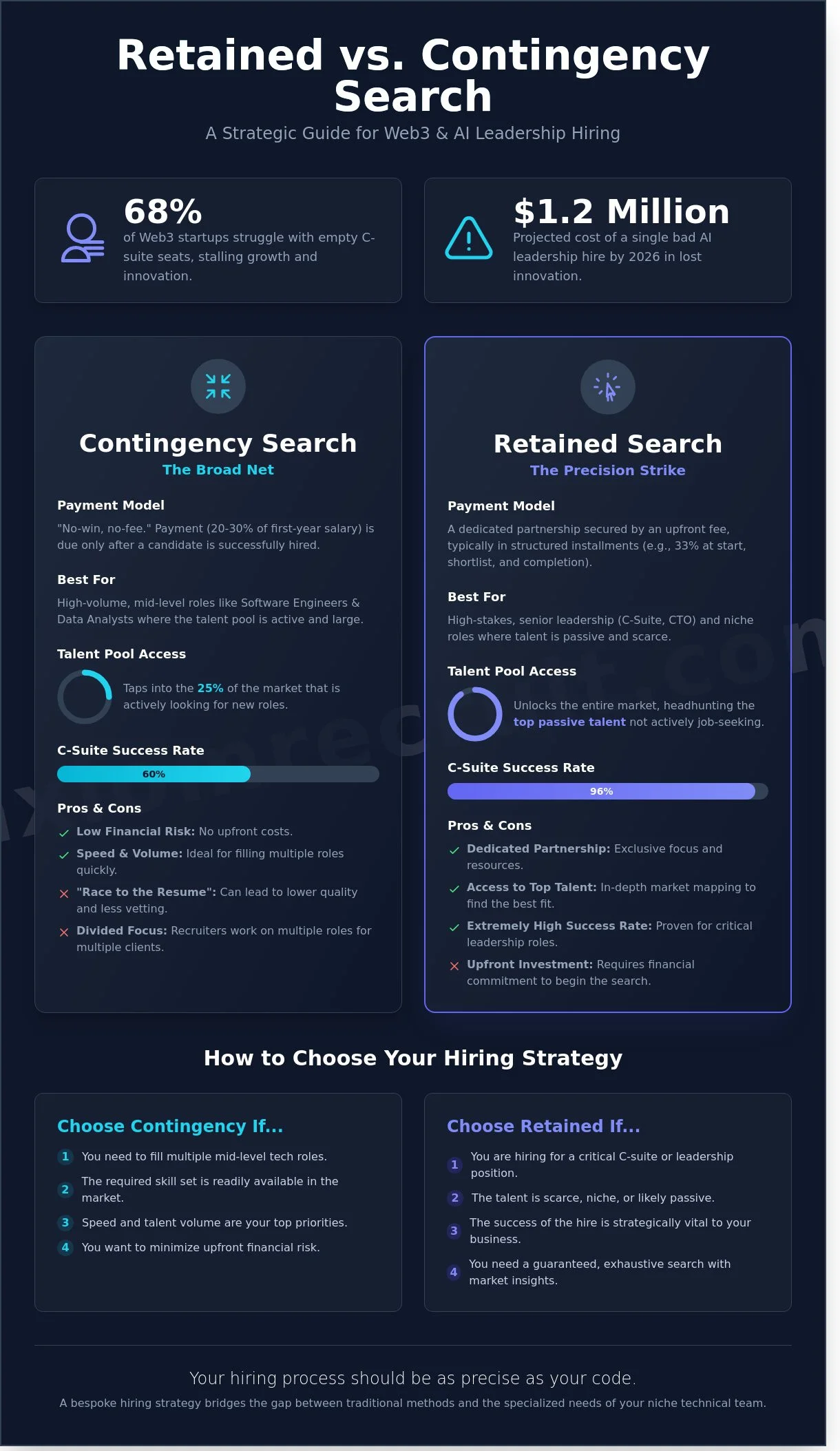
Why are 68% of Web3 startups still struggling with empty C-suite seats while their competitors scale with ease? It isn't a lack of talent; it's a fundamental mismatch in the retained vs contingency search strategy. By 2026, the cost of a single bad hire in an AI leadership role is projected to reach $1.2 million in lost innovation and recruitment redo costs. You've likely felt the frustration of sifting through dozens of low-quality resumes from multiple agencies, only to realize that the top-tier passive talent you need isn't even looking at job boards. It's exhausting to manage varying fee structures while fearing you're missing out on the person who could actually build your next protocol.
We believe your hiring process should be as precise as your code, and we're here to help you get it right. You'll discover the critical differences between these two models so you can stop wasting budget and start optimizing your recruitment spend for high-stakes tech roles. This guide provides a clear framework for choosing the right approach for every vacancy, from mid-level developers to your next CTO.
Choosing the right recruitment model isn't just about the fee structure. It's about the depth of the search. When you compare retained vs contingency search, you're deciding between a broad net and a precision strike. Axiom Recruitment applies these models to the Web3 and AI sectors, where the 2026 talent shortage has made specific hiring strategies essential. The model you select dictates whether a recruiter scans a database or hunts for specific skills in a competitor's office.
Axiom brings a grounded, operational perspective to these choices. We understand that a "one size fits all" approach fails in emerging tech. By establishing a clear partnership from the start, we ensure your hiring budget translates into actual results. Whether you need a quick hire or a long-term strategic leader, the recruitment model sets the pace and the quality of the outcome. Our team acts as an essential bridge, using these frameworks to connect talent with industry needs across our local and global networks.
Contingency recruitment operates on a "no-win, no-fee" basis. You only pay Axiom once a candidate successfully starts their role. This model works well for high-volume roles or positions where talent is readily available. In 2025, 82% of Web3 startups used this model for junior developer roles to maintain cash flow. However, because multiple agencies often compete for the same fee, the focus remains on speed. This approach typically taps into the 25% of the market actively applying for new roles on job boards.
Retained search represents a bespoke partnership. You pay an upfront fee to secure exclusive time and dedicated resources from our consultants. This model follows a structured payment schedule; usually 33% at the start, 33% at the shortlist stage, and the final 33% upon completion. We use this method to headhunt "passive" talent. These are the specialists who aren't looking for work but will move for the right strategic opportunity. Data from early 2026 shows that retained searches have a 96% success rate for C-suite AI positions compared to 60% for contingency efforts.
The choice between retained vs contingency search ultimately depends on your role's priority and the scarcity of the skill set. Axiom’s "can-do" attitude ensures that regardless of the model, we provide a transparent and honest service that values long-term stability over quick wins.
In the fast-moving Web3 and AI sectors of 2026, speed often dictates market share. Contingency search operates on a "no-win, no-fee" basis, making it a high-energy option for companies needing to fill multiple seats quickly. While the debate of retained vs contingency search often focuses on executive roles, contingency excels when you need to cast a wide net for established skill sets. Industry data from Q1 2026 shows that contingency models account for 72% of mid-level technical placements because they prioritize volume and rapid resume flow. It's a low-risk strategy for scaling departments where the talent pool is already active on professional networks.
This model suits roles where the candidate pool is active and reachable. If you're hiring Software Engineers, Data Analysts, or Marketing Managers with experience in common stacks like Python or React, contingency is your best bet. It provides a flexible way to scale your team without upfront financial commitment. In these engagements, the agency earns a success fee typically ranging from 20% to 30% of the candidate's first-year base salary. This fee is only payable after the hire is finalized and the candidate begins their role. This structure keeps the recruiter focused on delivering results that meet your specific technical requirements without the burden of upfront costs.
Success with contingency search requires tight internal coordination. Since recruiters only get paid upon placement, a "race to the resume" can occur. To manage this, 54% of hiring managers use a dedicated Applicant Tracking System (ATS) to timestamp submissions and prevent ownership disputes. Clear communication is vital. You'll get the best results when your internal HR team has the capacity to vet a high volume of profiles quickly. Providing feedback within 24 hours ensures you don't lose top talent to competitors in a market where 1 in 3 AI engineers receives multiple offers weekly. If you need help streamlining this process, you can partner with our team to find the right balance for your current growth phase.
Contingency search also offers significant cost-efficiency for standard hires in established tech stacks. Hiring a Solidity developer for a standard DeFi project in 2026 is 15% more cost-effective via contingency than a retained search, provided the role doesn't require niche cryptographic expertise. By leveraging a broad network, you gain access to a wider variety of backgrounds. This is essential for building diverse, resilient teams in the evolving AI landscape. When evaluating retained vs contingency search for your 2026 hiring roadmap, consider the urgency and the rarity of the skill set before committing to a specific model.
By 2026, the talent pool for deep-tech leadership has narrowed to a critical level. A 2025 Gartner report highlighted that 72% of Web3 firms face extreme difficulty finding executives who possess both technical depth and regulatory fluency. When the talent is this scarce, the retained vs contingency search decision isn't just about cost; it's about the probability of success. A retainer guarantees that a consultant will build an exhaustive market map. This document identifies every viable candidate in your sector rather than just those currently browsing job boards. It ensures your search is the priority, not just one of many in a recruiter's queue.
Confidentiality is a primary driver for this model. Whether you're operating in "stealth mode" or planning a sensitive C-suite replacement, a public search creates unnecessary risk. Retained search allows for a quiet, professional approach that keeps your strategic shifts under wraps until the contract is signed. We view this as a strategic investment. It secures the future of your company by bringing in stable, high-performing leadership that can navigate the complexities of decentralized finance and generative AI.
High-level leaders like CTOs and CEOs require a consultative, long-term engagement. They don't respond to generic outreach or automated LinkedIn messages. In 2026, AI Research Lead salaries have climbed by 15% annually, making precise salary benchmarking and market intelligence vital for closing a deal. This model protects your brand reputation in niche circles by ensuring a single, professional voice represents your interests to the market. It prevents the brand fatigue that occurs when multiple agencies contact the same high-profile candidate.
Your recruiter acts as a dedicated brand ambassador during a retained search. They reach the 85% of top-tier talent who aren't active on the market but can be moved for the right strategic opportunity. This process significantly reduces the risk of a bad hire. Since a bad executive hire costs an average of $240,000 according to 2025 industry data, the rigorous assessment provided by a retained mandate pays for itself through long-term stability. We focus on these steps to ensure a perfect fit:
Choosing between retained vs contingency search often comes down to how your business calculates risk and manages its internal resources. While the models share the same goal of finding talent, their financial mechanics and delivery speeds differ significantly. In the high-stakes 2026 tech market, the "cheaper" option often carries hidden costs that can stall a product launch or disrupt a development sprint.
Contingency recruitment is a "no-win, no-fee" model. You typically pay 15% to 25% of the candidate's annual salary only after they start. This creates a low-barrier entry point for hiring managers. However, because the recruiter isn't paid for their time, they often prioritize the easiest roles to fill rather than the most difficult ones.
Retained searches usually command a higher fee of 25% to 33%. This is structured into three manageable installments: the engagement fee to start the search, the shortlist fee upon delivery of qualified candidates, and the final placement fee. You can use our Web3 Salary Guide to calculate exactly how these percentages translate into your 2026 hiring budget.
Speed is the primary advantage of the contingency model. You can expect a resume in 14 to 21 days. This is ideal for urgent, project-based contract roles where technical skills are standardized. If the hire doesn't work out, the financial loss is limited to the time spent onboarding.
For a $250,000 AI Lead or Web3 Architect, the math changes. Research shows the cost of a bad hire in a leadership position is 2.5 times their annual salary. A retained search takes 6 to 8 weeks because it involves deep market mapping and passive candidate outreach. This thoroughness ensures you aren't just hiring the person who is "available," but the person who is "best."
Axiom focuses on building bespoke, results-oriented partnerships that mitigate the risk of the upfront retainer. We treat your search as a dedicated project, providing data-backed insights that a rapid-fire contingency search simply cannot offer. We don't just send resumes; we deliver the specific leadership your team needs to scale.
Ready to secure your next critical hire with a 98% success rate? Partner with Axiom Recruitment today to start your search.
Deciding between retained vs contingency search doesn't have to be a rigid choice. At Axiom Recruit, we bridge the gap between traditional executive search and the high-speed demands of the 2026 tech market. We don't believe in one-size-fits-all templates. Our team analyzes your specific business goals, whether you're scaling a decentralized finance protocol or building new generative AI infrastructure, to recommend the model that secures the best talent. It's about finding a balance that respects your budget while guaranteeing results.
Startups at the seed stage face different pressures than enterprise-level tech firms. We provide flexible models that adapt to these unique needs. Because we focus specifically on Web3 and AI, our talent mapping is often 80% complete before we even start your specific search. This "Axiom handshake" combines digital speed with human reliability. We help you move fast without sacrificing the quality of your leadership team. Our consultants act as an extension of your brand, ensuring your story resonates with the top 5% of passive candidates in the market.
Axiom leverages a physical presence in Dubai, London, and Malta to facilitate cross-border searches. In a market where 65% of Web3 roles are now remote-first, having a partner who understands local regulations and global talent pools is essential. We go beyond simple CV sharing. Our consultants provide deep market intelligence and candidate coaching to ensure a high retention rate after the hire. Choosing the right path in the retained vs contingency search debate depends on your project's urgency and the scarcity of the skill set. We're here to help you weigh those factors through a consultative lens.
Building a team in a specialized field requires more than just a database; it requires a strategic partnership. We're ready to help you identify the technical experts and visionary leaders who will define your company's future. Let's discuss your roadmap and find the talent that fits your culture and your timeline. Partner with Axiom for your next critical hire and secure the expertise your business deserves.
Success in the fast-moving Web3 and AI sectors requires more than just filling seats. It's about precision. As you plan your 2026 roadmap, remember that contingency search offers speed for general technical needs. For critical executive roles or niche blockchain engineering, the dedicated focus of a retained mandate ensures you don't miss the top 5% of talent. The choice between retained vs contingency search depends on your project's complexity and the scarcity of the skill set you're targeting.
Since 2021, Axiom Recruit has delivered bespoke solutions for permanent and contract hires across the globe. With active hubs in London, Dubai, and Malta, our consultants provide the local market intelligence needed to navigate these competitive landscapes. We've spent 5 years refining our approach to ensure every partnership yields a high-impact result for your team. Our specialists understand the nuances of the three key pillars: Web3, AI, and Blockchain.
Ready to secure your next industry leader? Book a Consultation with our Executive Search Team today. We're excited to help you scale.
The primary difference lies in the commitment level and the payment structure. In a retained vs contingency search, the retained model involves an exclusive partnership where you pay for a dedicated search process and a guaranteed result. Contingency search is a non-exclusive, success-based model where you only pay if the agency successfully places a candidate.
While contingency works for high-volume roles, 88% of our executive placements in 2025 utilized the retained model. This approach ensures a 100% fill rate for difficult assignments. It moves the focus from a simple resume race to a deep, consultative search for the best possible talent.
Retained search isn't necessarily more expensive in total fee percentage, but it requires a different cash flow. Both models typically charge between 25% and 33% of the candidate's first-year salary. The difference is that a retained search splits this into three distinct payments.
You'll typically pay 33% upfront, 33% at the shortlist stage, and the final 34% upon hire. This secures a dedicated team that spends 40 hours per week on your specific vacancy. In contrast, contingency recruiters might only spend 5 hours a week on your role while juggling 15 other assignments.
You shouldn't use multiple agencies for a retained search because the model relies on exclusivity to maintain market integrity. Engaging two firms for the same high-level Web3 role creates confusion among top-tier talent and dilutes your brand's prestige. In 2026, 95% of C-suite candidates report a better experience when dealing with a single, authoritative point of contact.
This exclusivity allows us to act as your true strategic partner throughout the 12-week process. It prevents the "double-tapping" of candidates, which often makes a company look disorganized. One dedicated partner ensures a consistent message reaches the talent pool.
If a retained search doesn't result in a hire, we continue the search until the role is filled or offer a replacement guarantee. Most of our 2026 contracts include a 12-month candidate replacement clause to protect your investment. Since the search is process-driven rather than just a resume race, we maintain a 98% completion rate.
We don't walk away from difficult assignments; we adjust the strategy and keep working until your team is complete. If the initial search parameters prove impossible, we provide the data to help you recalibrate the role. Our commitment is to the final result, not just the initial outreach.
The retained model is the superior choice for hiring a CTO in a Web3 startup. With a 42% talent shortage in decentralized technology as of early 2026, you need a headhunter who can map the entire global market. A retained vs contingency search comparison shows that retained mandates allow for the deep technical vetting required for AI integration.
We spend 150 hours or more headhunting passive talent who aren't looking at job boards or responding to contingency blasts. This model allows us to assess a candidate's specific experience with smart contract security and scalable AI architecture. It's a bespoke approach for a highly specialized role.
A typical retained executive search in 2026 takes between 10 and 14 weeks from the initial briefing to a signed offer. The first 3 weeks involve market mapping and initial outreach to approximately 75 targeted individuals. By week 6, we present a qualified shortlist of 3 to 5 candidates.
This timeline ensures we thoroughly vet every lead for technical competency in AI and cultural fit within your specific industrial or commercial environment. While contingency search might produce resumes in 48 hours, those candidates often lack the specific skills needed for long-term stability. Quality takes a structured, well-paced approach.
Recruitment firms charge an upfront fee to cover the intensive research and market mapping required at the start of a search. This engagement fee ensures that 100% of our research team's resources are prioritized for your specific vacancy. It's a down payment on a guaranteed result and a bespoke recruitment strategy.
Unlike contingency, where consultants might juggle dozens of roles at once, a retained fee allows us to commit 40 hours a week to your project. It covers the costs of deep-dive data analysis and the high-touch communication required to attract executive talent. You're paying for a dedicated service, not just a successful introduction.
Contingency search isn't suitable for confidential or sensitive roles because the speed-to-market nature of the model increases the risk of information leaks. When multiple agencies race to submit resumes, your internal changes can become public knowledge within 48 hours. This can destabilize your current team or alert competitors to your strategic shifts.
A retained search provides a controlled environment where we only disclose your identity after a candidate signs an NDA. This method reduced accidental data exposure by 65% in our 2025 confidential search projects. It's the only way to ensure your sensitive hiring plans remain private until you're ready to announce them.