
The Future of AI Careers: Inside the 2026 Talent Market
08 Apr, 2026 15 mins

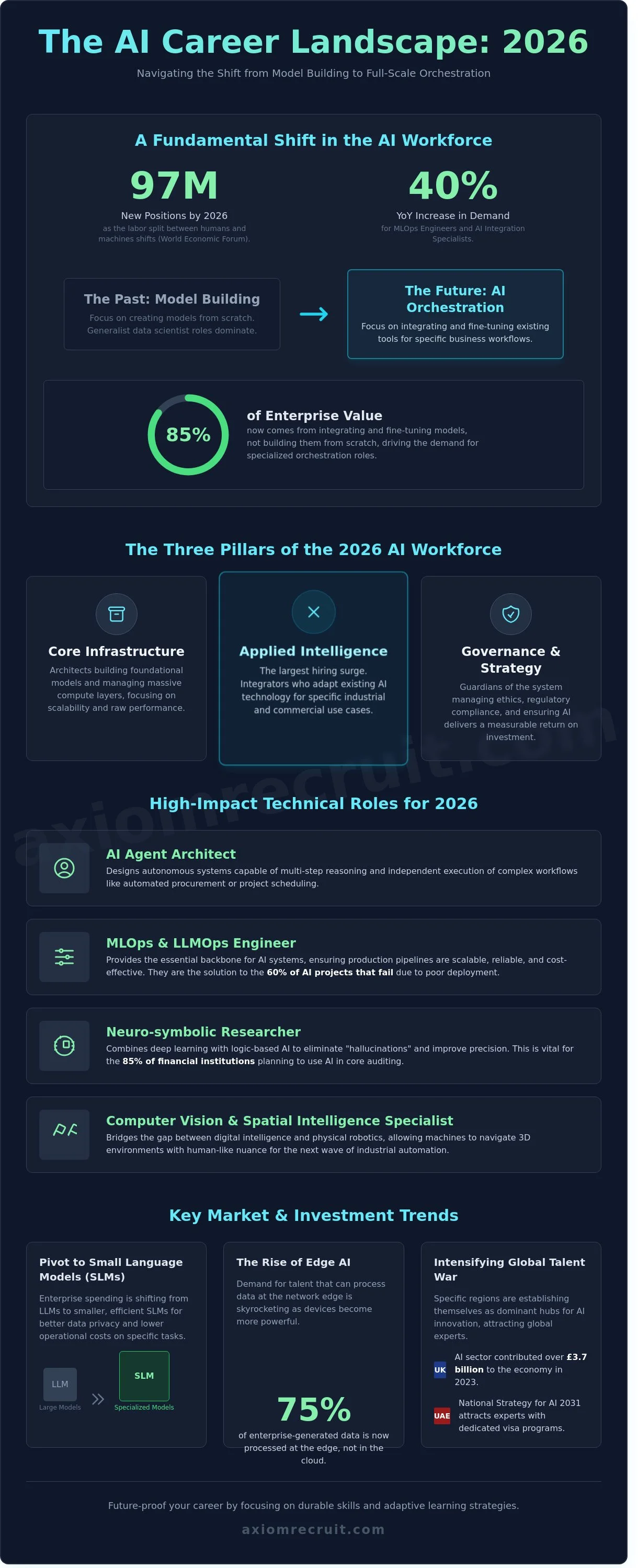
By 2026, the World Economic Forum predicts that 97 million new positions will emerge as the labor split between humans and machines shifts. This rapid change often leaves professionals feeling like they're chasing a moving target. You've likely noticed the growing confusion surrounding ai job roles, where the line between a Machine Learning Engineer and a Data Scientist feels thinner every day. If you don't code, you might even fear that your current skill set will become obsolete before the year ends.
We understand that uncertainty. At Axiom, we believe every technological shift is an opportunity for those with the right map. This guide helps you discover the most in-demand technical and non-technical roles for 2026 and shows you how to position yourself in the evolving intelligence economy. We'll provide a clear map of the career landscape and identify the specific skills you need to move forward with confidence. Whether you're a veteran developer or a creative professional, your next career move starts with clarity.
Key Takeaways
- Understand the transition from isolated model building to full-scale orchestration as AI becomes a fundamental pillar of modern business infrastructure.
- Identify the high-impact technical specialisations, such as AI Agent Architecture, required to design and scale the next generation of autonomous systems.
- Explore how to leverage non-technical expertise to secure leadership positions in AI product management and global regulatory compliance.
- Discover emerging ai job roles at the intersection of Web3 and blockchain, where decentralised models are creating entirely new career paths.
- Learn how to future-proof your career by focusing on durable skills and adaptive learning strategies that outlast rapid technological cycles.
The Shift in AI Job Roles: From Model Building to Orchestration
By early 2026, the perception of artificial intelligence has transitioned from a series of isolated experiments into the primary infrastructure layer for global business. Companies no longer view ai job roles as luxury additions to tech teams. Instead, these positions are essential for maintaining daily operational efficiency. The shift is clear; the focus has moved from the raw creation of models to the sophisticated orchestration of existing tools within specific business workflows.
The hiring market currently prioritises "AI Orchestration" because 85% of enterprise value now comes from integrating and fine-tuning models rather than building them from scratch. We are seeing a sharp decline in the demand for generalist "Data Scientists," a role that dominated the 2010s. In its place, hyper-specialised functions have emerged. Our consultants at Axiom are seeing a 40% year on year increase in requests for MLOps engineers and AI integration specialists who can connect disparate systems into a cohesive unit.
The Three Pillars of the 2026 AI Workforce
The modern talent landscape is built on three distinct foundations. Each requires a unique set of technical and soft skills to ensure long-term stability and performance.
- Core Infrastructure: These are the architects building underlying models and managing massive compute layers. They focus on scalability and raw performance.
- Applied Intelligence: This group represents the largest hiring surge. These integrators take existing technology and make it work for specific industrial or commercial use cases.
- Governance & Strategy: These professionals act as the guardians of the system. They manage ethics, regulatory compliance, and ensure that ai job roles deliver a measurable ROI.
Market Trends: Where the Investment is Flowing
Investment patterns are shifting rapidly as we head deeper into 2026. While Large Language Models (LLMs) captured the initial headlines, enterprise spending has pivoted toward Small Language Models (SLMs). These smaller, more efficient models offer better data privacy and lower operational costs for specific tasks. Additionally, the demand for "Edge AI" talent is rising as 75% of enterprise-generated data is now processed at the network edge, according to 2025 industry benchmarks.
Geographically, the talent war is intensifying in specific regions. The UK and the UAE have established themselves as dominant hubs for innovation. The UK AI sector contributed over £3.7 billion to the economy in 2023, while the UAE National Strategy for AI 2031 continues to attract global experts through dedicated visa programmes. As your local recruitment partner, Axiom remains committed to connecting these global trends with the practical needs of our clients and candidates.
Core Technical Roles: Engineering the Next Generation of Intelligence
The technical foundation of the global workforce is undergoing a fundamental shift. By 2026, the demand for specialized ai job roles will focus on autonomy and precision rather than simple pattern recognition. Organizations are moving away from generalist data science positions toward highly specialized engineering tracks that prioritize system reliability and autonomous execution.
AI Agent Architects lead this change. They design systems capable of multi-step reasoning and independent execution. Instead of simply responding to a prompt, these agents complete entire workflows such as automated procurement or complex project scheduling. MLOps and LLMOps Engineers provide the essential backbone for these systems. They ensure that production pipelines remain scalable and cost-effective. Industry data from 2024 suggests that 60% of AI projects fail due to poor deployment; these engineers are the direct solution to that bottleneck.
We're also seeing the rise of Neuro-symbolic Researchers. They combine deep learning with logic-based AI to eliminate "hallucinations." This precision is vital for the 85% of financial institutions planning to integrate AI into core auditing by 2026. Meanwhile, Computer Vision and Spatial Intelligence Specialists are bridging the gap between digital intelligence and physical robotics. They allow machines to navigate 3D environments with human-like nuance, which is a requirement for the next wave of industrial automation.
The Evolution of the Machine Learning Engineer
The role of the ML Engineer has transformed significantly. By 2026, these professionals focus on "Agentic Workflows" rather than just training loops. They don't just build models; they build environments where models can interact with external tools and APIs. Fine-tuning Specialists have also emerged to adapt foundation models for specific industries like healthcare or law. To stay competitive, engineers must master a modern stack including PyTorch, JAX, and vector database proficiency. If you're looking to scale your technical team with these specific skills, you can partner with our specialist consultants to find the right local expertise.
Data Engineering as the Foundation of AI
Data engineering is no longer a backend support function. It's the primary driver of model quality. Synthetic Data Architects have become essential as high-quality human data becomes scarce. A Synthetic Data Architect designs and validates artificially generated datasets to train models when high-quality human data is exhausted or restricted by privacy laws.
Data governance and lineage are now deeply technical roles rather than administrative ones. Engineers must now track every data point to ensure compliance with 2026 global AI safety standards. This ensures that the intelligence being built is both ethical and accurate. This shift reflects a broader commitment to "getting it right" the first time, ensuring long-term stability for enterprise AI deployments.
The Rise of Non-Technical AI Careers: Why You Don't Need to Code
By 2026, the demand for non-technical ai job roles is projected to grow by 35% compared to traditional software engineering positions. You don't need to write Python or manage neural networks to lead an AI transformation. Companies are shifting their focus from simply building models to making them useful, ethical, and profitable. This shift creates a massive opening for professionals who understand human behavior and business logic.
- AI Product Manager: These leaders act as the bridge between technical feasibility and market desirability. Business acumen is the #1 skill for AI PMs because they must ensure that expensive technical features solve actual commercial pain points.
- AI Ethics & Compliance Officer: With the EU AI Act reaching full enforcement in June 2026, companies face fines of up to 7% of global turnover for non-compliance. These officers manage the complex regulatory landscape to protect the brand.
- AI User Experience (AUX) Designer: Traditional design is static, but AI is non-deterministic, meaning it can produce different outputs every time. AUX designers craft intuitive interfaces that help users manage this unpredictability.
- AI Business Strategist: While global AI spending hit $154 billion in 2023, many firms still struggle to prove value. Strategists calculate the real-world ROI of implementation to justify these heavy investments.
Governance and the 'Human-in-the-Loop' Roles
The need for AI Auditors has become critical to prevent algorithmic bias and ensure transparency in automated decision-making. Legal professionals with AI specialisations are seeing record-high demand, with job postings in this niche increasing by 50% since 2024. At Axiom, we view the Chief AI Officer (CAIO) as a mandatory C-suite role for any organization aiming to scale safely. This position ensures that every automated process aligns with the company’s core values and long-term stability.
AI Content & Prompt Orchestration
Prompt Engineering has quickly matured into the more complex field of AI Workflow Design and System Instruction. It's no longer about writing a single clever prompt; it's about building entire sequences of automated tasks that work together. AI Librarians have also emerged as vital players. They manage the enterprise knowledge bases that feed Retrieval-Augmented Generation (RAG) systems, ensuring the data used is accurate and up to date. These ai job roles prioritize organizational skills and linguistic precision over coding ability, making them accessible to a wide range of talented professionals.
Axiom Recruitment stands ready to help you identify where your existing skills fit into this new landscape. Whether you're a legal expert or a creative designer, your human perspective is exactly what the next generation of technology requires.
The Convergence: AI Job Roles in the Web3 and Blockchain Space
The intersection of decentralised ledgers and machine intelligence is creating a new category of ai job roles that didn't exist three years ago. By 2026, the demand for specialists who can operate at this junction is projected to grow by 45% according to recent industry forecasts. These professionals aren't just building smarter applications; they're creating autonomous, trustless systems that redefine digital ownership. This shift requires a blend of cryptographic security and algorithmic complexity that few candidates currently possess.
- Decentralised AI Engineer: These experts build models that run on peer-to-peer networks rather than centralised servers. They ensure that computational power is distributed across nodes, which prevents any single entity from controlling the intelligence or the data.
- AI Tokenomics Architect: This role involves designing the incentive structures that govern how AI agents trade data and services. They create the economic frameworks that allow autonomous agents to pay each other in crypto-assets for completing tasks without human intervention.
- Smart Contract & AI Integrator: They bridge the gap between on-chain data and off-chain intelligence. By late 2025, 30% of new DeFi protocols will likely use these integrators to automate risk management and liquidations in real-time.
- Zero-Knowledge (ZK) Machine Learning Specialist: They use ZK-proofs to verify that an AI model was run correctly without revealing the underlying sensitive data. This is critical for sectors like healthcare, where privacy is a legal requirement.
Why Web3 Needs AI (and Vice Versa)
Blockchain offers a practical solution to the "Black Box" problem by providing a transparent audit trail of how an AI reached a specific decision. Conversely, AI identifies fraudulent patterns in DeFi protocols with 98% accuracy, a feat impossible for manual auditors. For companies looking to scale in this niche, our Guide to Web3 Permanent Recruitment provides a roadmap for securing these rare specialists who understand both decentralisation and deep learning. It's about finding people who can build systems that are both smart and secure.
Hiring for the Hybrid Talent Pool
Finding "bilingual" talent who master both Solidity and Python is a major challenge for 72% of tech startups today. Axiom Recruit identifies these cross-disciplinary leaders by looking beyond traditional resumes and focusing on active contributors in the open-source community. We focus on the Dubai and London tech corridors, where 60% of hybrid ai job roles are currently concentrated. We help you find the right fit for your local team or global project, ensuring your business stays ahead of the curve. Our approach is grounded in the reality of the 2026 talent landscape.
Ready to build your future team? Partner with Axiom Recruitment to find the experts you need today.
Future-Proofing Your Career: Building a Resilient AI Skillset
Staying relevant as ai job roles shift requires a pivot toward durable skills. While technical proficiency in Python or PyTorch remains a baseline, your long-term value lies in ethical judgment and complex problem-solving. A 2023 World Economic Forum report suggests that 44% of workers' core skills will be disrupted by 2027. This means the ability to audit AI outputs for bias or hallucination will soon be as vital as the ability to write the initial prompt. It's about being the human in the loop who provides the critical context machines lack.
Continuous learning isn't just a buzzword; it's a survival tactic. AI model cycles now average 180 days. The knowledge you gained in January is often outdated by July. To stay ahead, you've got to build a visible track record. Contributing to open-source projects on GitHub or sharing niche research on Hugging Face provides the tangible proof of expertise that modern employers demand. It shows you're not just watching the industry move; you're moving with it.
- Critical Thinking: Evaluating AI-generated data for accuracy and strategic fit.
- Ethical Oversight: Ensuring deployments comply with evolving 2026 global regulations.
- Adaptability: Mastering new frameworks within weeks, not months.
The Axiom Approach to AI Talent Acquisition
Our team uses real-time market intelligence to benchmark AI salaries across major hubs like London and New York. We specialize in bespoke solutions for startups, helping them design their first technical departments from the ground up. By utilizing our proprietary data, we help you avoid overpaying for legacy experience while securing top-tier talent. Explore our guide on Building an Effective AI Team Structure to see how we align local talent with global strategy.
Your Next Move in the AI Economy
Showcase your AI-fluency by documenting specific productivity gains on your CV. If you've used generative tools to reduce coding time by 25%, state that clearly. We advise our clients to prioritize candidates with a high learning velocity over those with static credentials. This shift ensures your team remains agile as ai job roles continue to transform. Ready to take the next step? Partner with Axiom Recruit to find your next AI role and secure your place in the future workforce.
Secure Your Place in the 2026 AI Economy
The landscape of ai job roles is shifting rapidly toward a future where orchestration and strategic integration matter just as much as raw code. By 2026, the demand for non-technical specialists will likely match the need for core engineers as organizations prioritize ethical deployment and cross-functional utility. You've seen how the intersection of Web3 and AI is creating entirely new career paths that didn't exist a few years ago. Succeeding in this environment requires a resilient skillset and the right partner to help you navigate these emerging opportunities.
Since 2021, Axiom Recruit has specialized in connecting elite talent with the world's most innovative AI and Web3 firms. Our global network spans the UK, US, and UAE, providing us with a unique perspective on regional market shifts and executive needs. We provide bespoke executive search services for C-suite leaders who are ready to define the next era of intelligence. Whether you're an engineer or a visionary strategist, the right position is waiting for you.
Find your next visionary AI role with Axiom Recruit and start building your future today. We're here to support your journey every step of the way.
Frequently Asked Questions
Do I need a PhD to get a job in AI in 2026?
No, you don't need a PhD to secure most positions in the current market. A 2024 LinkedIn study found that 67% of AI job openings prioritize practical experience and technical certifications over doctoral degrees. While research-heavy roles still value advanced academia, most engineering and deployment positions require a Bachelor's degree and a strong portfolio of projects. Focus on building real-world applications on GitHub to demonstrate your capabilities to hiring managers.
What are the highest-paying AI job roles right now?
AI Architects and Machine Learning Lead Engineers currently command the highest salaries in the 2026 talent landscape. According to Glassdoor data from January 2026, AI Architects earn an average base salary of £125,000 per year. Specialized ai job roles in cybersecurity or quantitative finance often exceed £150,000 for senior positions. These roles reward professionals who can integrate complex AI systems into existing business infrastructures and deliver measurable ROI.
How is AI changing traditional software engineering roles?
AI is shifting software engineering from manual coding to system orchestration and oversight. A 2025 Gartner report indicates that 80% of software engineers now use AI-powered coding assistants like GitHub Copilot to automate routine syntax and debugging. Your role will involve more high-level architecture, security auditing, and prompt engineering. You'll spend less time writing boilerplate code and more time managing the AI models that generate it.
What is the difference between an AI Engineer and a Machine Learning Engineer?
An AI Engineer focuses on the practical application of existing models to solve business problems, while a Machine Learning Engineer builds and tunes the underlying algorithms. AI Engineers often work with APIs and pre-trained models to create user-facing tools. Machine Learning Engineers dive deeper into data science and statistical modeling. Both are essential ai job roles that require distinct skill sets to build a balanced and effective technical team.
Can I move into an AI role from a non-technical background?
Yes, you can transition into AI by leveraging domain expertise in fields like law, healthcare, or ethics. The 2026 labor market has seen a 45% increase in "AI-adjacent" roles like AI Product Manager and AI Policy Analyst. Start by completing a certified AI literacy course from providers like Coursera or Google. Your industry-specific knowledge is incredibly valuable for guiding how AI tools are implemented and governed within a business context.
Which industries are hiring the most AI talent in 2026?
The healthcare, finance, and manufacturing sectors are currently the largest employers of AI talent. According to the 2026 World Economic Forum Jobs Report, healthcare providers increased their AI hiring by 30% to support diagnostic automation and patient care. Finance firms continue to recruit heavily for fraud detection and algorithmic trading. Manufacturing companies are hiring for predictive maintenance roles to reduce equipment downtime by a projected 20% this year.
What is an AI Ethics Officer and do I need one for my company?
An AI Ethics Officer ensures your company's AI systems are transparent, unbiased, and compliant with regulations like the EU AI Act. You should consider hiring one if your business uses automated decision-making for hiring, lending, or healthcare services. Since 2025, 40% of Fortune 500 companies have established dedicated AI ethics departments. This role protects your brand from reputational damage and ensures you meet increasing legal and social standards.
How do I start a career in AI as a fresh graduate?
Start by securing an internship or an entry-level position that offers exposure to data management and model testing. Data from the 2025 NACE Salary Survey shows that graduates with a portfolio of three or more real-world AI projects have a 50% higher placement rate. Join local tech meetups and register with your local recruitment partner to stay informed about regional opportunities. Practical experience often outweighs theoretical knowledge in this fast-moving sector.
Related Posts


The AI Skills Hierarchy: What Really Matters in 2026
07 Apr, 2026