From Prep to Offer: 2026 Web3 & AI Interview Guide
30 Mar, 2026




By January 2026, the traditional machine learning researcher role will no longer be the primary driver of corporate innovation. While the 2023-2024 period was defined by experimental model building, 85% of Fortune 500 enterprises are now shifting their budgets toward deployment and integration. You've likely noticed that the hype around general AI is cooling, replaced by a pressing need for tangible results. It's frustrating to watch your current toolkit age while the market moves this fast, especially when the lines between AI expert and software engineer are blurring. Identifying the most in-demand ai skills is no longer just about learning Python; it's about understanding how to build resilient, scalable systems that actually deliver ROI.
At Axiom Recruitment, we see these shifts in hiring patterns every day through our network of local partners. We're here to help you stay ahead of the curve with a clear roadmap for the next 24 months. You'll discover the specific technical competencies and strategic mindsets that top-tier startups are competing for right now. We'll break down the transition from theoretical ML research to practical AI engineering, clarify the emerging AI-Web3 crossover, and provide a direct path to building a future-proof career or team.
The hiring market in 2026 has moved past the experimental phase. We now see a clear divide between the ML Researcher and the AI Engineer. ML Researchers, typically found in global labs like DeepMind or OpenAI, focus on the foundational overview of AI and architectural breakthroughs. Conversely, the AI Engineer is the role currently dominating local job boards in tech hubs. These specialists don't build models from scratch. Instead, they integrate existing Large Language Models into business workflows using APIs and vector databases.
By early 2026, 70% of AI roles focus on model orchestration rather than architecture. Startups have largely abandoned the goal of training foundation models. The compute costs, which often exceeded $100 million for a single training run in 2024, are now prohibitive for all but the largest players. In the UK and UAE, we see a surge in "Applied AI" specialists. These professionals bridge the gap between raw code and commercial value, ensuring that in-demand ai skills are mapped directly to business ROI.
General data science roles are fading as AI tools automate data cleaning and basic predictive modeling. Axiom's consultants in London and Dubai report a sharp increase in mandates for domain-specific experts. It's no longer enough to know Python; you must understand LegalTech, FinTech, or HealthTech nuances. Companies want partners who understand their specific industry hurdles. Our local branches are seeing a 35% year-on-year shift toward these specialized hybrid roles where sector knowledge is as vital as technical ability.
Responsible AI is now a mandatory requirement for any enterprise deployment. The UK AI Safety Institute's 2024 guidelines have matured into a strict regulatory framework that shapes how we recruit. We've seen a 45% increase in demand for AI Compliance Officers across European enterprises. These professionals ensure that in-demand ai skills include ethical auditing, bias mitigation, and transparency. Safety isn't a footnote anymore; it's a non-negotiable skill for every 2026 project lead. Organizations are prioritizing stability and trust over rapid, unregulated deployment to avoid the heavy fines associated with the EU AI Act.
By 2026, the baseline for technical proficiency has shifted from simple prompt engineering to complex system architecture. It's no longer enough to interact with a model; engineers must now build environments where models interact with each other. Agentic Design is the ability to build self-correcting AI workflows. This skill is now a primary requirement for 85% of senior AI developer roles, as companies move away from static chatbots toward autonomous systems that can reason through multi-step problems.
Mastering these highly desirable AI skills requires deep fluency with the "Frontier Trio": OpenAI, Anthropic, and Meta's Llama 4. Since Llama 4's release in early 2025, the ability to deploy high-reasoning models locally has become a competitive advantage for firms prioritizing data privacy. Developers must also master Advanced Retrieval-Augmented Generation (RAG) to connect these models to proprietary, domain-specific data. This ensures the AI doesn't just guess; it references a company’s specific legal, medical, or industrial records with 99% accuracy. To maintain this precision, top talent uses "LLM-as-Judge" frameworks, building automated pipelines that evaluate model performance against strict benchmarks in real-time.
Modern AI development has moved from single-input prompts to autonomous agent loops. In 2026, the industry standard involves using tools like LangGraph, CrewAI, and Microsoft AutoGen to create "digital workforces." These frameworks allow developers to assign specific roles to different models, such as a "Researcher" agent and a "Validator" agent, who collaborate to complete tasks without human intervention. If you're ready to partner with a team that understands these complex hierarchies, focusing on multi-agent experience is the fastest way to see a return on your AI investment.
Building a model is only 20% of the challenge; the rest is infrastructure. Professionals must manage vector databases like Pinecone, Milvus, and Weaviate to store and retrieve the massive amounts of unstructured data that fuel RAG systems. While traditional MLOps focused on training models, 2026 is the era of LLMOps. This discipline manages the lifecycle of generative models, focusing on prompt versioning, latency control, and cost optimization. For those identifying as "Full-Stack AI Engineers," proficiency in TypeScript and React is essential to build the intuitive interfaces that bridge the gap between complex backends and the end user.
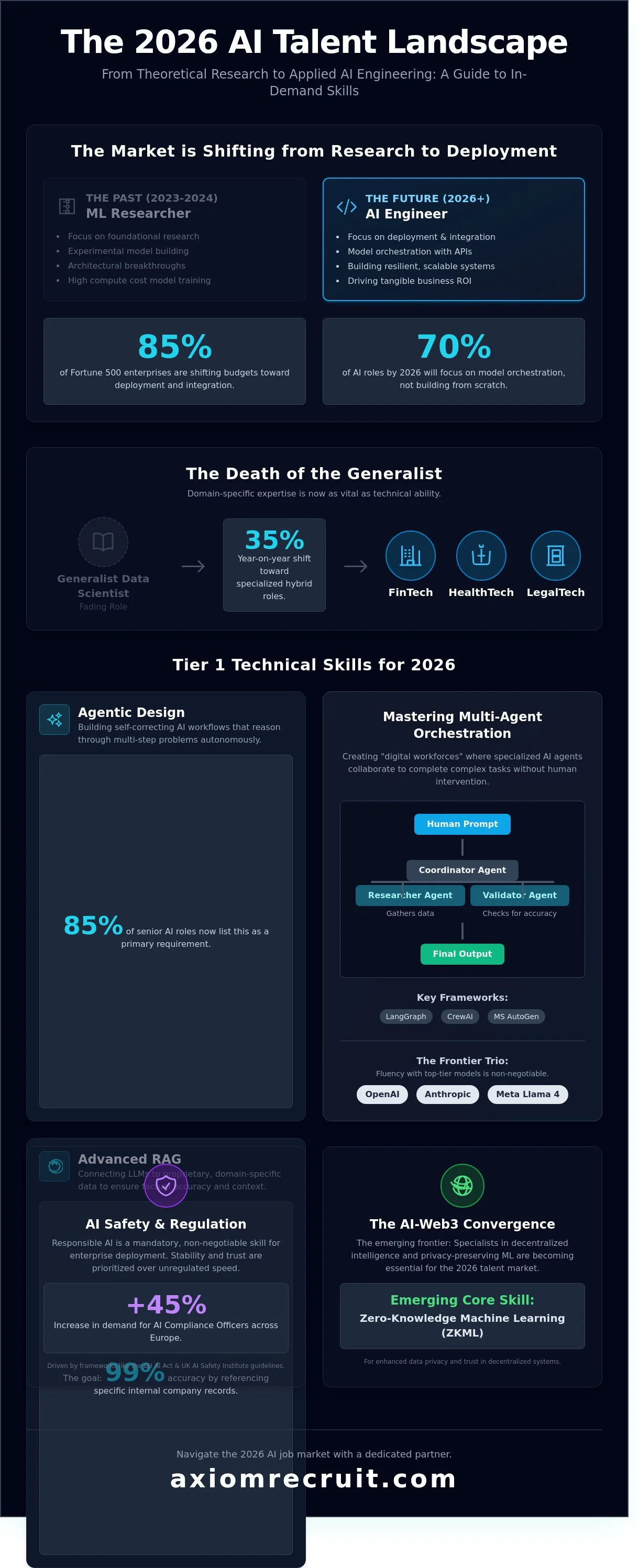
By 2026, the centralised control of artificial intelligence will face a serious challenge from Decentralised AI (DeAI). This shift creates a massive need for professionals who understand how to merge neural networks with blockchain protocols. Companies are moving away from monolithic providers to avoid single points of failure. The transition makes Zero-Knowledge Machine Learning (ZK-ML) one of the most essential AI skills for the future workforce because it allows for model verification without exposing sensitive underlying data.
The infrastructure layer is already scaling to meet these needs. Networks like Akash and Render provide the GPU power necessary for these operations; Akash reported a 144% increase in active leases during 2023, signaling the rapid growth of this decentralised stack. Professionals who can manage these distributed compute resources will be at the top of the hiring list for firms looking to reduce their reliance on traditional cloud giants.
We're seeing a rise in AI agents equipped with digital wallets. These agents don't just provide information; they execute financial transactions independently. Developers need to master tool-calling within Large Language Models (LLMs) to interact with smart contracts. Startups like Valory are already hiring experts to build autonomous agents for DAO governance. These roles require a blend of Solidity expertise and prompt engineering to ensure agents manage treasury funds safely. Mastering these in-demand ai skills allows developers to build systems that operate without human intervention.
Trust is the biggest hurdle for AI adoption. By 2026, verifying the provenance of training data will be a legal necessity in many jurisdictions. Web3 talent is uniquely positioned here. They use blockchain to create immutable logs of where data comes from. This prevents model collapse and ensures creators get paid. Using federated learning on decentralised networks allows models to train on private data without ever actually seeing it. This technical crossover is why blockchain literacy is now part of the in-demand ai skills for the next three years.
AI isn't replacing the workforce; it's reshaping the expertise required to guide it. By 2026, technical proficiency alone won't suffice for leadership roles. Companies are prioritizing in-demand ai skills that focus on oversight, governance, and strategic integration. The "AI Translator" role has emerged as a vital bridge in this new hierarchy. These professionals translate complex engineering documentations into actionable business cases for the C-suite, ensuring that technical capabilities align with commercial goals.
AI Product Managers now focus on value over volume. They don't just launch tools; they ensure every model solves a specific operational bottleneck. Prompt Engineering has also matured into a sophisticated architecture. We've moved past simple queries into "System Prompting" and "Chain-of-Thought" design. This involves building multi-step reasoning pathways that have been shown to reduce error rates in LLMs by up to 30% compared to 2023 baseline standards.
Ethics and bias mitigation are no longer optional side-projects. With the full enforcement of the EU AI Act in 2026, businesses face potential fines of up to 7% of global annual turnover for non-compliance. Specialists who can audit models for algorithmic bias and ensure transparency are essential for modern risk management. They protect the brand's reputation while ensuring the AI remains a dependable asset.
Successful adoption starts with a rigorous AI Audit. This process evaluates your current data infrastructure and identifies where automation offers the highest return. AI Strategy is now about identifying high-ROI use cases, not just tech adoption. Leaders must decide between "Build vs. Buy" by analyzing the long-term total cost of ownership. While a bespoke model might cost $500,000 to develop, it often provides a 15% performance edge over generic API solutions for niche industrial tasks.
The human element remains the ultimate fail-safe in an automated environment. Developing these in-demand ai skills requires a commitment to continuous learning.
Axiom Recruitment helps you find the talent that balances these technical and human needs. Partner with your local recruitment experts to secure the strategic leaders your business needs to stay ahead.
Securing a leadership role in the 2026 economy requires more than a list of certifications. High-growth startups now prioritize "AI-native" resumes that demonstrate a mastery of in-demand ai skills, particularly the ability to architect autonomous agentic workflows. To stand out, your portfolio must show how you've moved beyond simple prompt engineering into the territory of multi-agent orchestration and decentralized model deployment. Axiom Recruit acts as your strategic partner in this transition, translating your technical depth into the specific language that founders in London, Dubai, and Silicon Valley value most.
Salary benchmarks for 2026 reflect the scarcity of top-tier talent. A Senior AI Engineer can expect a base salary ranging from $180,000 to $260,000 in major tech hubs, representing a 15% increase from 2024 levels. In Dubai, tax-free packages for similar roles often start at $15,500 per month, frequently including equity stakes that align your success with the company’s growth. We provide the market intelligence you need to negotiate these packages with confidence, ensuring your compensation reflects the true value of your expertise.
Axiom delivers bespoke solutions for AI startups across the UAE and Europe, helping teams scale from 5 to 50 employees within a single fiscal year. We don't just fill seats; we build the foundational teams that drive innovation. By joining our exclusive AI and Web3 talent pool, you gain access to "off-market" opportunities that aren't advertised on traditional job boards. Our consultants provide a human touch in a digital age, acting as a verbal handshake between you and your next employer.
Advancing your career in 2026 means staying ahead of the curve. Focus on building a portfolio of agentic projects that solve real-world business bottlenecks. Engage with the decentralized AI community to understand how blockchain and machine learning are merging. When you're ready to make your next move, Partner with Axiom Recruit to find your next leadership role in AI. We're here to ensure your career trajectory matches the fast-moving pace of the industry.
The transition toward the 2026 landscape demands a move away from generalist knowledge into specialized technical domains. Mastery of agentic design and RAG frameworks now sits at the top of the talent hierarchy, alongside a deep understanding of decentralized intelligence. These in-demand ai skills are no longer optional for those seeking leadership roles in the next wave of innovation. Since 2021, Axiom Recruit has focused exclusively on the AI, Web3, and blockchain sectors to bridge this talent gap. We operate from physical hubs in London, Dubai, and Malta, providing a local touch to a global industry. Our consultants have successfully placed executive talent in 45+ high-growth startups, proving that a grounded, results-oriented approach wins in a volatile market. We've seen how quickly the hierarchy of talent shifts; we're ready to help you navigate it. Your expertise is the engine of the future economy. Let's work together to find the right platform for your talents.
Find Your Next AI Opportunity with Axiom Recruit
AI Orchestration and Agentic Workflow design are the most in-demand ai skills for 2026. Companies are moving beyond simple chatbots to systems that autonomously execute complex tasks using frameworks like LangChain or CrewAI. By January 2026, 75% of enterprise AI projects will focus on these autonomous agents rather than static models. You'll need to master tool-use integration and multi-agent coordination to lead in this specific space.
You don't need a PhD to secure a high-paying AI role in 2026. While research positions at firms like OpenAI still favor doctoral degrees, 82% of commercial AI engineering roles now prioritize a strong portfolio of deployed applications. Practical experience with Retrieval-Augmented Generation (RAG) and model fine-tuning often carries more weight than academic credentials. Focus on building and documenting four robust projects on GitHub to prove your value.
AI engineers in London typically earn between £85,000 and £155,000; however, roles in Dubai offer $100,000 to $190,000 tax-free. According to 2025 market data, the total compensation package in Dubai often includes housing allowances that add 25% to your base value. London remains a global hub for venture capital, but Dubai's D33 economic plan is driving a 30% year-on-year increase in AI-specific vacancies.
The primary difference lies in application versus creation. An AI Engineer focuses on integrating existing models into products using APIs and orchestration layers. In contrast, a Machine Learning Engineer builds, trains, and optimizes the underlying mathematical models from scratch. Data from 2025 shows that AI Engineering roles have grown 45% faster than ML roles as businesses prioritize rapid deployment over custom model development.
Python remains the dominant language for AI development in 2026, used by 91% of developers in the field. Its massive ecosystem of libraries like PyTorch and TensorFlow ensures it stays the industry standard. However, you should also monitor Mojo and Rust. These languages are gaining 15% more usage annually for performance-critical components where Python's execution speed becomes a bottleneck in high-scale production environments.
Start your transition by mastering API-based model integration before moving into full-stack AI development. Your existing skills in JavaScript or Python are valuable foundations. Spend 10 hours a week learning how to implement vector databases like Pinecone and orchestration frameworks like Haystack. By mid-2026, 60% of traditional software roles will require these in-demand ai skills to maintain relevance in a competitive job market.
The most valuable certifications for 2026 are the AWS Certified AI Practitioner and the Google Professional Machine Learning Engineer. Industry reports indicate that candidates with these credentials see a 22% increase in initial salary offers. You should also consider the Microsoft Certified: Azure AI Engineer Associate. These programs provide a structured way to demonstrate your technical proficiency to our recruitment consultants and prospective employers.
AI has shifted recruitment toward 85% skill-based matching and automated technical screening. Platforms now use LLMs to analyze your code repositories and project history rather than just scanning keywords on a CV. At Axiom, we use these tools to ensure a faster, more accurate match between your specific talents and the needs of local businesses. This technology reduces the average hiring cycle from 45 days down to just 18 days.