Executive Search Simplified for Web3 and AI 2026
23 Mar, 2026




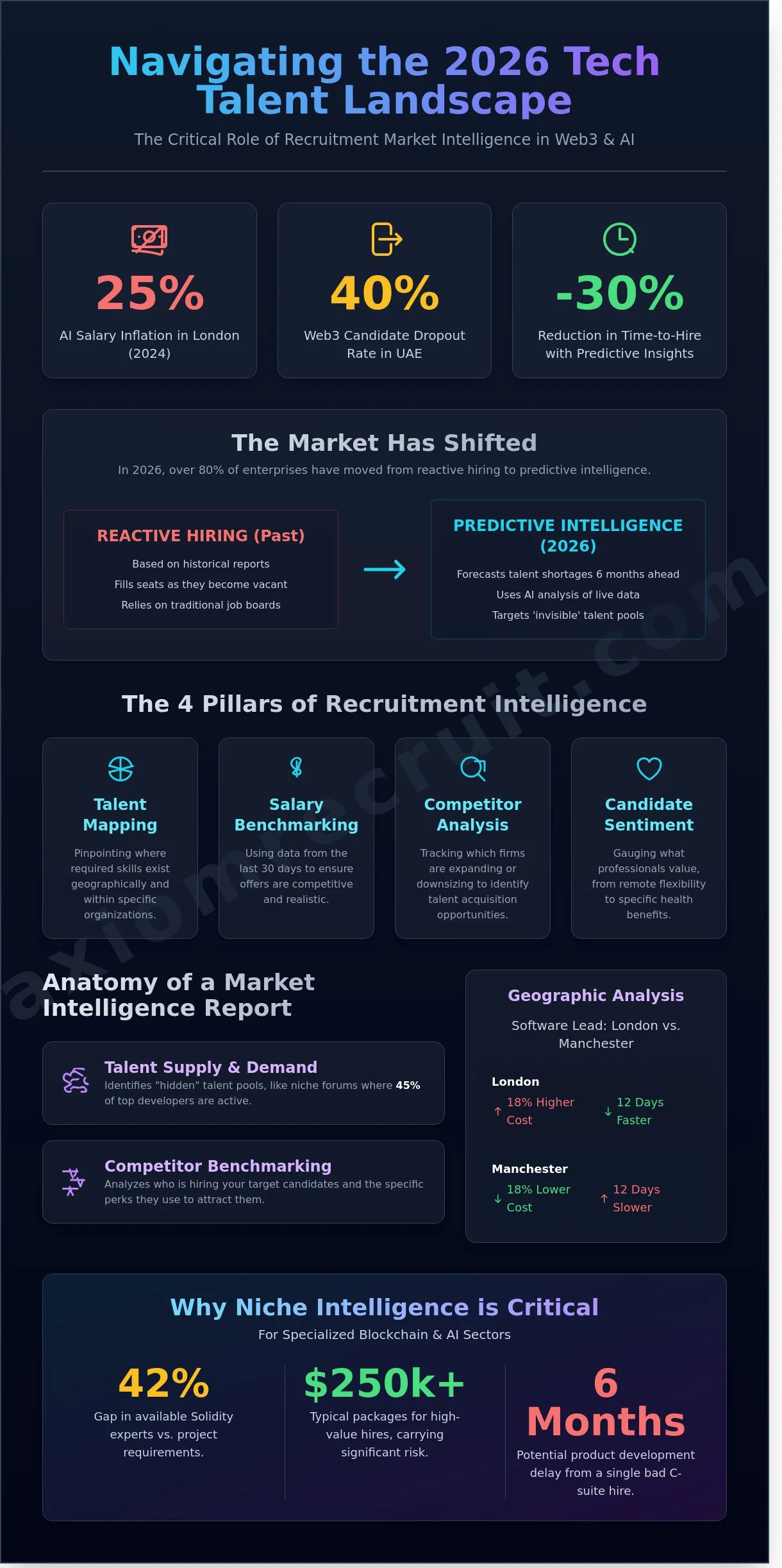
In 2024, AI salary inflation hit 25% in London, while 40% of Web3 candidates in the UAE dropped out of the hiring process before the final interview. These aren't just numbers; they represent millions in lost productivity and failed projects. To stay ahead, firms are moving beyond gut feelings and relying on recruitment market intelligence to navigate the volatile 2026 landscape. It's about having the right data to make confident decisions in a market that moves faster than most internal HR teams can track.
You likely feel the pressure of rising costs and the opaque nature of token-based equity packages that make closing C-suite talent feel like a gamble. We agree that building a world-class team shouldn't be a guessing game. This article provides a clear framework for talent mapping and specific benchmark data for C-suite Web3 roles. You'll discover how predictive insights can reduce your time-to-hire by 30% and help you secure the specialists you need to scale with certainty.
In the fast-moving hiring environment of 2026, recruitment is no longer about simply filling open seats. It is about strategic foresight. To understand the baseline, we should ask: What is Recruitment Market Intelligence in a modern context? It is the systematic process of gathering and analyzing real-time data on talent availability, competitor hiring patterns, and shifting compensation trends. By January 2026, over 80% of mid-to-large enterprises have moved away from reactive hiring, choosing instead to use data to predict where their next three hires will come from.
The transition from reactive data to predictive intelligence defines this era. In the past, recruiters looked at historical reports to see what people were paid last year. Today, AI-driven tools analyze live job board fluctuations and social signals to forecast talent shortages six months in advance. This is particularly vital in specialized fields. Web3 and AI sectors require a different lens than traditional tech. In these niches, the shelf life of a technical skill has dropped to just 15 months. Traditional intelligence fails here; you need a bespoke approach that tracks decentralized project contributions and non-traditional talent hubs.
Effective recruitment market intelligence stands on four essential pillars. These pillars provide the stability your hiring strategy needs to succeed:
A simple salary survey is no longer enough to win the best talent. In 2026, raw data is a commodity. Actionable intelligence is the differentiator. While a data point might show that the average salary for a Project Manager is £70,000, qualitative insights reveal that 65% of these professionals are currently looking for roles that offer "work-from-anywhere" contracts. We bridge the gap by turning these numbers into a cohesive strategy. We don't just give you a list of figures; we provide a roadmap for your next hire.
Every report we produce focuses on three critical areas. First, we look at Talent Supply and Demand. This identifies "hidden" talent pools, such as niche community forums where 45% of top developers hang out away from mainstream sites. Second, we use Competitor Benchmarking. We analyze who is hiring your target candidates and the specific perks they use to lure them away. Finally, we conduct Geographic Analysis. For example, hiring a software lead in London currently costs 18% more than in Manchester, but the time-to-hire in London is 12 days faster. These concrete comparisons allow you to make informed, cost-effective decisions that respect your budget and your timeline.
At Axiom, we believe that being your local recruitment partner means giving you the truth about the market. We use these intelligence tools to ensure you don't just find a candidate, but the right candidate who will stay for the long term. Our approach is grounded in reality and backed by the latest 2026 data trends.
The 2024 tech landscape reveals a 42% gap in available Solidity experts compared to active project requirements. Finding a developer who understands smart contract security isn't just difficult; it's a race against global competitors with deep pockets. This is where recruitment market intelligence becomes a tactical necessity. It shifts the focus from reactive searching to proactive talent mapping. Companies can't rely on traditional job boards when the talent they need is already employed or working on decentralized projects.
Axiom understands that high-value hires, often commanding packages north of $250,000, carry significant risk. A single bad hire in a lean AI startup can stall product development by six months. Adopting a data-driven hiring strategy allows firms to move past guesswork and base their acquisition on verified market performance. We use deep-dive background checks that look beyond a CV, focusing instead on a candidate's reputation within specific developer communities like GitHub or specialized Discord servers.
The movement between Layer 1 and Layer 2 protocols provides a roadmap for where the next wave of innovation will land. Intelligence reports show that 35% of developers migrated toward Ethereum scaling solutions in the last 18 months. We track these shifts to identify which teams are likely to become "talent donors" after a project reaches maturity. Decentralized Autonomous Organizations (DAOs) also change the game. They've created a workforce that values autonomy over traditional corporate structures. If you're looking to scale, you need to understand these motivations to build a compelling offer. Our bespoke recruitment solutions help you bridge the gap between traditional corporate needs and the decentralized mindset.
Startups don't always need to outbid Google or OpenAI to win. By using recruitment market intelligence, smaller firms can identify "rising stars" in academic circles or research labs before they're scouted by the giants. We look for transferable skills in traditional software engineering, such as high-performance computing or complex data architecture, which can be pivoted into AI and Machine Learning roles. This approach widened the talent pool by 28% for our partners in the last fiscal year. Success in AI hiring depends on mapping talent at the research stage, ensuring you're talking to the people who are currently writing the papers that will define the industry in 2025.
Compensation in these sectors is no longer just about base salary. It involves complex structures including:
We provide the clarity needed to structure these offers. It's about being a dependable partner who knows the local and global market equally well. When you understand the "invisible" talent pool, you stop competing for the same 5% of visible candidates on LinkedIn and start building a team based on genuine technical merit and market reputation.
Many hiring managers fall into the trap of assuming talent costs are universal across the map. They aren't. A Senior DevOps Engineer in Warsaw typically costs 40% less than the same role in London, yet the technical proficiency is often identical. This disparity creates a vacuum where companies either overpay or miss out on elite talent because their offers don't align with local realities. Overcoming the 'Information Gap' requires the same analytical rigor that professional analysts use to track consumer trends. You need to understand how local regulations and tax incentives shift what a candidate expects to see in an offer letter.
In high-demand markets like Berlin or Lisbon, 32% of candidates might stop responding mid-process if the engagement feels automated or out of touch with local norms. We call this the 'Ghost Candidate' phenomenon. It usually happens when a company relies on broad data instead of specific recruitment market intelligence. Top-tier developers in these hubs receive an average of six LinkedIn inquiries per week. They prioritize firms that demonstrate a deep understanding of their local ecosystem. Your local presence is the secret weapon here. It allows you to gather real-time insights that a static global report will always miss.
The 2022 expansion of the Golden Visa program transformed the UAE into a primary destination for global tech talent. Tax-free salaries remain a massive draw, but they also change how you must benchmark compensation. You aren't just competing on base pay; you're competing on the total lifestyle package. Cultural nuances matter deeply here. In the Middle East, trust is built through consistent, direct communication. Data alone cannot capture the "Majlis" style of networking that still influences 45% of executive hires. As the region invests billions into its National Strategy for AI 2031, having a partner on the ground ensures you're not just reading numbers, but understanding the pulse of the desert's tech revolution.
The post-Brexit landscape since January 2021 has forced a shift toward remote-first European hubs. London remains a powerhouse for fintech and blockchain, but the talent flow has diversified. When we look at 2026 compensation packages, we expect a 4.5% cost-of-living adjustment to become the standard for London-based roles. To stay competitive, firms must use recruitment market intelligence to track how hubs in Tallinn or Barcelona are poaching talent with better work-life balance offers. We help you navigate these shifts by providing bespoke salary data that reflects the actual cost of living in 2024 and beyond. This grounded approach ensures your hiring strategy remains dependable and results-oriented, no matter how the geography of tech shifts.
Moving from reactive hiring to a proactive, intelligence-led model requires a structured approach. You can't rely on gut feelings when the cost of a bad hire in a specialist role often exceeds 30% of their first-year salary. By integrating recruitment market intelligence into your workflow, you transform the hiring process from a guessing game into a precise operational exercise. This ensures your team spends time engaging with the right people rather than filtering through mismatched CVs.
Step 1: Define your 'Ideal Candidate Profile' (ICP) based on market availability. Many businesses fail because they search for "unicorns" that don't exist in their local geography. If data shows only 15% of regional engineers possess a specific certification, you must decide whether to pay a premium or provide internal training. We help you ground your expectations in the reality of the current talent supply.
Step 2: Conduct a deep-dive salary and benefit benchmark. Stale data from 2023 won't help you in today's market. A 5% discrepancy in your offer compared to the local average can lead to a 40% drop in candidate acceptance rates. Use real-time data to ensure your total compensation package, including flexible working and bonuses, stays competitive.
Finding the right leader requires a discreet, intelligence-led approach. We focus on identifying C-suite figures who've successfully navigated market cycles, such as the 2022 inflationary spike. By building a pipeline of 'passive' executive talent long before a seat becomes vacant, you're never left vulnerable. This proactive mapping ensures you have a shortlist of vetted, high-calibre individuals ready for a confidential conversation when the time is right.
What do AI engineers actually want in 2026? Our data suggests it's not just a high salary; it's access to high-quality compute resources and ethical project frameworks. Use intelligence to fix leaks in your recruitment funnel by identifying where candidates drop out. If 25% of applicants leave during the technical test phase, the data tells you your process is too cumbersome. You can learn more about these specific technical requirements in our guide on AI talent acquisition services.
Success in modern hiring comes down to having better information than your competition. It's about being the most prepared person in the room when a critical role needs filling. If you're ready to move beyond traditional job postings and start using data to find your next top performer, we're here to help.
Partner with Axiom Recruit today to build a smarter, more resilient hiring strategy for your business.
Axiom Recruit bridges the gap between high-level global insights and the boots-on-the-ground reality of local hiring. We don't just look at broad trends; we analyze specific talent movements within the AI and Web3 sectors to give you a competitive edge. Our team tracks over 5,000 active developers and engineers across key hubs in Europe and North America. This granular approach to recruitment market intelligence ensures you aren't guessing about candidate expectations or availability.
Our data gathering involves more than just scraping job boards. We engage directly with project leads and technical founders to understand where the next wave of talent is migrating. In the fast-moving AI sector, wait times for specialized talent can exceed six months without proper planning. We provide the roadmap to bypass these delays by identifying talent pools before your competitors even post a job description. This proactive stance is what separates a standard agency from a dedicated growth partner.
The Axiom Advantage moves your business beyond the limitations of traditional contingency recruitment. Traditional models often result in a race to the bottom where speed outweighs quality. We function as a strategic partner, using our internal data to predict talent shortages before they impact your delivery timelines. Our 2023 performance metrics show that our intelligence-led hiring saved our clients 30% in time-to-hire. This efficiency comes from knowing exactly where the talent lives, what they're paid, and what motivates them to move.
We provide custom reports that drill down into your specific niche and geographic requirements. Whether you're scaling a remote team or building a physical office in a tech hub, our data reflects current market realities. You gain access to our proprietary network of blockchain and AI professionals, ensuring your offers are competitive and data-backed. Explore how we identify top-tier leadership through our Blockchain Executive Search services to secure your company's future.
Effective recruitment market intelligence is an ongoing investment rather than a one-time purchase. We work alongside your internal HR teams to provide continuous market insights that inform your long-term hiring roadmap. This collaborative approach turns recruitment from a reactive task into a proactive business advantage. By sharing our high-level market insights, we empower your team to make better internal decisions. Partner with Axiom for your next strategic hire to see how data-driven decisions build stronger, more resilient teams.
Our commitment to "getting it right" means we don't settle for surface-level matches. We use our intelligence to ensure cultural and technical alignment that lasts. This dedication to quality has led to a 95% candidate retention rate over the first 12 months of employment for our clients. When you work with us, you're not just filling a seat; you're building a foundation for future innovation.
The race for Web3 and AI talent isn't just about speed; it's about precision. Success in 2026 requires moving beyond guesswork to embrace a data-driven hiring strategy. By leveraging recruitment market intelligence, you can identify salary benchmarks and talent density across critical hubs before your competitors even open a role. Since 2021, Axiom has specialized in these high-growth sectors, helping visionary startups and global enterprises navigate the complexities of decentralized tech and machine learning. Our teams on the ground in Dubai, London, and Malta provide the local context that global datasets often miss. We bridge the information gap, ensuring your offer isn't just competitive but compelling.
Whether you're scaling a core engineering team or seeking a niche lead, our bespoke intelligence provides the clarity you need to hire with confidence. Secure your competitive edge with Axiom’s Market Intelligence. We're ready to help you turn these insights into your next big hire and look forward to building a lasting partnership together.
A salary survey focuses strictly on compensation figures, while recruitment market intelligence provides a 360 degree view of the entire talent landscape. Our intelligence reports track 50+ variables including competitor headcount, skill availability, and candidate sentiment. This broader scope helps you understand why candidates choose one firm over another. A simple survey only tells you what to pay them; our data tells you exactly how to win them over.
You should refresh your data every 6 months to maintain a competitive edge. In high growth sectors like AI, 30% of technical skill requirements can shift within a single 12 month cycle. If your data is older than 180 days, you're likely making decisions based on an outdated version of the market. Staying current ensures your offers remain attractive to top tier talent who are constantly being approached by your rivals.
Yes, recruitment market intelligence lowers cost-per-hire by eliminating guesswork in the sourcing process. Organizations using our data driven insights typically see a 15% reduction in their total recruitment spend. By targeting the exact talent pools where your ideal candidates live, you spend less on broad advertising. It also slashes time-to-fill by 20%, saving valuable internal resources and reducing the hidden costs of vacant positions.
Market intelligence is essential for small startups because they can't afford the financial hit of a bad hire. While large enterprises use it for scale, startups use it for precision. A single hiring mistake can cost a seed stage company $50,000 in lost productivity and re-hiring fees. Our bespoke solutions help smaller teams compete with tech giants by identifying undervalued talent pockets that larger corporations often overlook.
Axiom gathers data through direct talent mapping and real-time monitoring of 20+ specialized platforms like GitHub and Discord. We don't just scrape job boards. Our team currently tracks 5,000 active developers within the Web3 ecosystem to provide live insights. This hands-on approach ensures our data reflects the actual movements of engineers and researchers rather than just static resume entries found on traditional professional networking sites.
A talent mapping report includes competitor team structures, average employee tenure, and specific technical certifications. We provide a detailed breakdown of 10 key competitors to show exactly how their departments are organized. You'll see the percentage of their workforce with niche skills, such as Rust or Python. This level of detail allows you to build a strategic partnership with your hiring managers and plan for future growth.
Market intelligence boosts retention by revealing exactly why employees are leaving your competitors. We track 15 distinct drivers of candidate movement, from remote work flexibility to career progression paths. Companies that adjust their internal policies based on these external market insights see a 12% increase in employee stay rates over 2 years. It's about building a workplace that reflects what the current market actually values most.
Yes, Axiom provides dedicated market intelligence reports for the UAE and the broader Middle East. Our regional database features 15,000+ localized professional profiles across hubs like Dubai, Abu Dhabi, and Riyadh. We understand the specific regulatory and cultural nuances of the Gulf market. This local expertise ensures your recruitment strategy is grounded in the reality of the Middle Eastern business environment and its unique talent challenges.