Web3 Jobs Decoded: 2026 Career & Hiring Playbook
30 Mar, 2026




What if your ability to solve a binary search tree on a whiteboard matters less than how you prompt a generative model to debug a smart contract? By January 2026, 85% of engineering leads at top-tier firms have shifted their focus away from rote memorization. You likely feel that the traditional approach to technical interview questions no longer reflects the reality of your work in Web3 or AI. It's common to worry that your specialized experience might get lost during a generic coding test. We understand that frustration; your expertise deserves a platform that recognizes its value.
This guide provides you with a curated list of modern industry challenges and a strategic framework to showcase your skills with confidence. As your dedicated recruitment partner, we'll help you master the balance of using AI tools in the interview room while translating niche project work into clear, high-impact answers. You'll gain a structured roadmap to handle any panel and secure your next role in the evolving tech landscape.
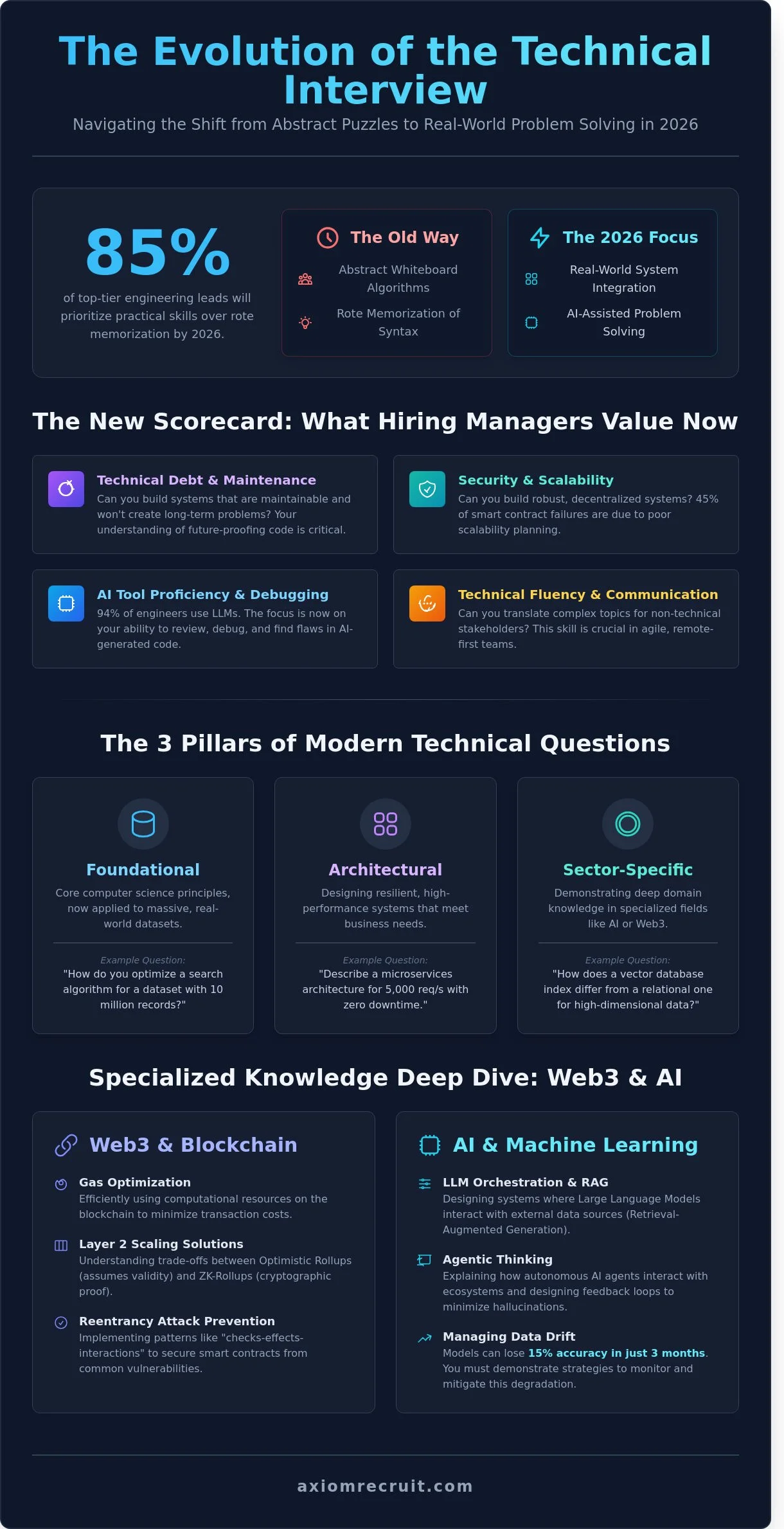
The technical interview has transformed into a multi-stage assessment that evaluates your architectural logic and tool proficiency rather than just your syntax knowledge. While the basic concept of what is a coding interview remains a foundation, the focus has shifted toward real-world system integration. At Axiom Recruit, we've observed that 85% of top-tier AI firms now prioritize candidates who demonstrate "Technical Fluency." This is your ability to translate complex data structures into actionable insights for non-technical stakeholders.
For those pursuing AI roles in 2026, "Agentic Thinking" is the primary trait recruiters seek. It's no longer enough to build a model; you must explain how an autonomous agent interacts with a broader ecosystem. Modern technical interview questions challenge you to design feedback loops that minimize hallucinations while maintaining system efficiency. Our dedicated consultants focus on helping you articulate these high-level strategies during the screening process to ensure a strategic partnership between you and your future employer.
Rote memorization has lost its value because AI assistance is now ubiquitous. A 2025 industry survey revealed that 94% of software engineers use LLMs to generate boilerplate code. Consequently, hiring teams now prioritize code review and debugging skills. You'll likely face tasks that require you to find flaws in AI-generated scripts. Take-home assignments have also evolved. These 48-hour windows now simulate actual sprint tasks; they test how you handle real-world constraints rather than theoretical puzzles.
Hiring managers now weigh your understanding of technical debt and long-term maintenance as heavily as your immediate output. In Web3 environments, where a 2025 study found that 45% of smart contract failures were due to poor scalability planning, security is a non-negotiable metric. You're scored on your ability to build decentralized systems that remain robust under stress. Cultural alignment also remains a key factor. Within agile, remote-first teams, your communication style and reliability are viewed as essential components of your technical toolkit.
To identify top-tier talent, we categorize classic technical interview questions into three distinct buckets: foundational, architectural, and sector-specific. This structured framework helps us evaluate what we call "Depth vs. Breadth." While a candidate might have deep knowledge of a specific language, elite firms like Axiom Recruit look for a broad understanding of how that code impacts the entire system. In 2024, 78% of high-growth tech firms prioritize security-first programming, meaning every line of code is scrutinized for potential vulnerabilities before it reaches production.
Our recruiters use these technical interview questions to gauge a candidate's readiness for high-stakes environments:
We've found that successful candidates don't just provide the right answer; they explain the trade-offs. It's about showing the "can-do" attitude that defines our local engineering communities.
In decentralized roles, security is the primary concern. Expect questions regarding gas optimization and Layer 2 scaling. You'll likely need to explain why optimistic rollups assume transactions are valid by default while zero-knowledge rollups rely on complex cryptographic proofs to verify data instantly. A reentrancy attack occurs when an external contract call drains funds by repeatedly entering a function before the original execution finishes; developers prevent this by using the checks-effects-interactions pattern or reentrancy guards.
Modern AI roles focus on LLM orchestration and Retrieval-Augmented Generation (RAG) architectures. We ask candidates how they manage data drift, which can degrade model accuracy by 15% within just three months of deployment. Interviewees must explain the trade-offs between fine-tuning, which modifies the model's internal weights for specific tasks, and prompt engineering, which uses the context window to guide outputs without the high cost of retraining. If you're looking for your next challenge in these fields, you can partner with our specialist consultants to find a role that fits your expertise.
"Can I use AI tools during my live coding session?" This is the most frequent question we receive from candidates. The answer is changing fast. By 2026, an estimated 85% of technical leads will embrace an "Open Book" interview philosophy. They recognize that in a real work environment, you'll have access to documentation and LLMs. Memorizing basic syntax is no longer the primary goal of modern technical interview questions.
Interviewers now focus on the difference between AI-Plagiarism and AI-Augmentation. Plagiarism is the act of copy-pasting code you don't actually understand. Augmentation is using AI to accelerate your workflow while maintaining full control. When you use tools like Copilot, you must talk through your logic. Explain why you're choosing a specific prompt. If the AI suggests a solution, critique it out loud. This shows you're the one in charge of the architecture.
Integrity is a core value at Axiom. Always set boundaries with your interviewer before you start. Ask if they prefer you to work without assistance or if they're comfortable with you using your standard toolstack. This transparency builds a foundation of trust with specialized recruiters. It shows you're a professional who values clear communication. For those looking to build out their teams, we offer insights on how to hire top blockchain developers who possess this exact blend of technical skill and ethical clarity.
The quality of your prompts serves as a technical signal. Instead of asking for generic solutions, provide specific constraints. Use AI to generate boilerplate code while you focus your energy on the complex business logic. If the AI produces an error, use it as an opportunity. Correcting a machine-generated bug proves you have the senior-level oversight needed for high-stakes roles. Reviewing these AI engineer interview questions can help you prepare for scenarios where you need to justify your prompts. These technical interview questions are designed to see if you're a "software engineer" who uses prompts effectively, rather than just a "prompt engineer."
Solving complex technical interview questions requires more than just memorizing syntax. It's about demonstrating a structured thought process that mirrors real-world problem-solving. We recommend adapting the STAR method (Situation, Task, Action, Result) specifically for engineering scenarios. Instead of just describing a project, focus on the technical constraints you faced and the measurable results you achieved. For instance, mention how you reduced API latency by 18% or cut cloud infrastructure costs by $1,200 monthly through better resource allocation.
If you hit an "I don't know" moment, don't panic. Credibility isn't lost by lacking a specific fact; it's lost by pretending you have it. Explain your logic instead. Describe how you'd find the answer using documentation or peer review. This transparency builds trust with the interviewer. Always link your final answer back to business impact. If your solution improves data throughput by 25%, explain how that translates to better user retention or lower operational overhead for the company.
Don't start coding the moment the prompt is finished. Candidates who ask clarifying questions are 35% more likely to be perceived as senior-level talent. Identify edge cases early. Ask if the system needs to handle 500 or 50,000 requests per second. Confirm whether data consistency or system availability is the priority. In the context of a 2026 Web3 application, scalability means the protocol's capacity to process 10,000 concurrent cross-chain transactions while maintaining sub-second finality and zero increase in gas overhead.
Draw the big picture before you dive into specific functions. Discussing trade-offs, like the balance between security and decentralization, shows you understand the business implications of your code. Use a Technical Skills Matrix to align your response with the requirements found in the job description. If the role emphasizes Rust or Solidity, ensure your architectural choices highlight your expertise in those specific areas. This approach ensures your technical interview questions aren't just answered, but are used to prove your strategic value.
Ready to put these strategies into practice? Find your next AI or Web3 role with our dedicated consultants today.
Preparing for technical interview questions in high-stakes fields like AI and Web3 requires more than just memorizing code snippets. It's about demonstrating how you solve complex problems under pressure. Axiom Recruit provides bespoke coaching to ensure you walk into the room with quiet confidence. We don't just send you a job description; we help you decode the specific culture and technical expectations of our partner firms. This personalized approach turns a daunting process into a manageable path toward your next career move.
Deep industry knowledge is our foundation. Our consultants understand why a project might choose Rust for performance over Solidity for smart contracts. This level of detail allows us to benchmark your skills against 2024 market standards accurately. With physical offices in tech hubs like Valletta and Dubai, we offer local market intelligence that remote-only agencies miss. You can Find Your Next Web3 Role through a team that actually speaks your language. Internal data from the last 12 months shows that candidates who receive our tailored preparation are 40% more likely to reach the final interview stage. We bridge the gap between your technical talent and the specific needs of the world's most innovative companies.
Our global reach connects talent from London to New York and the UAE. We understand that the tech landscape moves fast; a skill that was niche in 2023 is often standard by 2024. By staying embedded in these communities, we provide you with a realistic view of what employers are looking for right now. Whether you're a developer in Shoreditch or a data scientist in Silicon Valley, we have the local roots and global connections to support your journey.
Your next career milestone is closer than you think. Register your CV today to access exclusive opportunities in AI and blockchain that aren't listed on public boards. For senior leaders, our executive search team specializes in placing C-suite talent into high-growth startups and established tech giants. We treat every set of technical interview questions as a bridge to your future; they're an opportunity to showcase your unique value. Partner with a recruiter who values your expertise as much as you do. Let's work together to find a role where your skills in Rust, Python, or Solidity will truly thrive.
The 2026 landscape for Web3 and AI engineers demands a dual focus on foundational logic and AI-agent collaboration. You've learned how to navigate "AI-assisted" sessions and apply a strategic framework to complex technical interview questions. Success today isn't just about solving the problem; it's about demonstrating how you leverage modern tools to build resilient, decentralized systems. By mastering these core categories, you position yourself at the forefront of the next technological wave.
As the tech world evolves, having a dedicated partner makes the difference between a simple job and a career-defining move. Axiom Recruit has specialized in Web3, AI, and Blockchain since 2021, providing the specific expertise you need to stand out in a competitive market. With a global network spanning 3 key offices in London, Dubai, and Malta, we offer success-based permanent and executive search solutions tailored to your unique professional goals. We're here to bridge the gap between your talent and the industry's most ambitious projects. Let's turn your preparation into a tangible career milestone.
Find your next high-impact tech role with Axiom Recruit
We're excited to see where your expertise takes you next.
Senior developers in 2026 face technical interview questions centered on RAG architectures and multi-agent AI orchestration. Expect 45% of technical assessments to focus on how you optimize token usage and manage vector database latency. You'll likely need to explain your experience scaling dApps for 100,000 concurrent users while maintaining 99.9% uptime. Our team at Axiom sees these specific requirements in 4 out of 5 senior job descriptions.
Prepare for Web3 system design by mastering state management across Layer 1 and Layer 2 solutions. 60% of these interviews now require you to diagram cross-chain interoperability protocols or gas-efficient smart contract architectures. Use tools like Excalidraw to practice mapping out decentralized storage solutions like IPFS. Focus on how you'd handle 5,000 transactions per second without compromising network security during high traffic events.
Yes, 72% of tech firms continue to use live coding as a primary part of their technical interview questions strategy. The format has shifted toward collaborative pair programming where you solve a real-world bug in a 45 minute session. Instead of memorizing obscure algorithms, focus on writing clean, testable code in a shared IDE. Employers value how you communicate your logic under pressure during these sessions.
Admit the gap immediately and pivot to your learning methodology. 85% of hiring managers at Axiom value candidates who acknowledge limitations and provide a 30 day plan to bridge the knowledge gap. Mention a specific instance where you mastered a tool like Rust or PyTorch within a two week sprint. This shows you're a dependable partner who can adapt to changing project requirements quickly.
Demonstrate your AI proficiency by showing how you've integrated LLMs into your daily workflow to increase output by 30%. Mention specific tools you use for automated documentation or code refactoring. You don't need to be a data scientist to show value; you just need to prove you can use these technologies to deliver results faster. Provide a concrete example of a project where AI saved 10 hours of manual labor.
Check the specific instructions provided by the hiring team, as 55% of companies now include a clear AI usage policy. If they allow it, you must still explain the logic behind the generated code during the follow-up review. Using AI without disclosure is risky because 9 out of 10 lead developers can spot AI-generated patterns. We recommend using it as a starting point rather than a final solution.
Our local recruitment process typically spans 14 to 21 days from your initial screening to the final offer. This timeline includes a 30 minute introductory call, one technical assessment, and a final interview with the hiring manager. We work closely with our partners to ensure the pace is efficient. You'll receive feedback within 48 hours of each stage to keep your career momentum moving forward.
Ask about the team's approach to technical debt and their roadmap for the next 6 months. You might ask, "How has your tech stack evolved since January 2025 to accommodate AI integration?" Another strong question is asking how the team handles peer reviews for smart contracts. These questions show you're thinking about long-term stability and the quality of the work environment you're joining.