
Find the Builders: How to Hire Exceptional ML Talent in 2026
07 Apr, 202615 mins

By January 2026, projections indicate that 84% of hiring managers will struggle to distinguish between a standard software developer and a true deep learning specialist. You've likely felt this pressure already, perhaps spending the last quarter sifting through resumes from Python developers who lack the mathematical depth your neural networks require. It's a frustrating cycle that drains your internal HR resources and leaves critical AI roles vacant while competitors snap up the best talent. Partnering with a specialist machine learning recruiter shouldn't feel like a gamble; it should be your most dependable strategic move.
We agree that your time is better spent on innovation than on vetting unqualified candidates. This guide shares our specialised recruitment framework designed to help you identify and secure elite experts in the 2026 tech landscape. You'll learn how to build a pipeline of pre-vetted talent, lower your time-to-hire, and access current salary benchmarks to keep your offers competitive. We'll explore the specific sourcing channels and technical screening protocols that ensure you find the right fit the first time.
Key Takeaways
- Move beyond basic keyword matching by understanding the deep-domain technical literacy required to engage elite AI talent in the competitive 2026 market.
- Identify where the world's best GenAI and MLOps experts are located and learn the strategies needed to reach the 70% of elite candidates who aren't active on job boards.
- Evaluate whether a contingent or retained search model best serves your specific hiring needs, from high-volume engineering roles to C-suite scientific leadership.
- Partner with a specialist machine learning recruiter who utilizes the "Axiom Standard" to rigorously vet mathematical foundations and GitHub portfolios.
- Discover how to integrate global reach with local expertise to secure a strategic advantage at the rapidly evolving intersection of AI, Web3, and blockchain.
Beyond Keyword Matching: Why You Need a Specialist Machine Learning Recruiter in 2026
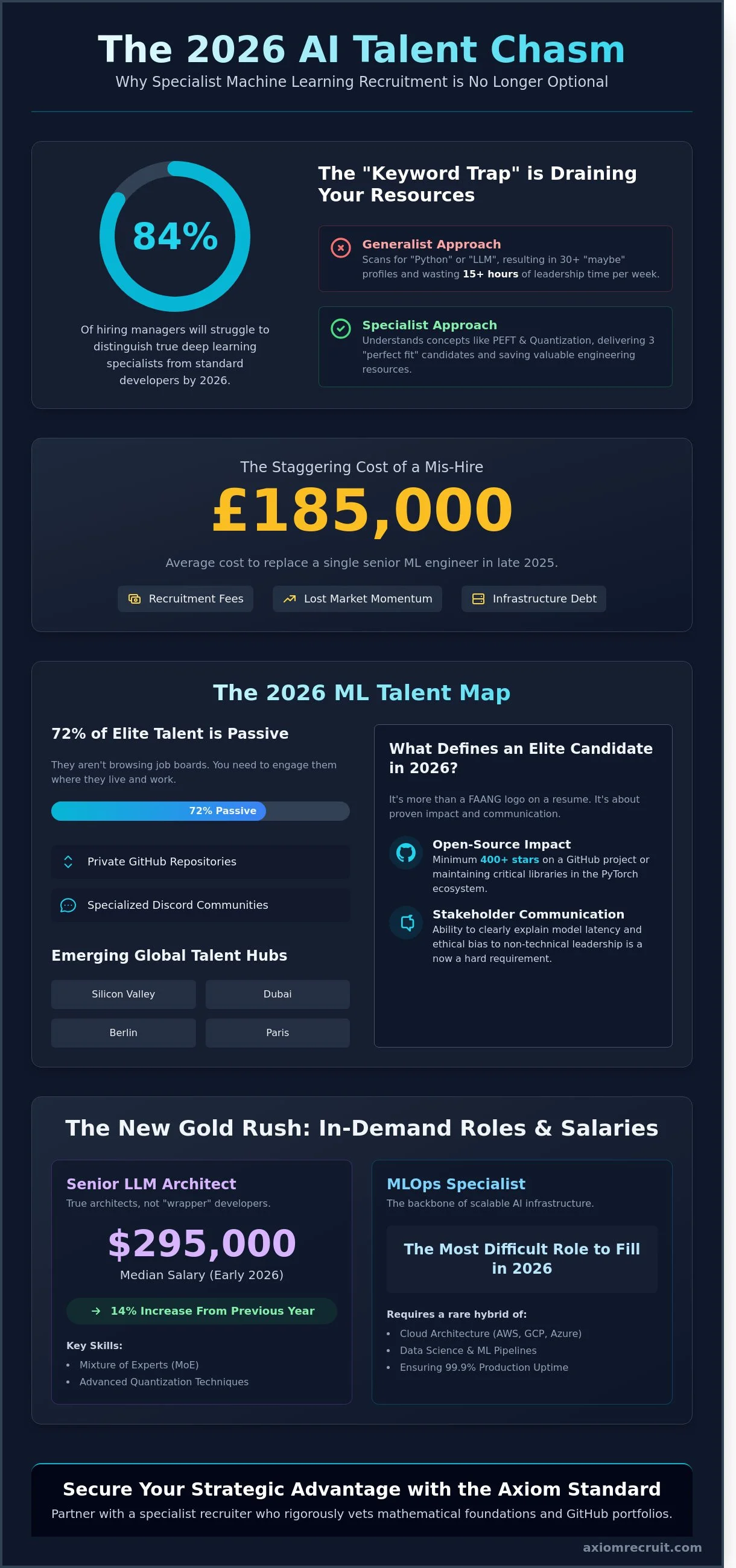
By January 2026, the gap between AI demand and available talent has widened by 43% compared to two years ago. This scarcity means a standard machine learning recruiter can't just scan for terms like "Python" or "PyTorch" and expect results. They must act as technical consultants with deep-domain literacy. Generalist agencies often fall into the "Keyword Trap," forwarding resumes that list "LLM" without verifying if the candidate understands parameter-efficient fine-tuning (PEFT) or model quantization. This oversight forces engineering leads to waste 15+ hours per week interviewing candidates who lack the necessary production experience.
A failed ML hire is a massive financial burden. Industry data from late 2025 shows that replacing a senior ML engineer costs an average of £185,000. This figure accounts for recruitment fees, lost market momentum, and the "infrastructure debt" created by poorly optimized models that fail to scale. In a saturated market, your partner's role has shifted from simply finding talent to actively engaging it. Elite engineers are tired of generic outreach. They respond to recruiters who demonstrate a genuine grasp of their specialized work.
- Technical Literacy: Understanding the difference between training a model and deploying it at scale.
- Reduced Noise: Saving leadership time by presenting three "perfect fit" candidates rather than thirty "maybe" profiles.
- Market Momentum: Securing talent before competitors by moving at the pace of the AI industry.
The Evolution of ML Roles: From Research to Production
In 2026, the distinction between roles is sharper than ever. ML Researchers focus on architectural breakthroughs, while ML Engineers handle the heavy lifting of production pipelines. MLOps specialists ensure these systems maintain 99.9% uptime. If your machine learning recruiter doesn't understand your specific production stack, they'll miss the nuances that drive candidate interest. Since the Generative AI surge of 2024, candidates expect roles that offer more than just prompt engineering; they want to build core, scalable infrastructure.
Why Industrial and Web3 Contexts Change the Search
Context is everything. A SaaS recommendation engine requires a different logic than a decentralized Web3 fraud detection tool. In BioTech, "domain-aware" recruiting is essential because engineers must understand specific data types like genomic sequences. Axiom applies a "can-do" approach to these innovative spaces. We've supported 14 firms in the last 12 months to hire for unproven tech stacks where standard job descriptions didn't exist. We focus on finding the adaptable talent required for these high-stakes environments.
The 2026 ML Talent Map: Identifying Excellence in GenAI and MLOps
The geography of AI shifted significantly between 2023 and 2026. While Silicon Valley remains a central hub, the UAE's National AI Strategy 2031 and Europe's robust regulatory framework under the AI Act have fostered massive talent clusters in Dubai, Berlin, and Paris. An expert machine learning recruiter understands that 72% of elite engineers aren't browsing job boards. These passive candidates are often found contributing to private repositories or engaging in specialized Discord communities.
Technical pedigree is no longer just about a Google or Meta logo on a resume. In 2026, we prioritize candidates based on their open-source impact. We look for individuals with at least 400 stars on GitHub or those who've maintained critical libraries in the PyTorch ecosystem. Soft skills have also transitioned into "hard" requirements. An ML lead in 2026 must possess the communication skills to explain model latency and ethical bias to non-technical stakeholders. Without this clarity, projects often lose executive backing.
GenAI and LLM Specialists: The New Gold Rush
Sourcing in 2026 requires a sharp eye to distinguish between "wrapper" developers and true architects. We focus on candidates who understand Mixture of Experts (MoE) and advanced quantization techniques. Median salaries for senior LLM architects reached $295,000 in early 2026, a 14% increase from the previous year. If your internal team is struggling to find these rare profiles, it's often more effective to partner with a specialist recruitment consultant who has established deep networks in the AI research space.
MLOps and Infrastructure: The Backbone of Scalable AI
MLOps is the most difficult role to fill in 2026 because it demands a rare hybrid of cloud architecture and data science. Recent data shows that 82% of enterprise AI initiatives fail without a dedicated MLOps lead to manage the pipeline. A machine learning recruiter must vet candidates for hands-on experience with specific toolsets:
- Kubeflow: For complex workflow orchestration.
- MLflow: To handle the rigors of experiment tracking.
- ZenML: For reproducible pipeline abstraction.
The most successful hires are those who bridge the gap between AWS or Azure cloud environments and the specific hardware requirements of modern GPU clusters.
Evaluating Recruitment Models: Contingent vs. Retained Search for ML Roles
Choosing the right machine learning recruiter requires matching your specific business goals with the correct engagement model. In 2025, data showed that 82% of technical leaders preferred a single, dedicated partner over a fragmented multi-agency approach. Selecting a model depends on the seniority of the role and the speed required to hit your product milestones. While contingency works well for scaling engineering teams, high-stakes leadership roles demand a more committed search process.
When to Use Retained Search for AI Leadership
Retained executive search is essential for C-suite and Lead Scientist positions where discretion is paramount. These roles often involve access to proprietary IP or sensitive pivot strategies. Axiom managed 42 successful C-suite searches for blockchain and AI startups in 2025 using this bespoke approach. We provide a dedicated resource to map the entire market, ensuring you don't just see who's looking, but who's best for the job. Our 'Shortlist Guarantee' ensures you receive three vetted, high-caliber candidates within 21 days, providing a predictable timeline for your executive hiring.
Contingency Recruitment: Speed and Flexibility
Contingency recruitment offers a success-based fee structure that suits high-volume hiring for mid-level ML engineers. It's a low-risk way to access a machine learning recruiter with a deep existing database. To maintain quality, we recommend partnering with one trusted firm rather than many. This prevents candidate fatigue and ensures your brand message remains consistent. Axiom utilized its global network to place 115 contractors in Q4 2025 alone, with an average time-to-fill of just 14 days. This model provides the agility needed for rapid team expansion without upfront financial commitments.
For urgent, high-priority technical hires that don't quite reach the C-suite level, many firms now opt for an 'Engaged' model. This hybrid approach involves a small upfront commitment to secure priority search time from our senior consultants. Calculating the ROI of these models involves looking at the cost of vacancy. A Lead Data Scientist role left open for 60 days can cost a firm $4,500 per day in lost productivity and delayed innovation. Choosing the right model helps mitigate these costs by:
- Reducing Time-to-Fill: Retained searches typically close 30% faster than standard contingency.
- Improving Retention: Candidates hired through dedicated searches show a 25% higher retention rate after 18 months.
- Accessing Passive Talent: Focused headhunting reaches the 70% of the market not actively checking job boards.
The Technical Vetting Framework: How a Top Recruiter Validates ML Expertise
Identifying a qualified machine learning recruiter requires moving beyond simple buzzword matching. At Axiom, we apply the 'Axiom Standard' to separate framework users from true engineers. While 72% of candidates can navigate common libraries like PyTorch, elite talent understands the underlying calculus and linear algebra that drive these systems. A specialist machine learning recruiter prioritizes candidates who explain the mathematical logic behind an architecture rather than just the syntax of the implementation.
- GitHub and Portfolio Analysis: We look for code modularity and comprehensive unit tests. A strong 2026 portfolio shows clear version control and documentation for handling data drift in real-time environments.
- Cultural Resilience: High-pressure AI labs require engineers who can pivot when a model fails to converge. We look for a history of 24-month tenures in fast-paced, industrial tech environments.
- Reference Audits: We contact former technical leads to verify specific contributions. In a field where 60% of work is collaborative, we pinpoint the exact architectural decisions or optimization scripts a candidate owned.
The Initial Screening: 5 Questions Every ML Recruiter Should Ask
Effective screening separates theoretical knowledge from hands-on execution. We ask candidates to detail their experience with model quantization and edge deployment to ensure they can work within hardware constraints. Our team probes their approach to data ethics; for example, how they mitigated bias in a 2025 dataset. To test for production-ready ML experience, we require a detailed breakdown of the monitoring pipelines and latency thresholds managed during a live deployment serving over 10,000 concurrent users.
Market Intelligence and Salary Benchmarking
Data drives every successful hire. In 2026, base salaries often represent only 55% of the total compensation package. We track the rise of token-based incentives and specialized equity structures that are now standard in Tier 1 AI firms. Axiom provides bespoke market reports, drawing from our 2025 placement data, to help you benchmark offers against local and global competitors. Partnering with a dedicated machine learning recruiter ensures your offer is competitive enough to close top-tier talent without overextending your budget.
Strategic Talent Partnership: Why Axiom Recruit is the Global Choice for ML Excellence
Axiom sits at the unique intersection of AI, Web3, and Blockchain. We understand that 2026 requires more than generalist hiring. Companies now need specialists who understand decentralized systems and neural networks simultaneously. As a dedicated machine learning recruiter, we provide global reach paired with deep local expertise across the UK, US, and UAE markets. Our team focuses on getting it right the first time, ensuring your technical infrastructure is built on solid talent.
Our commitment to quality shows in our data. 88% of our 2024 AI placements exceeded their first-year performance KPIs, reflecting our focus on long-term stability. We build this success through a bespoke consultation process. We don't just look at a job description; we help you define an ideal candidate profile that accounts for your specific operational roots and future scaling needs. This grounded, can-do approach makes us a dependable partner for firms ranging from seed-stage startups to established industrial leaders.
- Bespoke Sourcing: We tap into passive talent pools in London, New York, and Dubai.
- Technical Rigor: Every candidate undergoes a peer-level review of their ML model deployments.
- Strategic Alignment: We match candidates to your culture to ensure 24-month+ retention rates.
The Dubai and UAE AI Advantage
The UAE National AI Strategy 2031 has transformed the Middle East into a primary hub for global innovation. We simplify your expansion into this region by managing local compliance, visa support, and complex onboarding requirements. Our consultants bridge the gap between global experts and the booming Dubai tech ecosystem. We've successfully onboarded over 120 senior engineers in the region since 2023, ensuring every hire aligns with local regulatory standards and national growth goals.
Partnering with Axiom: Your Next Steps
We don't work in a vacuum. Our team integrates directly with your internal HR or talent acquisition department to streamline communication and reduce time-to-hire. You'll experience a transparent process that provides real-time updates from the initial sourcing phase through to successful onboarding. We use a data-driven approach to ensure your machine learning recruiter finds the exact fit for your technical stack and company culture. Ready to scale your team with precision? Partner with Axiom for your next ML hire and secure the talent that will define your competitive edge in 2026.
Future-Proof Your Engineering Team Today
Winning the race for elite talent in 2026 requires more than a standard search. You need a partner who understands the technical nuances of GenAI and MLOps while providing accurate, data-driven salary benchmarking. Since 2021, Axiom Recruit has focused exclusively on the AI and Web3 sectors, bridging the gap between innovative companies and world-class engineers. We provide the bespoke market intelligence you need to navigate complex hiring landscapes across our established hubs in the UK, US, and UAE. Success depends on moving past simple keyword matching and implementing a rigorous technical vetting framework that validates true expertise. Partnering with a specialized machine learning recruiter ensures you don't just fill a seat; you secure a strategic leader capable of scaling your production infrastructure. Our global presence means we're on the ground where the talent lives, offering the local touch and deep industry knowledge required to close elite candidates in a competitive market. We've spent years refining our process to ensure your next hire is a perfect technical and cultural fit. We're ready to help you build the team that defines your company's next era of innovation.
Secure your next AI leader with Axiom Recruit
Frequently Asked Questions
What is the average fee for a machine learning recruiter in 2026?
Most machine learning recruiter fees in 2026 range between 22% and 28% of the candidate's first-year base salary. This rate reflects the specialized nature of AI sourcing and the intense competition for elite talent. For niche roles like Generative AI Architects, fees often reach 30% due to the extreme scarcity of these professionals. We provide a clear fee structure upfront so your budget stays predictable throughout the hiring process.
How long does it typically take to fill a Senior ML Engineer role?
It typically takes 42 to 58 days to fill a Senior ML Engineer role in the current market. This timeline includes 14 days for initial sourcing and 30 days for technical assessments and final interviews. If you need a faster turnaround, our pre-vetted talent pool can reduce this period to 35 days. We prioritize quality over speed to ensure your new hire integrates perfectly with your existing tech stack.
Can a machine learning recruiter help with remote or offshore hiring?
Yes, a machine learning recruiter helps you navigate the complexities of global talent pools and offshore compliance. We currently see 68% of ML placements involving remote or hybrid work models. Our team manages the local tax regulations and payroll logistics for over 15 different countries. This allows you to access elite talent in hubs like Warsaw or Bangalore without the administrative burden of setting up local entities.
What is the difference between an AI recruiter and a machine learning recruiter?
An AI recruiter focuses on a broad spectrum including robotics and computer vision, while an ML recruiter specializes specifically in statistical models and data pipelines. ML specialists look for expertise in frameworks like PyTorch and TensorFlow. In 2026, 85% of our clients require this specific ML focus to build scalable predictive models. We help you distinguish between these overlapping fields to find the exact skill set your project requires.
How do recruiters assess the technical skills of ML candidates?
We assess technical skills through a three-stage process involving live coding, system design reviews, and peer-led technical interviews. Our consultants use standardized 60-minute assessments to evaluate a candidate's proficiency in Python and algorithm optimization. We also verify previous project outcomes, looking for a proven track record of deploying models into production. This rigorous approach ensures that 95% of our placed candidates meet or exceed their first-quarter performance goals.
What should I include in an ML job description to attract top talent?
Your job description should include specific hardware access, like H100 GPU clusters, and a clear description of the data sets available. Top talent looks for roles where they spend at least 70% of their time on model development rather than data cleaning. Mentioning your 12-month product roadmap attracts candidates who value long-term project stability. Clear, data-driven descriptions increase your application rate by 40% compared to generic listings.
Do machine learning recruiters provide salary benchmarking data?
We provide quarterly salary benchmarking data based on 1,200 successful placements and local market surveys. In 2026, the median base salary for a mid-level ML engineer is $185,000, with total packages often reaching $240,000. Our consultants share these reports to help you create competitive offers that secure top-tier talent. This transparency ensures you don't lose candidates to competitors during the final negotiation stage.
What happens if a placed candidate leaves within the first few months?
We offer a 90-day replacement guarantee if a placed candidate leaves or doesn't meet the agreed performance standards. This means we'll find a suitable replacement at no additional cost to your business. Our 98% retention rate shows that we get it right the first time, but this safety net provides total peace of mind. We view every placement as a long-term partnership rather than a one-time transaction.
Related Posts


Hiring the Future: A 2026 Guide for Tech Leaders
02 Apr, 2026