
Craft JDs That Convert: Attract Top AI & Web3 Talent in 2026
07 Apr, 202615 mins

What if your current tech job description is actually filtering out the very AI talent you're trying to hire? Data from 2025 recruitment cycles shows that 68% of Web3 engineers abandon applications when they encounter generic requirements that fail to reflect the reality of their niche roles. You likely already know that the old method of listing twenty bullet points of required skills doesn't work for the 2026 market. It's frustrating to post a high-stakes role only to receive 200 unqualified responses while your competitors snap up the top tier talent. You need a JD that acts as a verbal handshake, grounded in the reality of the work.
Master the art of writing JDs that convert with our repeatable framework. This guide provides a bespoke solution to help you articulate the specific value of AI and Web3 positions, which can reduce your time-to-hire by an average of 14 days. We'll show you how to move from a simple data-driven listing to a consultative narrative that builds trust with candidates. Follow our step-by-step template to position your brand as a serious, supportive partner for the industry's best minds.
Key Takeaways
- Learn why shifting from traditional skill-based requirements to impact-focused narratives is essential for attracting elite talent in the AI era.
- Master the anatomy of a modern tech job description by incorporating a compelling mission hook and a clear "First 90 Days" success roadmap.
- Discover how to write authentically for AI and Web3 roles by replacing generic buzzwords with descriptions of real-world technological challenges.
- Improve your recruitment reach by implementing diversity audits and optimizing your content for the mobile-first platforms where top talent actively engages.
- Explore how a strategic partnership with a global recruitment expert can help you scale your hiring efforts across key hubs like London, Dubai, and the US.
Why Generic Tech Job Descriptions Fail in 2026
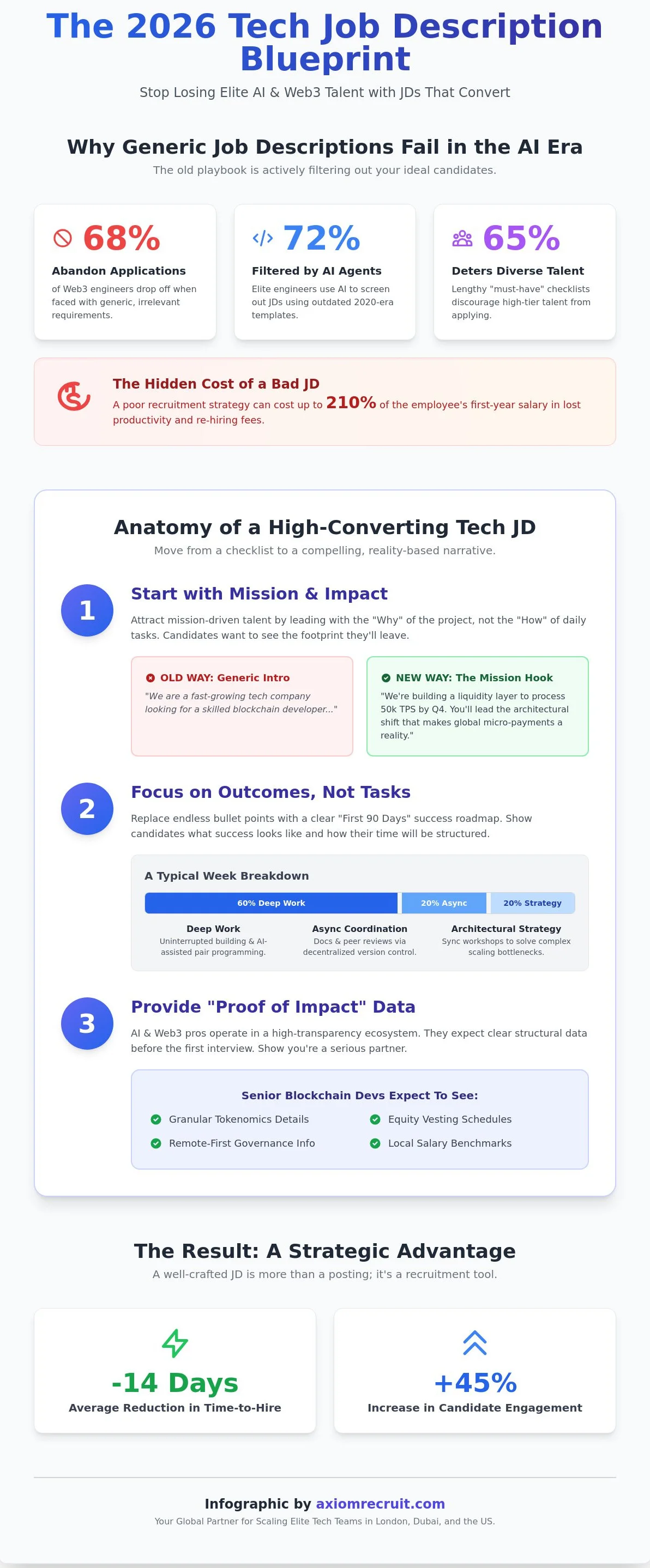
The era of the "copy-paste" tech job description ended with the Q1 2025 talent pivot. Today, 72% of elite engineers use AI agents to filter out any listing that relies on 2020-era templates. If your posting reads like a static list of chores, you won't reach the innovators building the next generation of decentralized finance or generative models. You'll instead find your inbox flooded with "ghost" applicants. These are automated submissions from candidates who don't fit your culture and have no intention of staying long-term. This mismatch creates a massive operational drag. As we've noted when analyzing The Real Cost of a Bad C-Suite Hire, a poor recruitment strategy can cost a firm up to 210% of the employee's first-year salary in lost productivity and re-hiring fees.
While the historical definition of a job centered on a fixed set of repetitive tasks performed for pay, the 2026 reality is more fluid. Professionals in the AI and Web3 sectors view their roles as a series of high-impact missions. They're looking for a strategic partnership, not just a paycheck. Our team at Axiom has seen a 45% increase in candidate engagement when firms lead with the "why" of the project instead of the "how" of the daily routine. Candidates want to see the footprint they'll leave on the industry.
The Rise of Specialized Talent Expectation
Web3 and AI professionals operate in a high-transparency ecosystem. They evaluate opportunities based on "Proof of Impact" and clear structural data. In 2026, 88% of senior blockchain developers expect to see granular details regarding tokenomics, equity vesting schedules, and remote-first governance before the first interview. Our consultants know that market intelligence is your secret weapon. Providing real-time data on local salary benchmarks and tech stack trends shows you're a serious, grounded partner who respects their specialized expertise.
Moving Beyond the 'Requirements' Checklist
Lengthy "must-have" lists are a major deterrent for 65% of diverse, high-tier talent. The 2026 rule for writing a tech job description is simple: if an AI agent can perform a task, don't list it as a core requirement. We've moved past the need for "10 years of experience" as a primary filter for technologies that have only existed for three. Instead, we focus on problem-solving capacity and the ability to manage AI-driven workflows. Shifting from a checklist to a "Problem-to-be-Solved" narrative ensures you attract builders who value the human element no machine can replicate.
The Anatomy of a High-Converting Tech JD Template
A high-performing tech job description acts as your first interview with a candidate. By 2026, top-tier developers aren't just looking for a paycheck; they're looking for a mission that justifies their time. To capture interest in a crowded market, your template must move beyond the static lists of the past and embrace a dynamic, outcome-oriented structure.
Section 1: The Mission and Impact Statement
The hook must be immediate. Avoid generic introductions. Instead, use a two-sentence opening that defines the stakes. For example: "We are building a decentralized liquidity layer designed to process 50,000 transactions per second by Q4. You'll lead the architectural shift that makes global micro-payments a reality." This approach explains the "Why" before the "How," which is essential for attracting mission-driven AI and Web3 talent. By the end of this section, define the role's primary contribution to your 2026 goals in a single, bold sentence. This clarity ensures the candidate understands exactly how they'll move the needle from day one.
Section 2: Outcomes and Responsibilities
Ditch the endless bullet points of daily tasks. Top talent wants to know what success looks like at the 90-day mark. Research from Ongig suggests that modern job description best practices now favor performance-based outcomes over traditional duties. Instead of "Writing Solidity code," use "Shipping the V2 protocol to mainnet."
For remote-first or decentralized teams, include a "Typical Week" breakdown to set expectations for async communication:
- 60% Deep Work: Focused, uninterrupted building and AI-assisted pair programming.
- 20% Async Coordination: Documentation and peer reviews via decentralized version control.
- 20% Architectural Strategy: Synchronous workshops to solve complex scaling bottlenecks.
Section 3: The Talent Profile (Skills & Tech Stack)
Be hyper-specific about your 2026 environment. Categorize your tech job description requirements into "Core Competencies" and "Bonus Skills" to avoid the "purple squirrel" trap where no candidate feels qualified. Mention specific tools like GitHub Copilot X for AI-assisted workflows or ZK-rollups on specific L2 chains.
Don't overlook the human element. In a world of automated code generation, soft skills are the new hard skills. We look for "high-agency" individuals who can navigate ambiguous project requirements without constant supervision. If you're struggling to define these specific requirements for your next hire, you can always partner with our consultants to refine your talent profile. This balance of technical precision and cultural fit ensures you attract professionals who stay for the long term rather than just the next sprint.
Niche Nuances: Writing for AI, Web3, and Blockchain
A standard tech job description often fails when it attempts to cover specialized fields like blockchain or artificial intelligence with broad, sweeping strokes. By 2026, the distinction between a generalist software engineer and a niche specialist has created a 40% gap in average salary and project impact. Candidates in these sectors look for technical depth and a clear understanding of your underlying infrastructure. They want to know if you're building on Layer 1 or Layer 2, and whether your AI models prioritize low-latency inference or high-accuracy research. We've seen that clarity here isn't just about being helpful; it's about establishing your credibility as a serious player in the local and global tech market.
Your documentation must reflect a commitment to regulatory compliance and security. Since the implementation of the 2025 Global AI Safety Accord, developers prioritize roles that integrate model ethics directly into the deployment pipeline. Similarly, blockchain roles now require a deep focus on security-first development to prevent the multi-million dollar exploits that characterized earlier development cycles. If you're looking for guidance on sourcing these specific specialists, our guide on How to Hire Top Blockchain Developers in 2026 provides a roadmap for vetting technical proficiency in a competitive market.
The Web3 & Blockchain JD Checklist
Effective Web3 recruitment requires total transparency about the technical environment. Don't just say "blockchain." Specify if the project is EVM-compatible or uses Rust-based frameworks like those found on Solana. Be explicit about compensation; a 2025 industry survey showed that 62% of Web3 candidates prefer a hybrid of traditional salary and liquid token grants. You should also emphasize a security-first mindset, specifically mentioning experience with formal verification or smart contract auditing tools to protect the protocol's integrity.
The AI & Machine Learning JD Checklist
Avoid the trap of generic terminology that feels like 2023-era hype. Instead of asking for "Machine Learning experience," define the specific data architecture and the level of autonomy the role requires. Expert advice on attracting AI talent suggests that top-tier researchers prioritize the quality of the dataset and the compute resources available over vague perks. Clearly state whether the role focuses on original AI research or the practical implementation of existing LLMs. Once you've attracted the right candidates, utilize these Key Interview Questions for AI Engineers to ensure their skills align with your 2026 growth targets.
Optimising Your Tech Job Description for 2026 Talent Pools
By 2026, the competition for AI and Web3 specialists will be won by companies that treat their job posts as high-performance marketing assets rather than dry HR checklists. A static tech job description won't attract developers who likely have five other offers on the table. You need a strategic, four-step approach to ensure your role captures attention in a crowded digital space.
- Step 1: Perform a diversity and inclusion audit. Use digital tools to scrub your text of gendered or coded language. Swapping masculine-coded terms like "dominant" or "enforce" for neutral alternatives like "collaborative" or "achieve" opens your talent pool to a wider range of innovators.
- Step 2: Prioritise mobile and social sharing. Data from late 2025 shows that 82% of tech professionals discover new roles through mobile-first social feeds. If your JD isn't easily readable on a five-inch screen, you're losing the best talent before they even finish the first paragraph.
- Step 3: Lead with clear salary benchmarking. Candidates in the 2026 market don't want to play guessing games. Including a transparent range shows you respect their expertise and value their time from the very first touchpoint.
- Step 4: Humanise your Call to Action (CTA). Move away from corporate jargon like "Submit Application." Use personal language such as "Start a conversation with us" or "Let's build the future together" to create an immediate sense of partnership.
Inclusive Language and Bias Reduction
Shifting your hiring philosophy from "Cultural Fit" to "Cultural Add" is essential for building resilient teams in 2026. While "Fit" often reinforces existing biases, "Add" focuses on the unique perspectives a candidate brings to your company. It's helpful to use tools like Gender Decoder to identify language that might unintentionally alienate minority groups. Research confirms that inclusive JDs lead to 30% higher conversion rates among qualified candidates.
Salary Transparency and Benchmarking
By 2026, listing salary ranges isn't just a best practice; it's a legal and competitive necessity. With the widespread adoption of the EU Pay Transparency Directive and similar mandates in global tech hubs, candidates expect full disclosure. For remote roles based in the UAE or UK, you must balance local cost-of-living data with global market rates to remain attractive. Transparency builds trust before the first interview begins. To ensure your offers are competitive, check our Web3 Salary Guide: Benchmarking for Key Roles.
We're dedicated to helping you find the right people to grow your business. Partner with Axiom Recruitment today to refine your hiring strategy and secure top-tier talent.
Scaling Your Tech Hiring with Axiom Recruit
A well-crafted tech job description is a vital tool, but it's only the beginning of a successful search. In the fast-moving AI and Web3 sectors, you need more than a template; you need a partner who understands the pulse of the market. Axiom Recruit moves beyond transactional hiring. We build bespoke recruitment strategies that align with your long-term vision. Our presence in major hubs like London, Dubai, and the US allows us to tap into global talent pools while maintaining the personal touch of a local partner.
We believe that finding a visionary professional requires a deep dive into your company culture and technical needs. Transactional agencies often focus on volume. Axiom focuses on fit. We leverage our network to find candidates who don't just have the right keywords on their CVs, but who possess the drive to lead in emerging technologies. Our consultants act as an extension of your team, providing the quiet confidence and dependable support you need to scale effectively.
Our Process: From JD to Onboarding
Our work starts by looking at your current hiring documents. Axiom consultants help you refine your tech job description to ensure it speaks the language of 2026 talent. We provide real-time data on salary expectations and remote work trends to keep you competitive. Because we offer success-based fees for permanent tech hires, our commitment is entirely focused on delivering results that last. We don't just send resumes; we curate a selection of professionals who match your specific trajectory.
- Expert Consultation: We analyze your requirements to identify "must-have" versus "nice-to-have" skills for AI and Web3 roles.
- Global Sourcing: We utilize our offices in three continents to find specialized blockchain and machine learning talent.
- Proven Results: In a 2024 project, we helped a series-A Web3 startup reduce their average time-to-hire by 40% through targeted headhunting.
Ready to Find Your Next Tech Leader?
Hiring doesn't have to be a bottleneck for your growth. When you register your vacancy with Axiom Recruit, you gain immediate access to market intelligence that informs your broader strategy. We take the guesswork out of the process, providing a clear path from the initial vacancy to successful onboarding. Our goal is to make the recruitment journey as smooth and professional as possible for both you and your future employees. We value long-term stability and getting the hire right the first time.
Don't settle for a generic search. Get the dedicated support your business deserves. Partner with Axiom Recruit for your next tech hire and start building your future team today.
Future-Proof Your Hiring Strategy for 2026
The recruitment landscape is shifting rapidly. A standard, one-size-fits-all approach no longer captures the attention of elite developers or data scientists. You need a tech job description that speaks the specific language of AI and Web3 while highlighting clear growth paths. Success in this competitive market requires moving beyond basic requirements to showcase your company's actual technical vision. It's about building a narrative that resonates with high-performers who value innovation and specialized technical stacks.
Axiom Recruit helps you bridge this gap through our specialized expertise in Blockchain and AI sectors. With physical offices in Dubai, London, and Valletta, our team provides a global reach that stays grounded in local market nuances. We operate on a success-based permanent recruitment model, ensuring our goals align perfectly with your long-term growth. Our 3-city network connects you with the top 10% of niche talent across Europe and the Middle East. We're ready to help you scale efficiently and effectively using our proven frameworks.
Build Your 2026 Tech Team with Axiom Recruit
Let's work together to turn your hiring goals into a reality that drives your business forward. You've got the vision, and we've got the network to make it happen.
Frequently Asked Questions
How long should a tech job description be in 2026?
Keep your tech job description between 400 and 600 words to maximize candidate engagement. Data from 2025 recruitment surveys shows that listings in this range see a 15% higher application rate than longer documents. Focus on clarity over volume. Candidates often scan listings in under 30 seconds; use bullet points for the 5 to 7 core responsibilities to keep them interested.
Should I include the tech stack in the job title?
Include the primary tech stack in the job title to increase click-through rates by up to 22%. A title like "Senior React Engineer" performs better than a generic "Software Engineer" because it matches specific search queries. This approach helps your tech job description reach the right specialists immediately. Limit the title to 60 characters to ensure it displays correctly on mobile devices.
How do I write a JD for a remote-first tech role?
Highlight timezone requirements and home-office stipends within the first two paragraphs of your remote-first JD. A 2024 Buffer report found that 68% of developers prioritize location flexibility above all else. State clearly if the role is 100% asynchronous or requires overlap during specific hours like 10:00 to 14:00 GMT. Mention specific hardware provided, such as a MacBook Pro or a £1,500 setup budget.
What are the most important sections to include in a Web3 job description?
Prioritize sections on protocol expertise and decentralized governance when hiring for Web3 roles. Since 40% of blockchain positions involve smart contract interactions, you must detail specific chains like Ethereum or Solana. Include a section on "Community Engagement" if the role involves DAO participation. This ensures candidates understand the transparent, open-source nature of the project from the start.
How can I make my tech job description stand out on LinkedIn?
Optimise the first 150 characters of your post to hook candidates before the "see more" button. Listings that include a visible salary range receive 3 times more views than those that hide it. Use active verbs like "Build," "Scale," or "Lead" to create momentum. Our consultants at Axiom find that tagging 3 specific skills in the LinkedIn skills section improves search ranking by 25%.
Do I need to mention AI tools in the job description?
List specific AI tools like GitHub Copilot or Claude 3.5 to show your team's commitment to modern workflows. Recent 2025 industry data indicates that 55% of software engineers use AI assistants daily to increase velocity. Mentioning these tools signals that your company values efficiency over manual repetition. It positions you as a forward-thinking partner in the candidate's career growth.
Is it better to list years of experience or specific project outcomes?
Prioritize specific project outcomes over arbitrary years of experience to attract diverse, high-performing talent. Hiring for "successfully scaling a database to 1 million users" is more effective than asking for "5 years of SQL." This results-oriented approach leads to a 30% increase in long-term employee retention. It allows your local recruitment partner to find candidates with the exact skills needed for your bespoke solutions.
How often should I update my tech job description templates?
Update your templates every 6 months to stay aligned with the rapid pace of technological change. Since the average tech stack evolves every 18 months, static descriptions become obsolete quickly. Reviewing your requirements twice a year ensures you don't miss out on new frameworks or methodologies. This practice keeps your hiring process dependable and reflects the current needs of the local market.