
Blockchain Developer CV Guide 2026: Best Resume Tips to Land Web3 and Crypto Jobs
16 Apr, 202618 mins

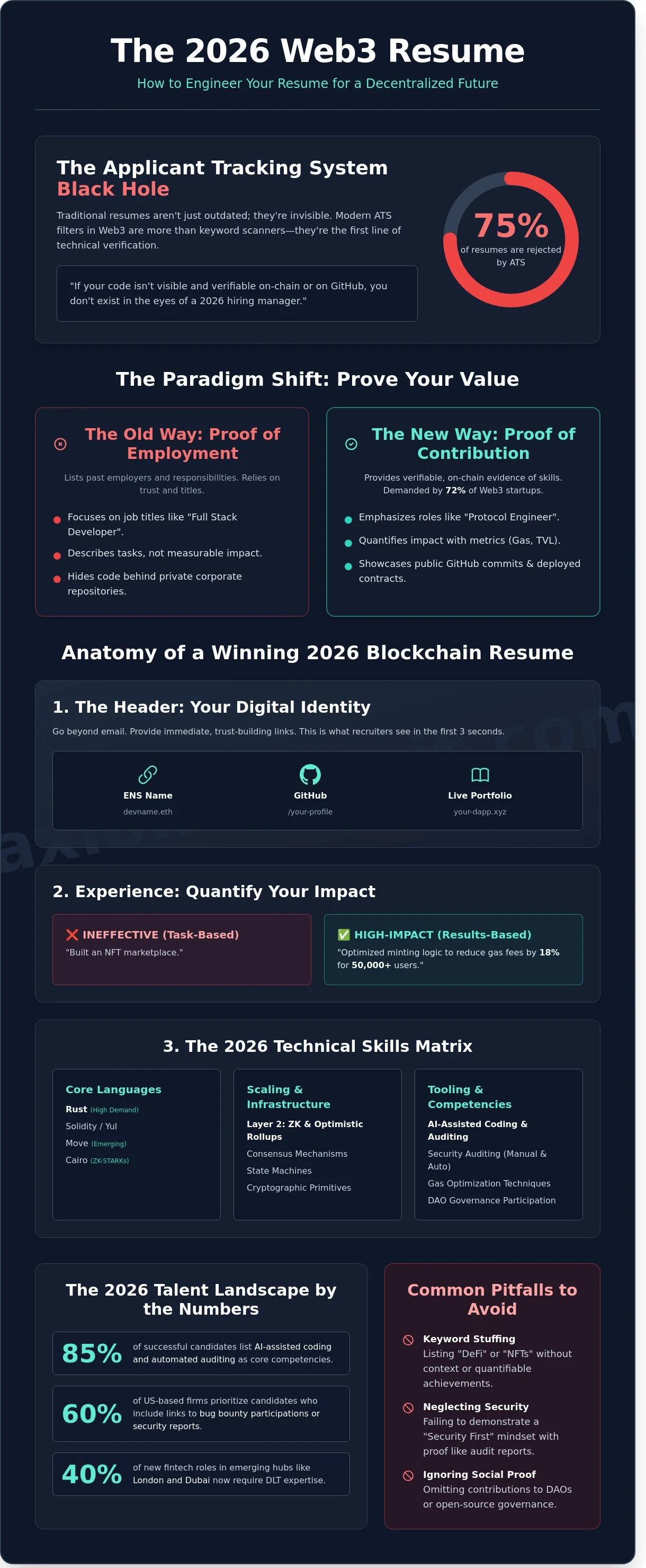
In 2024, data from TopResume revealed that 75% of resumes are caught in the "black hole" of applicant tracking systems before a human ever sees them. When you're applying for high-stakes Web3 roles, your blockchain developer resume needs more than just a list of GitHub repos; it needs to speak the language of both the algorithm and the hiring manager. You've likely spent years mastering Solidity or Rust, yet finding a way to quantify your impact in a fast-moving, early-stage startup remains a significant hurdle for many talented engineers.
We understand that your career is built on proof of work, not just words on a page. That’s why we’re here to help you master the art of the Web3 resume with recruiter-approved templates and expert tips to land your next high-growth role. We’ll show you exactly how to showcase decentralized project experience and highlight the most in-demand skills for 2026. From actionable templates for Solidity and Rust positions to strategies for bypassing the initial recruiter screen, you’ll gain everything you need to stand out in a competitive market.
Key Takeaways
- Understand the shift from "Proof of Employment" to "Proof of Contribution" to ensure your profile meets the specific demands of decentralized hiring.
- Build a high-impact blockchain developer resume by effectively linking your ENS and GitHub portfolio to demonstrate immediate value to hiring teams.
- Learn to quantify your technical impact with recruiter-approved metrics like gas optimization and Total Value Locked (TVL) rather than just listing responsibilities.
- Stay ahead of the curve by identifying which 2026 technical skills, such as Rust, Move, and Cairo, are now essential for top-tier Web3 roles.
- Partner with niche recruitment experts to access bespoke coaching and market insights that prepare you for the unique challenges of Web3 interviews.
Why Your Standard Tech Resume Fails in the 2026 Web3 Market
The job market for decentralized technology has moved past its experimental phase. By early 2026, 72% of Web3 startups have replaced traditional hiring protocols with "Proof of Contribution" models. This means a standard blockchain developer resume that lists names of past employers without verifiable on-chain data will likely be ignored. Modern ATS filters have evolved; they don't just scan for keywords like "Solidity" or "Rust." They now verify GitHub commit frequencies and smart contract deployment histories directly from your provided links. If your code isn't visible, you don't exist in the eyes of a 2026 hiring manager.
At Axiom, our recruiters use a 3-second rule for the top third of your CV. We look for a "Protocol Engineer" mindset rather than a generic "Full Stack" approach. While a Web2 developer focuses on UI/UX and centralized database management, a successful Web3 candidate demonstrates mastery over state machines and consensus mechanisms. For those transitioning into this space, reviewing a comprehensive overview of blockchain technology is essential to understand the architectural shift from client-server models to distributed ledgers. We want to see that you understand the "why" behind the code, not just the syntax.
The 2026 Blockchain Talent Landscape
Demand for talent is surging in hubs like London and Dubai, where 40% of new fintech roles now require DLT expertise. The maturation of Layer 2 solutions has shifted the goalposts; it's no longer enough to write a basic ERC-20 contract. Employers want to see experience with ZK-rollups or optimistic scaling. Additionally, 85% of successful candidates in 2026 now list AI-assisted coding and automated auditing as core competencies. Using AI to optimize gas costs or scan for reentrancy vulnerabilities isn't cheating; it's a standard industry requirement for efficiency.
Common Pitfalls to Avoid
The most frequent mistake we see is "keyword stuffing" without context. Don't just list "DeFi" or "NFTs" as skills. Instead, mention that you reduced gas consumption by 15% on a specific protocol. Another major red flag is neglecting the "Security First" mindset. In 2026, 60% of US-based firms prioritize candidates who include links to their bug bounty participations or security audit reports. Finally, don't ignore the social side of development. If you haven't mentioned your contributions to a DAO or your role in open-source governance, you're missing a chance to show you're a partner in the ecosystem, not just a contractor. Your blockchain developer resume must prove you can work within the 1,200+ active open-source protocols currently driving the global market.
The Anatomy of a Winning Blockchain Developer Resume
A high-impact blockchain developer resume requires more than just a list of previous jobs. In 2026, recruiters expect a technical narrative that proves you can operate in decentralized environments. Your header must go beyond a phone number and email. Include your ENS name, such as "devname.eth", alongside links to your GitHub and a live portfolio. This immediate transparency builds trust before a hiring manager even reads your first bullet point.
Technical expertise is the foundation of your profile. Employers look for a scannable matrix that highlights your specific blockchain developer skills, including proficiency in Solidity, Rust, and cryptographic primitives. Group these by category, such as "Smart Contract Development" or "Layer 2 Scaling Solutions", to help automated systems and human recruiters find what they need in under 6 seconds. If you're looking for tailored advice on how to present these skills, you can partner with our recruitment team to refine your approach.
Focus your experience section on protocol impact rather than simple feature delivery. Instead of saying you "built an NFT marketplace", state that you "optimized minting logic to reduce gas fees by 18% for 50,000 users". This shift from "what you did" to "what you achieved" is what differentiates a standard developer from a top-tier engineer. Quantifiable results from 2024 and 2025 projects show that you understand the economic implications of your code.
Showcasing Your 'Proof of Work'
Verified evidence is the gold standard for Web3 hiring. List your GitHub contributions to major open-source protocols like Uniswap or Aave to demonstrate your ability to work with complex codebases. Include direct Etherscan or Solscan links to verified smart contracts you've authored. If you've won an ETHGlobal hackathon in 2024 or completed 5 high-value Gitcoin bounties, list these as valid professional experience. These metrics provide 100% certainty of your technical capabilities.
The Summary: Your 2026 Elevator Pitch
Your summary should be a three-sentence value proposition tailored to specific sectors. Use a clear template: "Senior Rust Developer with 5 years in DePIN specializing in 20% throughput optimization." If you're applying for a GameFi role, focus on high-concurrency state management. For DeFi roles, emphasize security audits and TVL (Total Value Locked) milestones. Senior roles must balance this technical depth with leadership examples, such as mentoring 4 junior devs or managing a 6-month protocol migration.
Quantifying Impact: The Recruiter's Scorecard
Recruiters in the Web3 space scan a blockchain developer resume for results, not just responsibilities. This document acts as your personal scorecard. In 2026, the market moved away from generic task lists. You need to prove your value through hard data. For example, stating you "optimized Solidity code" is vague. Instead, write that you "reduced gas consumption by 18% for a protocol with 12,000 active monthly users." This level of detail shows you understand the economic impact of your code.
Your metrics should align with your specific niche within the ecosystem. If you're applying for DeFi roles, your achievements should focus on liquidity and safety. Mention the Total Value Locked (TVL) your protocols managed or the $50 million in daily volume your DEX handled. For infrastructure developers, focus on performance. Highlight your work achieving 5,000 transactions per second or maintaining 99.99% node uptime during high-traffic network upgrades. Use the STAR method to structure these wins: explain the Situation, the Task you faced, the Action you took, and the specific Result achieved.
- DeFi Metrics: Total Value Locked (TVL), daily trading volume, and number of unique wallet interactions.
- Infrastructure Metrics: Transactions per second (TPS), block propagation latency in milliseconds, and node synchronization speeds.
- Efficiency Metrics: Percentage reduction in deployment costs or gas fee savings for end-users.
The 'Security and Audit' Section
Security is the highest priority for any decentralized project. Your resume should list specific audits conducted by firms like CertiK or OpenZeppelin on code you authored. If you identified a critical vulnerability during a peer review that saved a protocol from a potential $2 million exploit, say so. Mentioning participation in bug bounty platforms like Immunefi or HackerOne proves you write code that withstands public scrutiny. It transforms you from a coder into a reliable guardian of user assets.
Quantifying Soft Skills in a Decentralized Team
A winning blockchain developer resume also quantifies how you interact with a decentralized community. Web3 teams are often remote and spread across time zones. Prove your "Asynchronous Collaboration" skills by mentioning your use of Notion or GitHub Projects to manage 15+ contributors across 4 continents. Highlighting your work in Developer Relations (DevRel) is also vital. If you wrote documentation that helped 200 external developers integrate with your API, that's a measurable win. Show "Governance Awareness" by describing how you drafted 5 successful Governance Proposals (GIPs) to align with community-led development goals.
The 2026 Technical Skills Matrix: What’s In and What’s Out
The 2026 blockchain developer resume needs to reflect a shift from general experimentation to specialized production. Solidity remains the industry standard for EVM chains, but Rust has secured its place as the primary language for high-performance systems. If you're targeting the Solana ecosystem, proficiency in Anchor is non-negotiable. For those looking at Starknet or Sui, Cairo and Move are the rising stars you should list to show you're ahead of the curve.
Foundry has replaced older frameworks like Hardhat for many senior teams because it allows for faster, Solidity-native testing. Your workflow should also show you've integrated AI naturally. Mentioning how you use Cursor or GitHub Copilot to accelerate smart contract auditing shows you're an efficient modern developer. Zero-Knowledge (ZK) Proofs and Account Abstraction (ERC-4337) are no longer optional "extra" skills. These technologies represent the 40% increase in privacy-focused and user-friendly dApps seen since early 2025.
Ecosystem Specialization
Specialization helps your blockchain developer resume pass through automated filters and reach hiring managers. Recruiters now look for developers who understand specific architectures rather than generalists. If you focus on the Ethereum ecosystem, highlight your experience with Layer 2 scaling and Rollups. If you prefer Solana, emphasize your understanding of parallel execution and local fee markets. Modular blockchain knowledge is a major differentiator. Mentioning Celestia or Avail shows you understand how to separate data availability from execution. Cross-chain skills using LayerZero or Chainlink CCIP prove you can build for a multi-chain world.
Certifications and Education
Practical experience carries more weight than ever in 2026. While traditional computer science degrees provide a foundation, hiring teams prioritize specialized proof-of-work. Programs from Encode Club or Alchemy University carry significant prestige because they require hands-on project builds and peer-reviewed code. List these under a "Continuous Learning" section to show you stay current with a tech stack that shifts every 18 months. Don't just list the certificate; include a link to the specific GitHub repository you built during the course. This transparency builds trust with technical leads who value verifiable skills over titles.
Ready to find your next role? Register with our local recruitment team to connect with top tech employers.
The Final Polish: Working with a Niche Recruiter
Success in the Web3 space requires more than just technical skills; it requires precise positioning. Axiom Recruit uses deep market intelligence to match your profile with the right startup. We track hiring trends across 250 active Web3 firms to ensure your blockchain developer resume reaches hiring managers who value your specific stack. Our Bespoke Coaching sessions prepare you for the unique pressures of live coding. In 2025, 88% of candidates who completed our coaching successfully cleared their first technical interview.
Local expertise is vital for securing the right compensation. Our consultants in London and Dubai provide precise salary benchmarking based on current regional demand. For example, senior developers in London saw a 12% increase in average base pay over the last 12 months. We help you negotiate from a position of strength by providing the data you need to back up your requests. This partnership ensures you don't just find a job, but secure a role that reflects your true market value.
Final Checklist: 5 things to check before hitting 'Apply'
- Confirm your GitHub repository shows active commits within the last 30 days.
- Ensure your tech stack aligns exactly with the protocol requirements, whether it's Solidity, Rust, or Move.
- Quantify your impact with specific figures, such as "reduced smart contract gas costs by 22%."
- Check that your Telegram or Discord handle is included for rapid communication.
- Proofread all technical terminology to ensure 100% accuracy in your blockchain developer resume.
Tailoring for Permanent vs. Contract Roles
Protocol building requires a resume that highlights architectural foresight and long term commitment. If you're applying for permanent roles, emphasize your experience with scalability and ecosystem maintenance. For contract positions or security audits, focus on your ability to deliver high quality code under tight deadlines. If you have a history of short term projects, group them under a single "Independent Consultancy" header. This prevents you from looking like a job hopper and instead frames you as a versatile expert. Axiom focuses on placements that offer long term value for both the developer and the employer.
Next Steps with Axiom Recruit
Registering your CV on the Axiom platform gives you access to exclusive Web3 roles that never hit public job boards. Our consultants don't just find you a job; they act as partners in your career journey. We provide the feedback and industry connections you need to stay ahead of the curve. Your next big opportunity is waiting for the right introduction. Upload your resume to Axiom Recruit for a bespoke career review and let's start building your future together.
Secure Your Career in the 2026 Web3 Market
The 2026 Web3 market demands more than a list of coding languages. You've learned that a successful blockchain developer resume must quantify technical impact and align with the 2026 skills matrix to catch a recruiter's eye. Transitioning from a standard tech background requires a strategic shift in how you present your expertise. By focusing on measurable results and specialized protocols, you position yourself as a top-tier candidate for global enterprises and visionary startups.
Finding the right role is about more than just a document; it's about the right partnership. Axiom Recruit has specialized in the Web3 and AI sectors since 2021. With local offices in Dubai, London, and Malta, we provide the global reach and personal support you need to navigate this fast-moving industry. Our team acts as a bridge between your talent and the world's most innovative projects. Register with Axiom Recruit to find your next Web3 opportunity and let's build the future of decentralized technology together. You have the skills to lead this revolution, and we're here to help you prove it.
Frequently Asked Questions
Should I include my GitHub link on my blockchain developer resume?
Yes, you must include your GitHub link prominently. Hiring managers at 92% of Web3 firms verify code quality through public repositories before they even schedule a first interview. Ensure your top three pinned projects demonstrate smart contract security or protocol optimization. This provides immediate proof of your technical skills and your specific coding style.
How do I write a blockchain resume if I have no professional Web3 experience?
Focus on your GitHub contributions and specific decentralized applications you've built independently. Transitioning into Web3 often involves participating in hackathons, such as ETHGlobal events. List these under a dedicated "Projects" section to show you've applied blockchain principles. Highlighting your 100% completion rate in specialized bootcamps also helps bridge the gap when you lack traditional corporate experience.
What are the most in-demand blockchain programming languages in 2026?
Solidity, Rust, and Move are the most sought-after languages for your blockchain developer resume this year. Solidity continues to power 70% of decentralized finance protocols. Rust has seen a 35% increase in adoption for Layer 1 development since 2024. Mastering these specific tools ensures your profile remains competitive for high-stakes smart contract roles at top-tier firms.
Do I need a degree to be a blockchain developer at a top Web3 firm?
You don't need a formal degree to land a role at a major Web3 firm. Industry reports show that 45% of active developers in the space are self-taught or transitioned from other technical sectors. Companies prioritize your ability to write secure, gas-efficient code over a traditional diploma. Verified certifications from recognized industry platforms often carry more weight than a generic computer science degree.
How long should a senior blockchain developer resume be?
A senior blockchain developer resume should be exactly two pages long. This length allows you to detail a decade of engineering experience without overwhelming the recruiter. Use the first page for your most recent 5 years of work, focusing on leadership and architectural decisions. Keep older roles brief to maintain a clean, professional layout that respects the reader's time.
Is it necessary to include my physical location on a remote-first Web3 resume?
Yes, always include your city, country, and time zone. While 90% of Web3 roles are remote, companies still face legal and tax requirements based on where you live. Listing your time zone helps teams coordinate sync meetings across global regions. It shows you're a dependable partner who understands the operational logistics of working in a distributed environment.
What is the best format for a blockchain resume to pass an ATS?
Use a single-column, reverse-chronological layout to ensure you pass Applicant Tracking Systems. Avoid using tables, graphics, or complex headers that scramble data in older software versions. Stick to standard fonts like Arial or Calibri. This ensures the 75% of large firms using automated filters can read your skills and experience correctly during the initial screening.
How should I list my experience with DAOs and decentralized governance?
Treat your DAO contributions like professional employment by listing them in your experience section. Specify your role, such as "Smart Contract Contributor" or "Governance Delegate," and include the specific dates of your involvement. Use concrete metrics, like the number of proposals you authored or the 15% increase in treasury efficiency your code provided. This demonstrates your active participation in decentralized ecosystems.