Landing the Perfect CTO: 2026 Executive Guide
19 Mar, 2026




Recent 2025 market data reveals that 42% of senior AI specialists now receive more than half of their total compensation through equity or token grants rather than traditional base pay. You likely know that the ai engineer salary landscape moves faster than most global recruitment models can track. It's frustrating to compare offer letters when figures feel six months out of date or fail to explain the true value of a complex stock package. At Axiom, we believe transparency is the foundation of a successful career move.
We've compiled the most accurate benchmarks for 2026 to provide the clarity you need for your next role. This guide delivers specific data on base pay, equity structures, and regional variations across the US, UK, and UAE. You'll gain a clear understanding of the current salary gaps and the leverage required to negotiate a package that reflects your true market value. We're here to break down exactly how these shifting compensation models will impact your professional future in the coming year.
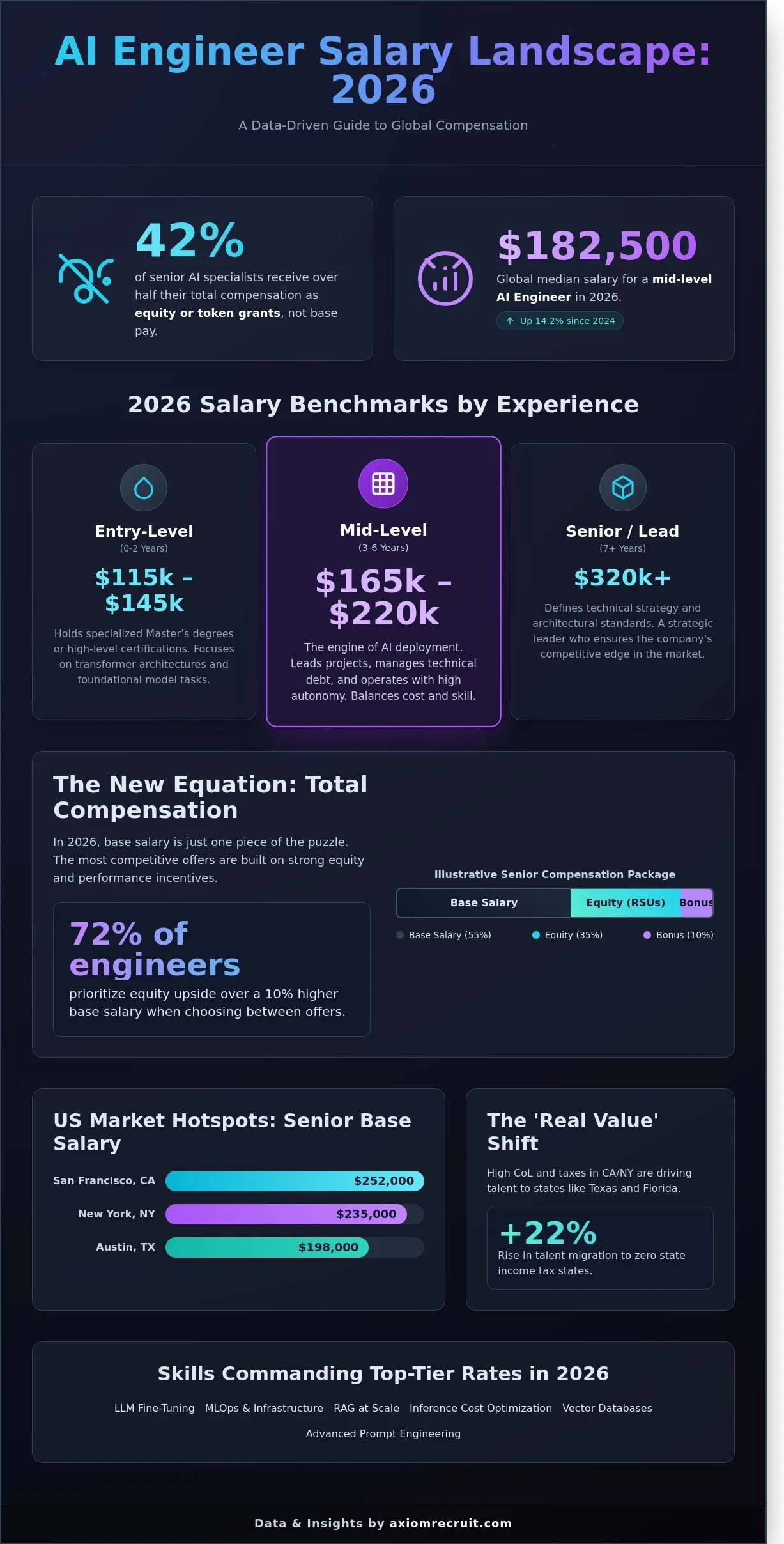
The role of an AI engineer has transformed since the initial LLM surge of 2023. By 2026, these professionals don't just write code; they manage the entire lifecycle of model deployment from LLM fine-tuning to complex MLOps. What is AI Engineering? It's a discipline that fuses software engineering with data science to build scalable, production-ready systems. Our data shows the global median ai engineer salary for mid-level professionals has reached $182,500. This 14.2% increase since 2024 reflects the move away from simple API integrations toward building proprietary, high-performance infrastructure.
Relying on base salary alone is a mistake for hiring managers in 2026. In high-growth technology hubs, base pay is often a secondary consideration compared to the total package. We see candidates prioritize equity and performance incentives that reflect the value they create. If your offer doesn't include a robust variable component, you'll likely lose talent to competitors who offer more upside. Our local consultants at Axiom see these trends daily across our regional branches, ensuring we provide bespoke advice for your specific hiring needs.
Demand for Generative AI specialists has fundamentally shifted the pay ceiling. In 2024, a $250,000 package was reserved for top-tier researchers, but in 2026, this is becoming standard for senior engineers who can optimize inference costs and manage RAG (Retrieval-Augmented Generation) at scale. Organizations are paying for the immediate ROI that efficient AI implementation brings to the bottom line. This shift means that technical proficiency in vector databases and prompt engineering is now a baseline requirement rather than a niche skill.
Compute-heavy startups are currently driving the most aggressive talent bidding wars. These firms often leverage massive venture capital rounds to offer equity packages that legacy corporations struggle to match. Total Compensation (TC) is the combined value of an employee's annual base salary, performance bonuses, and vested equity grants. We've found that 72% of engineers now prioritize equity upside over a 10% higher base salary when choosing between competing offers. This transition from general machine learning to specialized AI engineering has made recruitment a highly strategic endeavor.
Hiring for AI roles in 2026 requires a clear view of the global map. Talent is mobile; expectations are high. The "Silicon Valley Premium" continues to dictate the pace, but new hubs in the Middle East and Europe are challenging that dominance with unique financial incentives. You're no longer just competing with the company down the street. You're competing with global tax structures and lifestyle perks.
San Francisco remains the most expensive place to hire. A senior ai engineer salary in the Bay Area now averages $252,000 base pay, representing a 14% increase from 2024 levels. New York follows closely at $235,000, while Austin has solidified its position as a high-growth hub with averages around $198,000. These figures only tell half the story. In the US, Restricted Stock Units (RSUs) are the primary tool for retention; top-tier talent often receives equity packages equal to 40% of their base salary.
Cost of living remains the biggest hurdle for US-based firms. While the average AI engineer salary provides a comfortable lifestyle, the net take-home pay in California or New York is heavily impacted by state and federal taxes. Candidates are increasingly looking at the "real" value of their paycheck. This has led to a 22% rise in talent migration toward Texas and Florida, where state income tax is non-existent. Employers must account for these regional shifts when structuring offers to ensure they don't lose talent to lower-tax states.
London has firmly established itself as the AI capital of Europe. While base salaries are lower than in the US; a senior role typically pays between £125,000 and £145,000; the structure is more stable. UK packages often include better pension contributions and private healthcare as standard. The gap is narrowing, however. To attract top talent, 68% of London-based startups now include equity components that mirror the Silicon Valley model. This makes the UK a competitive middle ground for firms that want high-tier talent without the $300,000 price tag.
The Middle East offers a different value proposition. Dubai's tax-free environment is a massive draw for senior engineers. Because there's no income tax, a $150,000 salary in Dubai provides the same purchasing power as a $220,000 salary in New York City. The UAE's "Golden Visa" program, which offers 10-year residency to specialized talent, has simplified long-term relocation. Sovereign wealth funds are also backing local startups, allowing them to offer relocation packages that cover housing and school fees for the first 12 months. It's a compelling offer for mid-career professionals with families.
Location-based pay is evolving. By 2026, the "fully remote" premium has faded. Most firms now use a "hub-and-spoke" model. If an employee works from a low-cost area, their pay is typically adjusted downward by 15% to 18% compared to the office headquarters. This ensures internal equity among staff who face high commuting costs. It's a pragmatic approach that values flexibility while maintaining fiscal responsibility.
Finding the right balance between global standards and local realities is a challenge. If you're struggling to benchmark your internal roles, our bespoke salary mapping services can help you stay competitive. We focus on providing the data you need to make confident hiring decisions in a fast-moving market.
Hiring managers must look beyond the monthly paycheck to attract top-tier talent in 2026. A competitive ai engineer salary is now a multi-layered package where the base pay often accounts for less than 60% of the total value. We see a clear shift toward performance-based incentives that reward model accuracy and deployment efficiency. Sign-on bonuses have stabilized at roughly 15% of the annual base, providing immediate liquidity for candidates transitioning between roles. While the UK AI Engineer Salaries provide a baseline for local benchmarks, the global market demands a more aggressive approach to total compensation (TC).
Equity remains the primary tool for long-term retention. However, the structure of these grants has evolved. In 2026, the ai engineer salary conversation frequently includes "milestone-based" equity refreshes. These refreshes trigger when specific technical hurdles are met, such as reducing model latency by 20% or successfully scaling an application to one million active users. This aligns the engineer's financial success directly with the company's operational growth.
Startups face a unique challenge with "paper wealth." Since 70% of AI startups in 2025 experienced valuation corrections, candidates are more skeptical of private equity. We recommend providing a transparent "walk-through" of the current 409A valuation and the liquidation preferences attached to their shares. This honesty builds the trust necessary for a candidate to accept a lower base in exchange for high-upside stock options. It's about showing them a realistic path to a future exit rather than offering inflated promises.
Valuing stock in a pre-IPO company requires looking at the most recent funding round and applying a 25% "volatility haircut" to manage expectations. Many firms now utilize the "Token Incentive Plan" (TIP) alongside traditional equity. These tokens offer faster liquidity, as they often trade on secondary markets within 24 months of a project launch. Standard vesting still follows the 4-year cliff, where 25% of the grant vests after 12 months, but we're seeing more monthly vesting schedules after that first year to keep talent engaged.
Modern engineers prioritize the tools they use as much as the money they earn. Providing a dedicated hardware stipend of $5,000 or more for home-office GPU setups is a standard expectation in 2026. Remote work isn't just a perk anymore; it's a requirement for 65% of the talent pool. Companies that offer "Digital Nomad" support, including visa assistance and global health insurance, find it much easier to recruit from the worldwide talent market.
High-performing engineers won't join a team where they have to fight for resources. Access to high-end compute clusters and prioritized GPU time has become a critical negotiation point because it directly impacts an engineer's ability to innovate and meet their performance targets. Beyond the hardware, professional development budgets are now focused on specialized certifications. Offering $3,000 annually for advanced machine learning workshops shows a commitment to the candidate's long-term career trajectory.
Maximizing your ai engineer salary in 2026 requires a shift from being a generalist to a specialist who solves high-cost bottlenecks. Companies no longer just pay for model implementation; they reward those who can reduce inference costs or secure proprietary data. You'll find the highest pay tiers reserved for engineers who demonstrate "Proof of Work" through public contributions. Maintaining an active GitHub repository or a Hugging Face profile with 500+ monthly model downloads serves as a quantifiable metric during performance reviews. This tangible evidence of your expertise often leads to a 15% higher starting offer compared to candidates with private-only experience.
Technical depth in distributed systems and GPU optimization currently commands a $32,000 annual premium over standard machine learning roles. As compute costs remain a top-three expense for tech firms, the ability to optimize CUDA kernels or manage massive clusters is invaluable. AI Security, specifically Red Teaming, has seen a 40% increase in demand since 2025. Professionals who can identify model vulnerabilities and prevent prompt injections are entering the market at the top of the pay scale. To prepare for these technical discussions, review our guide on Key Interview Questions for AI Engineers to sharpen your responses.
Edge AI is another massive growth area. You'll see significant salary bumps if you can deploy complex models on low-power devices. This skill set bridges the gap between hardware and software, a rare combination that gives you immense leverage during annual reviews. Employers value the ability to bring AI directly to the user without relying on expensive cloud latency. If you can demonstrate a 20% reduction in latency through custom quantization, you've essentially written your own paycheck.
Negotiation is about market intelligence, not just asking for more. Use Axiom’s 2026 salary benchmarking data to show exactly where your skills sit within the current market. If you're holding multiple offers, don't just focus on the base pay. Negotiate for "Refreshers," which are additional equity grants awarded annually. In the 2025 hiring cycle, top-tier engineers secured refreshers worth 25% of their initial grant, ensuring their total compensation grew alongside the company's valuation.
Some engineers choose to pivot into AI Leadership or Architecture to break the $300,000 ceiling. Transitioning from a contributor to an architect means you're responsible for the entire system's scalability. This shift requires a deep understanding of how AI integrates with existing business logic. It's a move from "how do we build this" to "should we build this," and it’s where the most significant long-term wealth is created in the tech sector. We see that architects who manage cross-functional teams earn 22% more than their individual contributor counterparts.
Ready to see how your current compensation stacks up against the 2026 market leaders? Find your next high-paying AI role with our dedicated recruitment consultants today.
By 2026, relying solely on a high ai engineer salary to attract talent is a strategy destined for failure. While base pay remains a critical baseline, the most skilled developers look for innovation equity and technical sovereignty. A January 2025 industry report found that 64% of senior engineers prioritized the quality of a company's data stack over a 15% pay increase. You've got to offer more than just a paycheck to win the war for talent.
Attracting passive talent requires a shift in perspective. These individuals are currently employed and well-compensated. To move them, your offer must address their long-term career trajectory. Provide clear paths to leadership or specialized research roles. Ensure your infrastructure supports their work; nothing frustrates an AI expert more than waiting for compute time. Offer generous R&D budgets and the freedom to contribute to open-source projects. These non-monetary perks often tip the scales in your favor when the base ai engineer salary is already competitive across the board.
Retention is your second line of defense. High turnover costs businesses up to 213% of an employee's annual salary in lost productivity and recruitment fees. In the AI sector, where the average tenure has dropped to 22 months as of early 2026, stability is a competitive advantage. Implement quarterly stay interviews to understand what keeps your team engaged. Offer continuous learning stipends of at least $5,000 annually, specifically for emerging fields like agentic workflows or edge AI deployment. When people feel they're growing, they're less likely to look elsewhere.
Understanding the nuances of the current market is vital for any hiring manager. Our AI Talent Acquisition Services Explained guide provides a deep dive into how specialized search models work. Success-based recruitment is excellent for filling mid-level roles quickly by leveraging a wide network. However, for C-suite AI leadership, a retained search offers a 98% placement success rate. This method ensures a dedicated consultant maps the entire market to find the top 1% of talent who aren't browsing job boards.
Axiom connects visionary startups in the UK, US, and UAE with the global elite of AI talent. We don't just send resumes; we provide bespoke salary benchmarking based on real-time data from over 500 placements made in the last twelve months. This ensures your offer is perfectly calibrated to the specific region and technical niche. We act as your local partner with a global reach, ensuring every hire is a cultural and technical fit. Partner with Axiom to build your AI team today and secure the expertise you need to lead the market in 2026 and beyond.
The landscape for AI talent is shifting rapidly. By 2026, global benchmarks indicate that base pay is only one part of a complex package that often includes 20% to 40% in equity and performance bonuses. Whether you're targeting the high-ceiling markets in the US or looking at the tax-efficient growth in Dubai, understanding the nuances of your ai engineer salary is essential for long-term wealth. Success in this field isn't just about coding; it's about positioning yourself within high-growth sectors like Blockchain and Web3 where demand continues to outpace supply.
Axiom Recruit operates at the heart of these industries. With dedicated consultants in London, Dubai, and the US, we provide the deep market intelligence you need to make your next move. Our success-based recruitment model ensures we're fully invested in your career progression. We don't just fill roles; we build strategic partnerships that help you navigate the complexities of 2026 compensation structures. Our expertise ensures you aren't just finding a job, but securing a pivotal career milestone.
Find your next high-growth AI role with Axiom Recruit and step into a position that reflects your true market value. Your next big opportunity is ready when you are.
A $200,000 base salary is considered a standard entry point for mid-level roles, but it sits 15% below the projected 2026 median for major tech hubs. In cities like San Francisco or New York, senior talent now commands base pay closer to $265,000. You should evaluate the total package, as equity and performance bonuses often add another $80,000 to $150,000 to the annual compensation.
Senior AI engineers at OpenAI and Google typically earn between $550,000 and $850,000 in total annual compensation. According to 2025 internal pay data, an L6 engineer at Google receives a $285,000 base plus $350,000 in annual stock units. OpenAI's specialized researchers often see higher figures, with total packages frequently crossing the $900,000 mark when including profit-participation units.
A PhD typically adds a $45,000 to $75,000 premium to a base ai engineer salary. Data from the 2025 AI Talent Report indicates that 78% of high-level R&D positions require a doctorate, which also triggers larger initial equity grants. Candidates with specialized research backgrounds often receive 30% more in signing bonuses compared to those with a Master’s degree.
AI engineers currently earn 18% more than traditional ML engineers because of the urgent demand for generative AI integration. While an ML engineer might see an average salary of $190,000, an AI engineer focusing on large language models often earns $225,000. This pay gap emerged in late 2024 as companies shifted budgets toward agentic workflows and neural architecture search.
The US offers higher gross salaries, but Dubai provides 25% more in net take-home pay due to its 0% income tax policy. A $250,000 salary in California leaves you with roughly $155,000 after state and federal taxes. In contrast, a 900,000 AED ($245,000) package in Dubai is entirely tax-free, making it a more lucrative option for building immediate liquid wealth.
Historical trends from the 2023 tech correction show that base salaries remain stable while equity valuations and annual bonuses drop by 25%. Your ai engineer salary is currently anchored by a talent shortage where three jobs exist for every qualified candidate. Even if the market cools, the high cost of replacing specialized talent protects your core compensation from significant cuts.
A founding AI engineer at a seed-stage startup should expect an equity stake between 1% and 3%. If you're the first technical hire, 2% is the standard benchmark for 2026 agreements. This equity typically follows a four-year vesting schedule with a one-year cliff, offering a massive financial upside if the company reaches its target $150 million valuation.